












Detection, differentiation, and identification of botulinum neurotoxin serotypes C, CD, D, and DC by highly specific immunoassays and mass spectrometry
Literature Information
Publication Date
2016-06-23
DOI
10.1039/C6AN00693K
Impact Factor
4.616
Authors
Eva-Maria Hansbauer, Martin Skiba, Tanja Endermann, Jasmin Weisemann, Daniel Stern, Martin B. Dorner, Friedrich Finkenwirth, Jessica Wolf, Werner Luginbühl, Ute Messelhäußer, Laurent Bellanger, Cédric Woudstra, Andreas Rummel, Patrick Fach, Brigitte G. Dorner
View Original
Abstract
Botulinum neurotoxin (BoNT) serotypes C and D and their mosaic variants CD and DC cause severe cases of botulism in animal husbandry and wildlife. Epidemiological data on the exact serotype or toxin variant causing outbreaks are rarely available, mainly because of their high sequence identity and the lack of fast and specific screening tools to detect and differentiate the four similar toxins. To fill this gap, we developed four highly specific sandwich enzyme-linked immunosorbent assays (ELISAs) able to detect and differentiate botulinum neurotoxins type BoNT/C, D, CD, and DC based on four distinct combinations of specific monoclonal antibodies targeting both conserved and divergent subdomains of the four toxins. Here, highly sensitive detection with detection limits between 2 and 24 pg mL−1 was achieved. The ELISAs were extensively validated and results were compared with data obtained by quantitative real-time PCR using a panel of Clostridium botulinum strains, real sample materials from veterinary botulism outbreaks, and non-BoNT-producing Clostridia. Additionally, in order to verify the results obtained by ELISA screening, the new monoclonal antibodies were used for BoNT enrichment and subsequent detection (i) on a functional level by endopeptidase mass spectrometry (Endopep-MS) assays and (ii) on a protein sequence level by LC-MS/MS spectrometry. Based on all technical information gathered in the validation study, the four differentiating ELISAs turned out to be highly reliable screening tools for the rapid analysis of veterinary botulism cases and should aid future field investigations of botulism outbreaks and the acquisition of epidemiological data.
Related Literature
Electronic relaxation dynamics in DNA and RNA bases studied by time-resolved photoelectron spectroscopy
Susanne Ullrich, Thomas Schultz, Marek Z. Zgierski, Albert Stolow
2004-04-14
Paper
DOI: 10.1039/B316324E
Thiogermanate glasses—influence of the modifier cation—a combined XPS and theoretical study
D. Foix, H. Martinez, D. Gonbeau, D. Granier, A. Pradel, M. Ribes
2004-11-18
Paper
DOI: 10.1039/B410834E
Phase field modeling of CH4hydrate conversion into CO2 hydrate in the presence of liquid CO2
B. Kvamme
2007-04-27
Paper
DOI: 10.1039/B700423K
Dye-sensitized nanocrystalline solar cells
Laurence M. Peter
2007-01-25
Invited Article
DOI: 10.1039/B617073K
Highly effective quenching of the ultrafast radiationless decay of photoexcited pyrimidine bases by covalent modification: photophysics of 5,6-trimethylenecytosine and 5,6-trimethyleneuracil
Marek Z. Zgierski, Takashige Fujiwara, William G. Kofron, Edward C. Lim
2007-05-25
Communication
DOI: 10.1039/B704001F
Tautomeric and conformational equilibria of biologically important (hydroxyphenyl)alkylamines in the gas phase and in aqueous solution
Peter I. Nagy, Krisztina Takács-Novák
2004-03-18
Paper
DOI: 10.1039/B314924B
19F Magic angle spinning NMR reporter molecules: empirical measures of surface shielding, polarisability and H-bonding
Vitaliy L. Budarin, James H. Clark, Fabien E. I. Deswarte, Karl T. Mueller, Stewart J. Tavener
2007-04-16
Paper
DOI: 10.1039/B701023K
Preparation and characterisation of hydroxide stabilised ZnO(0001)–Zn–OH surfaces
Markus Valtiner, Sergiy Borodin, Guido Grundmeier
2007-03-19
Paper
DOI: 10.1039/B617600C
Orientation and conformation of octadecyl rhodamine B in hybrid Langmuir–Blodgett monolayers containing clay minerals
Robin H. A. Ras, Cliff T. Johnston, Imre Dékány, Robert A. Schoonheydt
2004-10-11
Paper
DOI: 10.1039/B411339J
Quantitative prediction of the absorption maxima of azobenzene dyes from bond lengths and critical points in the electron density
Bård Buttingsrud, Bjørn K. Alsberg, Per-Olof Åstrand
2007-02-26
Paper
DOI: 10.1039/B617470A
You might also like
Compound Q&A
What precautions should be taken when handling 2-Chloro-1,2-bis(4-methylphenyl)ethanone (CAS: 71193-32-3)?
When handling 2-Chloro-1,2-bis(4-methylphenyl)ethanone (CAS: 71193-32-3), it is ...
71193-32-32-Chloro-1,2-bis(4-m...
Compound Q&A
What industries use 4-Ethoxy-3-(5-methyl-4-oxo-7-propyl-1,4-dihydroimidazo[5,1-f][1,2,4]triazin-2-yl)benzenesulfonyl chloride (CAS: 224789-26-8)?
4-Ethoxy-3-(5-methyl-4-oxo-7-propyl-1,4-dihydroimidazo[5,1-f][1,2,4]triazin-2-yl...
224789-26-84-Ethoxy-3-(5-methyl...
Compound Q&A
How should Methyl 3-Oxo-4-Androsten-17-Carboxylate (CAS: 2681-55-2) be stored?
Methyl 3-Oxo-4-Androsten-17-Carboxylate (CAS: 2681-55-2) should be stored in a c...
2681-55-2Methyl 3-Oxo-4-Andro...
Compound Q&A
What are the main uses of (R)-3-Amino-4-(3-hexylphenylamino)-4-oxobutylphosphonic acid (CAS: 909725-61-7)?
(R)-3-Amino-4-(3-hexylphenylamino)-4-oxobutylphosphonic acid is primarily used i...
909725-61-7(R)-3-Amino-4-(3-hex...
Compound Q&A
What regulatory guidelines apply to 2-Methyl-2-propanyl 3-amino-3-carbamoyl-1-azetidinecarboxylate (CAS: 1254120-14-3)?
2-Methyl-2-propanyl 3-amino-3-carbamoyl-1-azetidinecarboxylate (CAS: 1254120-14-...
1254120-14-32-Methyl-2-propanyl ...
Compound Q&A
Are there alternatives to (E)-4-(tert-Butoxy)-4-oxobut-2-enoic acid (CAS: 135355-96-3) in synthesis?
There are alternative reagents that can be used in synthesis instead of (E)-4-(t...
135355-96-3(E)-4-(tert-Butoxy)-...
Compound Q&A
What are the physical and chemical properties of [2-(3-Chlorophenyl)-1,3-thiazol-4-yl]methanol (CAS: 121202-20-8)?
[2-(3-Chlorophenyl)-1,3-thiazol-4-yl]methanol (CAS: 121202-20-8) is a crystallin...
121202-20-8[2-(3-Chlorophenyl)-...
Compound Q&A
What is the market or research trend for Methyl (2S)-[(4S)-2,2-dimethyl-1,3-dioxolan-4-yl]{[(4-methylphenyl)sulfonyl]oxy}acetate (CAS: 166249-17-8)?
The market and research trends for Methyl (2S)-[(4S)-2,2-dimethyl-1,3-dioxolan-4...
166249-17-8Methyl (2S)-[(4S)-2,...
Compound Q&A
What is the market or research trend for 1-Bromo-2-isocyanatoethane (CAS: 42865-19-0)?
The market for 1-Bromo-2-isocyanatoethane (CAS: 42865-19-0) is driven by its use...
42865-19-01-Bromo-2-isocyanato...
Compound Q&A
What are the main uses of 4-Nitro-D-phenylalanine hydrochloride (CAS: 147065-06-3)?
4-Nitro-D-phenylalanine hydrochloride (CAS: 147065-06-3) is primarily used in re...
147065-06-34-Nitro-D-phenylalan...
Source Journal
Analyst

CiteScore:
7.8
Self-citation Rate:
5.6%
Articles per Year:
653
Analyst publishes analytical and bioanalytical research that reports premier fundamental discoveries and inventions, and the applications of those discoveries, unconfined by traditional discipline barriers.
Recommended Compounds

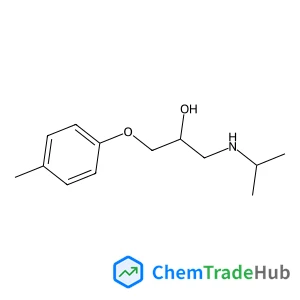
1-(4-Methylphenoxy)-3-(propan-2-ylamino)propan-2-ol
CAS Number:
5790-46-5
Molecular Formula:
C13H21NO2
Recommended Suppliers




Disclaimer
This page provides academic journal information for reference and research purposes only. We are not affiliated with any journal publishers and do not handle publication submissions. For publication-related inquiries, please contact the respective journal publishers directly.
If you notice any inaccuracies in the information displayed, please contact us at support@chemtradehub.com. We will promptly review and address your concerns.