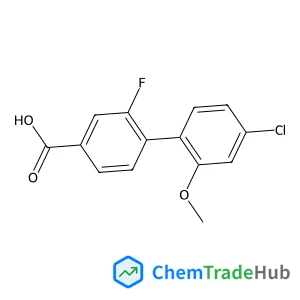
4-(4-Chloro-2-methoxyphenyl)-3-fluorobenzoic acid
CAS Number:
1261970-23-3
Molecular Formula:
C14H10ClFO3
Jia-Li Chen, Ming Su, Zhi-Qiang Jiang, Na Liu, Jun Yin, Yuan-Yuan Zhu, Zong-Quan Wu
The development of novel synthetic methods for the facile preparation of well-defined stereoregular helical polyisocyanides and their block copolymers in a living/controlled fashion is of great interest. In this contribution, a family of air-stable alkylethynyl Pd(II) complexes was unexpectedly found to promote the living polymerization of phenyl isocyanide, affording poly(phenyl isocyanide)s with controlled molecular weights, narrow molecular weight distributions and high stereoregularity. Interestingly, such alkylethynyl Pd(II) complexes exhibit very high helix-sense-selectivity in the living polymerization of an optically active phenyl isocyanide bearing an L-alanine pendant with a long decyl chain, and a single handed helical poly(phenyl isocyanide) with controlled helical sense was selectively produced. Moreover, a Pd(II) complex bearing a hydroxyl group can initiate the living polymerization of both phenyl isocyanide and L-lactide in one-pot, leading to the formation of well-defined poly(phenyl isocyanide)-b-poly(L-lactic acid) copolymers in high yields with controlled molecular weights and tunable compositions. Although the two monomers were polymerized via distinct mechanisms, the block copolymerization was revealed to proceed under living/controlled manners.
Oksana Plekan, Vitaliy Feyer, Andrew Cassidy, Victor Lyamayev, Nataliya Tsud, Sylwia Ptasińska, Sara Reiff, Rober G. Acres
DOI: 10.1039/C5CP01886B
Nicolas Ferré, Nathalie Guihéry, Jean-Paul Malrieu
DOI: 10.1039/C4CP05531D
Le Wang, Hong Zhang, Xiao-Jun Wang, Benjamin Dierre, Takayuki Suehiro, Takahashi Takeda, Naoto Hirosaki
DOI: 10.1039/C5CP01860A
DOI: 10.1039/C5CP00301F
Mandeep Kaur, Sandeep Singh
DOI: 10.1039/C5CP00540J
James N. Bull, Christopher W. West, Jan R. R. Verlet
DOI: 10.1039/C5CP02145F
Brian L. Watson, Benjamin D. Sherman, Ana L. Moore, Thomas A. Moore, Devens Gust
DOI: 10.1039/C5CP00860C
Puttaswamy Madhusudan, Jun Zhang, Bei Cheng
DOI: 10.1039/C5CP01598G
A. Bilic, Y. Tachibana, A. Miller, S. P. Russo
DOI: 10.1039/C4CP05290K
G. Gerogiokas, M. W. Y. Southey, M. P. Mazanetz, A. Hefeitz, M. Bodkin, R. J. Law, J. Michel
DOI: 10.1039/C5CP90084K
(5-Sulfamoyl-3-pyridinyl)boronic acid is primarily used in chemical synthesis, p...
Benzyl 2-methyl-2-(methylsulfonyl)-4-pentenoate is typically synthesized via est...
When handling 8-Fluoroquinolin-6-ol (CAS: 209353-22-0), it is important to use p...
1,3-Dibromo-5-(2-methyl-2-propanyl)benzene (CAS: 129316-09-2) is a crystalline c...
Ethyl 7-chloro-4-oxo-1-(1,3-thiazol-2-yl)-1,4-dihydro-1,8-naphthyridine-3-carbox...
When handling Delta-7-Avenasterol (CAS: 23290-26-8), it is important to wear app...
Proper handling involves the use of personal protective equipment such as gloves...
When handling 2-Methyl-2-proanyl 4-[(2-aminophenyl)amino]-1-piperidinecarboxylat...
N-Methyl-4-chlorobenzylamine hydrochloride (CAS: 65542-24-7) is a organic compou...
[2-(Dodecyloxy)ethoxy]acetic acid (CAS: 27306-90-7) is generally considered safe...

Polymer Chemistry welcomes submissions in all areas of polymer science that have a strong focus on macromolecular chemistry. Manuscripts may cover a broad range of fields, yet no direct application focus is required.
![[3-Fluoro-4-(1-pyrrolidinylcarbonyl)phenyl]boronic acid structure](https://static.chemtradehub.com/structs/874/874289-09-5-e3d4.webp "[3-Fluoro-4-(1-pyrrolidinylcarbonyl)phenyl]boronic acid structure")
![4,10-Dihydroxy-3H-pyrano[3,4,5-kl]xanthen-3-one structure](https://static.chemtradehub.com/structs/125/1259330-61-4-de48.webp "4,10-Dihydroxy-3H-pyrano[3,4,5-kl]xanthen-3-one structure")