












Strong anionic polyelectrolyte microgels
Literature Information
Publication Date
2015-04-30
DOI
10.1039/C5PY00426H
Impact Factor
5.582
Authors
Rahul Tiwari, Andreas Walther
View Original
Abstract
We report a facile synthesis of highly uniform poly(styrene sulfonic acid) microgels, which carry a strong polyelectrolyte group at every repeating unit. We demonstrate tuning of particle size, as well as particle softness, and show first solution state characterization.
Related Literature
Enhanced electrocatalytic activity of in situ carbon encapsulated molybdenum phosphide derived from a hybrid POM for the HER over a wide pH range
Balasingh Thangadurai Jebaslinhepzybai, Elavarasan Samaraj, Thangaian Kesavan, Manickam Sasidharan, J. Arockia Selvi
2021-12-20
Paper
DOI: 10.1039/D1SE01591E
Carbon dioxide to bio-oil in a bioelectrochemical system-assisted microalgae biorefinery process
Lluís Bañeras, Elisabet Perona-Vico, Andrea G. Capodaglio, Maria Dolors Balaguer, Sebastià Puig
2021-11-24
Paper
DOI: 10.1039/D1SE01701B
ITIC derivative acceptors for ternary organic solar cells: fine-tuning of absorption bands, LUMO energy levels, and cascade charge transfer
Seungyun Baik, Dong Won Kim, Hyun-Sik Kang, Seung Hwa Hong, Sungjin Park, Byeong-Kwan An, Soo Young Park
2021-11-17
Paper
DOI: 10.1039/D1SE01429C
A semitransparent particulate photoanode composed of SrTiO3 powder anchored on titania nanosheets
Haruka Momose, Fumiaki Takagi, Sora Fujisawa
2021-08-04
Paper
DOI: 10.1039/D1SE00914A
Porous graphene-like MoS2/carbon hierarchies for high-performance pseudocapacitive sodium storage
Tianhao Yao, Menglong Yao
2021-12-20
Paper
DOI: 10.1039/D1SE01406D
Unravelling the chemistry of catalyst surfaces and solvents towards C–C bond formation through activation and electrochemical conversion of CO2 into hydrocarbons over micro-structured dendritic copper
Nusrat Rashid, Mohsin Ahmad Bhat, Pravin P. Ingole
2021-11-08
Paper
DOI: 10.1039/D1SE01255J
The contribution of biomass and waste resources to decarbonizing transportation and related energy and environmental effects
Troy R. Hawkins
2022-01-04
Paper
DOI: 10.1039/D1SE01742J
Equilibrium modeling of thermal plasma assisted co-valorization of difficult waste streams for syngas production
Annika Reichert, Michael Pohorely, Erik Meers, Newton Libanio Ferreira, Michal Jeremias
2021-07-27
Paper
DOI: 10.1039/D1SE00998B
Redox flow batteries: a new frontier on energy storage
P. Arévalo-Cid, P. Dias, A. Mendes, J. Azevedo
2021-10-07
Review Article
DOI: 10.1039/D1SE00839K
Methane pyrolysis in low-cost, alkali-halide molten salts at high temperatures
Clarke Palmer, Maryam Tarazkar, Michael J. Gordon, Horia Metiu, Eric W. McFarland
2021-10-27
Paper
DOI: 10.1039/D1SE01408K
You might also like
Compound Q&A
What precautions should be taken when handling 2-Methyl-2-propanyl 5-amino-2-thiophenecarboxylate (CAS: 1498311-57-1)?
When handling 2-Methyl-2-propanyl 5-amino-2-thiophenecarboxylate (CAS: 1498311-5...
1498311-57-12-Methyl-2-propanyl ...
Compound Q&A
What are the physical and chemical properties of 5-Bromo-1,2-dichloro-3-fluorobenzene (CAS: 1000572-93-9)?
5-Bromo-1,2-dichloro-3-fluorobenzene (CAS: 1000572-93-9) is a crystalline solid ...
1000572-93-95-Bromo-1,2-dichloro...
Compound Q&A
How should (2R)-2-Amino-2-(4-bromophenyl)ethanol (CAS: 354153-64-3) be stored?
(2R)-2-Amino-2-(4-bromophenyl)ethanol (CAS: 354153-64-3) should be stored in a c...
354153-64-3(2R)-2-Amino-2-(4-br...
Compound Q&A
What regulatory guidelines apply to Methyl 4-(aminomethyl)tetrahydro-2H-pyran-4-carboxylate hydrochloride (CAS: 362707-24-2)?
Methyl 4-(aminomethyl)tetrahydro-2H-pyran-4-carboxylate hydrochloride (CAS: 3627...
362707-24-2Methyl 4-(aminomethy...
Compound Q&A
What are the main uses of 1,4-dimethyl-1H-pyrazole-5-sulfonyl chloride (CAS: 1174834-52-6)?
1,4-Dimethyl-1H-pyrazole-5-sulfonyl chloride is primarily used as an intermediat...
1174834-52-61,4-dimethyl-1H-pyra...
Compound Q&A
Is Dinaphtho[1,2-b:2',1'-d]furan (CAS: 239-69-0) safe?
Dinaphtho[1,2-b:2',1'-d]furan is generally safe when handled with appropriate pe...
239-69-0Dinaphtho[1,2-b:2',1...
Compound Q&A
What is the market or research trend for 7-Methyl-7,9-dihydro-1H-purine-2,6,8(3H)-trione (CAS: 612-37-3)?
The market for 7-Methyl-7,9-dihydro-1H-purine-2,6,8(3H)-trione (CAS: 612-37-3) i...
612-37-37-Methyl-7,9-dihydro...
Compound Q&A
What are the physical and chemical properties of 2-(4-Chlorophenyl)malonaldehyde (CAS: 205676-17-1)?
2-(4-Chlorophenyl)malonaldehyde (CAS: 205676-17-1) is a colorless or light yello...
205676-17-12-(4-Chlorophenyl)ma...
Compound Q&A
How is 2-Methylchrysene (CAS: 3351-32-4) typically synthesized?
2-Methylchrysene (CAS: 3351-32-4) is typically synthesized via the reaction of c...
3351-32-42-Methylchrysene
Compound Q&A
Is N-(6-aminopyrimidin-4-yl)acetamide (CAS: 89533-23-3) safe?
N-(6-aminopyrimidin-4-yl)acetamide (CAS: 89533-23-3) is generally considered saf...
89533-23-3N-(6-aminopyrimidin-...
Source Journal
Polymer Chemistry

CiteScore:
8.6
Self-citation Rate:
7.3%
Articles per Year:
457
Polymer Chemistry welcomes submissions in all areas of polymer science that have a strong focus on macromolecular chemistry. Manuscripts may cover a broad range of fields, yet no direct application focus is required.
Recommended Compounds

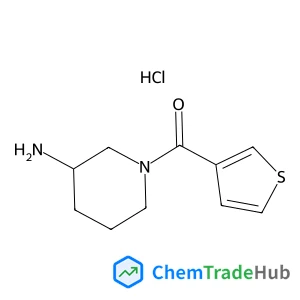
(3-Amino-piperidin-1-yl)-thiophen-3-yl-methanone hydrochloride
CAS Number:
1185316-70-4
Molecular Formula:
C10H15ClN2OS
Recommended Suppliers



Disclaimer
This page provides academic journal information for reference and research purposes only. We are not affiliated with any journal publishers and do not handle publication submissions. For publication-related inquiries, please contact the respective journal publishers directly.
If you notice any inaccuracies in the information displayed, please contact us at support@chemtradehub.com. We will promptly review and address your concerns.