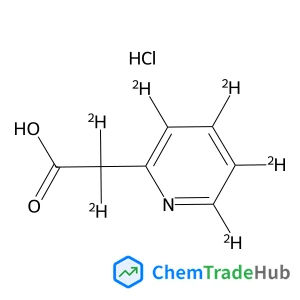
2,2-dideuterio-2-(3,4,5,6-tetradeuterio-2-pyridyl)acetic acid;hydrochloride
CAS Number:
1329799-67-8
Molecular Formula:
C7H2ClD6NO2
Xiaofeng Xu, Chuanfei Wang, Olof Bäcke, David I. James, Kim Bini, Eva Olsson, Mats Fahlman, Ergang Wang
A new electron-deficient building block 5,9-di(thiophen-2-yl)-6H-pyrrolo[3,4-g]quinoxaline-6,8(7H)-dione (PQD) was synthesized via functionalizing the 6- and 7-positions of quinoxaline (Qx) with a dicarboxylic imide moiety. Side chain substitution on the PQD unit leads to good solubility which enables very high molecular weight copolymers to be attained. The fusion of two strong electron-withdrawing groups (Qx and dicarboxylic imide) makes the PQD unit a stronger electron-deficient moiety than if the unit had just one electron-withdrawing group, thus enhancing the intramolecular charge transfer between electron-rich and deficient units of the copolymer. Four PQD-based polymers were synthesized which feature deep-lying highest occupied molecular orbital (HOMO) levels and bathochromic absorption spectra when compared to PBDT–Qx and PBDT–TPD analogues. The copolymers incorporated with benzo[1,2-b:4,5-b‘]dithiophene (BDT) units show that the 1D and 2D structural variations of the side groups on the BDT unit are correlated with the device performance. As a result, the corresponding solar cells (ITO/PEDOT:PSS/polymer:PC71BM/LiF/Al) based on the four copolymers feature very high open-circuit voltages (Voc) of around 1.0 V. The copolymer PBDT-PQD1 attains the best power conversion efficiency of 4.9%, owing to its relatively high absorption intensity and suitable film morphology. The structure–property correlation demonstrates that the new PQD unit is a promising electron-deficient building block for efficient photovoltaic materials with high Voc.
Patrícia Valderrama, Enrique Anastácio Alves, Juliana Azevedo Lima Pallone, Federico Marini
DOI: 10.1039/D3AN00104K
Xuan Sun, Weiya Wang, Yanyan Chai, Zhou Zheng, Yu Wang, Jing Bi, Qian Wang, Yonggang Hu, Zhixian Gao
DOI: 10.1039/D2AN01793H
Naga P. D. Boppana, Robyn Snow
DOI: 10.1039/D2AN02086F
Neha Jain, Prasad M. Sonawane, Haoyan Liu, Arkaprava Roychaudhury, Youngseob Lee, Jongkeol An, Donghyeon Kim, Dongwook Kim, Yunsu Kim, Yeu-Chun Kim, Kyung-Bin Cho, Hee-Sung Park, Cheol-Hee Kim
DOI: 10.1039/D3AN00646H
Kexuan Chen, Nan Ma, Haobo Sun, Xueji Zhang, Jinming Kong
DOI: 10.1039/D3AN00213F
Rongxian Ma, Jiaxuan Jiang, Yanfei Ya, Yu Lin, Yuyi Zhou, Yeyu Wu, Xuecai Tan, KeJing Huang, Fangkai Du, Jingjuan Xu
DOI: 10.1039/D3AN00024A
Xu Chen, Yue Ma, Shuangyu Miao, Dongnan Li, Ye Zhang
DOI: 10.1039/D2AN02002E
Shang-Ting Tsai, Hsu-Chen Hsu
DOI: 10.1039/D3AN00068K
Isidro Badillo-Ramírez, Bruno Landeros-Rivera, José M. Saniger
DOI: 10.1039/D3AN00027C
4-Nitrophenyl phosphate disodium salt hexahydrate is primarily used as a substra...
2-(Trifluoromethyl)-1,3-oxazole-4-carboxylic Acid (CAS: 1060816-01-4) is widely ...
2-Fluoro-4-biphenylcarboxylic acid should be stored in a cool, dry place at room...
Prednisolone-21-Carboxylic Acid is primarily used in the pharmaceutical industry...
4-(Hydrazinomethyl)-1,2,3-benzenetriol (CAS: 3614-72-0) should be stored in a co...
4-Amino-1-methyl-1H-pyrazole-5-carboxylic acid hydrochloride (CAS: 92534-70-8) i...
Dehydropachymic acid (CAS: 77012-31-8) is regulated by various agencies. It fall...
The market and research trends for 6-[(2,2-Dimethylpropanoyl)amino]nicotinic aci...
1,10-Phenanthroline-2,9-dicarbaldehyde should be stored in a cool, dry place awa...
5-Carbamoyl-11-oxo-10,11-dihydro-5H-dibenzo[b,f]azepin-10-yl acetate can be synt...

Polymer Chemistry welcomes submissions in all areas of polymer science that have a strong focus on macromolecular chemistry. Manuscripts may cover a broad range of fields, yet no direct application focus is required.


phosphoryl}methyl 4-methylbenzenesulfonate structure](https://static.chemtradehub.com/structs/864/864068-45-1-ba7c.webp "{[3-(Hexadecyloxy)propoxy](hydroxy)phosphoryl}methyl 4-methylbenzenesulfonate structure")