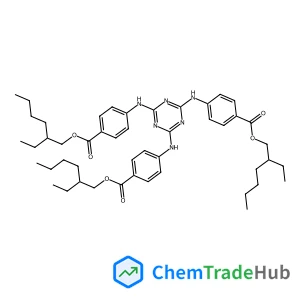
Tris(2-ethylhexyl) 4,4',4''-(1,3,5-triazine-2,4,6-triyltriimino)tribenzoate
CAS Number:
88122-99-0
Molecular Formula:
C48H66N6O6
M. Wang, G. Xu, D. Wang, Y. Zou, W. Frey
Three tailored ansa-type Zr(IV)- and Hf(IV)-complexes, Zr-1, Hf-1 and Zr-2, all bridged by a dimethylsilylene group and bearing both a 6-[2-(BR2)phenyl]pyrid-2-yl motif (R = ethyl, mesityl) and an η1/η5-bound ligand with different Lewis base character and steric demand, have been synthesized. Their structures have been determined by single-crystal X-ray diffraction analysis. Upon activation with methylalumoxane (MAO), Zr-1, Hf-1 and Zr-2 are capable of polymerizing norborn-2-ene (NBE) via ring-opening metathesis polymerization (ROMP). In the MAO-activated copolymerization of ethylene (E) with NBE; however, pure vinyl insertion polymerization (VIP)-derived poly(NBE)-co-poly(E) is obtained by Zr-1, Hf-1 and the model pre-catalyst (Zr-3), which does not contain the borylamino motif. In contrast, Zr-2 yields copolymers containing both ROMP- and VIP-derived poly(NBE)ROMP-co-poly(NBE)VIP-co-poly(E) units via an α-H elimination process. Variable-temperature 11B NMR measurements allow for identifying tri- and tetracoordinated borane species. The propensity of catalysts Zr-1, Hf-1, Zr-2 and Zr-3 to switch from VIP to ROMP is discussed on the basis of their structural differences. A detailed NMR study of the reaction of Zr-1, Zr-2, Hf-1 and in particular of dimethylsilylene-bis(6-[2-(diethylboryl)phenyl]pyrid-2-ylamido)ZrCl2 (Zr-4) with MAO and with MAO/NBE clarifies the reaction cascade from VIP to ROMP and allows for establishing a general concept for a tailored switch from VIP to ROMP within the same polymer chain, allowing for tandem VIP–ROMP copolymerization of E with NBE.
L. P. Singh, S. S. N. Murthy, Geeta Singh
DOI: 10.1039/B907215B
Anton S. Petrov, Batsal Devkota, Mustafa Burak Boz
DOI: 10.1039/B912884K
Rufus Boyack, Eric C. Le Ru
DOI: 10.1039/B905645A
Mohammad Kamal Hossain, Genin Gary Huang, Tadaaki Kaneko, Yukihiro Ozaki
DOI: 10.1039/B903819C
Natallia Shalkevich, Andrey Shalkevich, Lynda Si-Ahmed
DOI: 10.1039/B912571J
Peter Linton, Juan-Carlos Hernandez-Garrido, Paul A. Midgley, Håkan Wennerström, Viveka Alfredsson
DOI: 10.1039/B913755F
Anja Kranich, Hendrik Naumann, Fernando P. Molina-Heredia, H. Justin Moore, T. Randall Lee, Sophie Lecomte, Miguel A. de la Rosa, Peter Hildebrandt, Daniel H. Murgida
DOI: 10.1039/B904434E
Victoria Buch, J. Paul Devlin, I. Abrrey Monreal, Barbara Jagoda-Cwiklik, Nevin Uras-Aytemiz, Lukasz Cwiklik
DOI: 10.1039/B911600C
Ethyl 3-cyclohexylpropanoate is a clear, colorless to light yellow liquid with a...
Waste containing 2-(Hydroxymethyl)-5-(methoxycarbonyl)-6-methyl-4-(2-nitrophenyl...
Waste containing 2,4,6-Tris(pentafluoroethyl)-1,3,5-triazine (CAS: 858-46-8) sho...
When handling Chloroac-nle-oh (CAS: 56787-36-1), it is essential to wear appropr...
Ethyl 6-phenylimidazo[2,1-b][1,3]thiazole-3-carboxylate is primarily used in the...
Alternatives to alpha-(2-Bromophenyl)benzylamine (CAS: 55095-15-3) in synthesis ...
Waste containing 2-Chloro-5-methoxypyridine (CAS: 139585-48-1) should be managed...
1-(4-Methoxyphenyl)-2,5-dimethyl-1H-pyrrole (CAS: 5044-27-9) is used in various ...
There are alternative reagents and compounds that can be used in the synthesis o...
Tungsten(IV) oxide, also known as tungsten dioxide, is a chemical compound with ...

Polymer Chemistry welcomes submissions in all areas of polymer science that have a strong focus on macromolecular chemistry. Manuscripts may cover a broad range of fields, yet no direct application focus is required.

![2-Bromodibenzo[b,d]furan structure](https://static.chemtradehub.com/structs/86-/86-76-0-1814.webp "2-Bromodibenzo[b,d]furan structure")