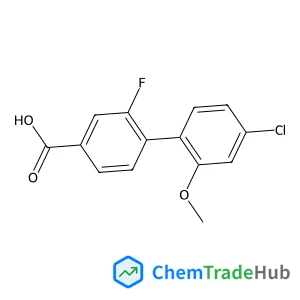
4-(4-Chloro-2-methoxyphenyl)-3-fluorobenzoic acid
CAS Number:
1261970-23-3
Molecular Formula:
C14H10ClFO3
Leena Pitkänen, Aaron A. Urbas, André M. Striegel
Examined here is the feasibility of employing Raman spectroscopy as a detection method in size-exclusion chromatography (SEC) and related macromolecular separations, for the purposes of determining the chemical heterogeneity of copolymers. To this effect, heart-cutting fractions from the SEC peak of a gradient random copolymer of styrene (S) and methyl methacrylate (MMA) were collected, at concentrations resembling those of eluting slices in an analytical SEC experiment, and subsequently analyzed by off-line Raman. The amount (weight or mole percent) of styrene in each fraction was quantitated by Raman by applying a calibration curve constructed through the analysis of well-characterized block, alternating, and random S-MMA copolymers. The weight percentages of S (w% S) obtained from SEC with off-line Raman analysis of the gradient copolymer were compared to results previously obtained using SEC with on-line multi-angle static light scattering, differential refractometry, and ultraviolet absorption detection. Not only did Raman rank the w% S of the fractions in the correct order but, on average, Raman results differed by 3% or less as compared to the values obtained via multi-detector SEC. The results from this study provide proof of principle of both the feasibility of continuous off-line Raman detection for macromolecular separations and of the possibility of employing for this purpose the same or similar hardware to that currently used for continuous off-line Fourier transform infrared detection.

European Journal of Organic Chemistry

Nature Reviews Drug Discovery

CrystEngComm

Mini-Reviews in Medicinal Chemistry

Journal of Enzyme inhibition and Medicinal Chemistry

Current Pharmaceutical Biotechnology

Coloration Technology

Photochemical & Photobiological Sciences

Angewandte Chemie International Edition

Journal of Medical Biochemistry
DOI: 10.1039/C5CP00329F
Tianyu Zhu, Peng Chen, Hongfeng Li, Wenbin Sun, Ting Gao, Pengfei Yan
DOI: 10.1039/C5CP01392E
Poonam Verma, Haridas Pal
DOI: 10.1039/C5CP01480H
Zhe Gui, Eleanor Gillette, Jonathon Duay, Junkai Hu, Nam Kim, Sang Bok Lee
DOI: 10.1039/C5CP01814E
Régis Stephan, Marie-Christine Hanf, Philippe Sonnet
DOI: 10.1039/C5CP00613A
Helen E. Hermes, Christoph E. Sitta, Burkhard Schillinger, Hartmut Löwen, Stefan U. Egelhaaf
DOI: 10.1039/C5CP01082A
DOI: 10.1039/C5CP00768B
Catherine Gauthier, Etienne Munch, Dominique Thiaudière
DOI: 10.1039/C5CP00384A
Shital Patangrao Pawar, Suryasarathi Bose
DOI: 10.1039/C5CP01644D
(5-Sulfamoyl-3-pyridinyl)boronic acid is primarily used in chemical synthesis, p...
Benzyl 2-methyl-2-(methylsulfonyl)-4-pentenoate is typically synthesized via est...
When handling 8-Fluoroquinolin-6-ol (CAS: 209353-22-0), it is important to use p...
1,3-Dibromo-5-(2-methyl-2-propanyl)benzene (CAS: 129316-09-2) is a crystalline c...
Ethyl 7-chloro-4-oxo-1-(1,3-thiazol-2-yl)-1,4-dihydro-1,8-naphthyridine-3-carbox...
When handling Delta-7-Avenasterol (CAS: 23290-26-8), it is important to wear app...
Proper handling involves the use of personal protective equipment such as gloves...
When handling 2-Methyl-2-proanyl 4-[(2-aminophenyl)amino]-1-piperidinecarboxylat...
N-Methyl-4-chlorobenzylamine hydrochloride (CAS: 65542-24-7) is a organic compou...
[2-(Dodecyloxy)ethoxy]acetic acid (CAS: 27306-90-7) is generally considered safe...

Polymer Chemistry welcomes submissions in all areas of polymer science that have a strong focus on macromolecular chemistry. Manuscripts may cover a broad range of fields, yet no direct application focus is required.