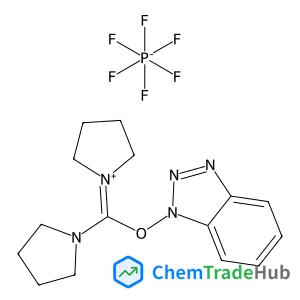
(1H-Benzotriazol-1-yloxy)(di-1-pyrrolidinyl)methylium hexafluorophosphate
CAS Number:
105379-24-6
Molecular Formula:
C15H21F6N5OP
Callum J. Dickson, Knut Teigen, Ian R. Gould
In this manuscript we expand significantly on our earlier communication by investigating the bilayer self-assembly of eight different types of phospholipids in unbiased molecular dynamics (MD) simulations using three widely used all-atom lipid force fields. Irrespective of the underlying force field, the lipids are shown to spontaneously form stable lamellar bilayer structures within 1 microsecond, the majority of which display properties in satisfactory agreement with the experimental data. The lipids self-assemble via the same general mechanism, though at formation rates that differ both between lipid types, force fields and even repeats on the same lipid/force field combination. In addition to zwitterionic phosphatidylcholine (PC) and phosphatidylethanolamine (PE) lipids, anionic phosphatidylserine (PS) and phosphatidylglycerol (PG) lipids are represented. To our knowledge this is the first time bilayer self-assembly of phospholipids with negatively charged head groups is demonstrated in all-atom MD simulations.
K. E. A. Hooper, H. K. H. Lee, M. J. Newman, S. Meroni, J. Baker, T. M. Watson, W. C. Tsoi
DOI: 10.1039/C6CP05123E
Lianjie Xue, Fehmi Bardak, George Tamas, Edward L. Quitevis
DOI: 10.1039/C6CP08263G
Kaiqi Wu, Wenfei Li, Lu Yu, Wei Tong, Yue Feng, Shenglong Ling, Longhua Zhang, Xiao Zheng, Maojun Yang
DOI: 10.1039/C6CP08107J
G. W. Driver, Y. Huang, A. Laaksonen, T. Sparrman, Y.-L. Wang, P.-O. Westlund
DOI: 10.1039/C6CP05801A
Natsumi Muramatsu, Naoki Mimura, Osamu Sato
DOI: 10.1039/C6CP06831F
Shimon Vega
DOI: 10.1039/C6CP07881H
Denis S. Grebenkov, Gleb Oshanin
DOI: 10.1039/C6CP06102H
Yuanjun Lu, Bryan E. G. Lucier, Yue Zhang, Anmin Zheng, Yining Huang
DOI: 10.1039/C7CP00199A
Penghui Li, Fang Wang, Shiqian Wei, Xinyu Li
DOI: 10.1039/C6CP08409E
When handling 4-(2-Furylmethyl)thiomorpholine 1,1-dioxide (CAS: 79206-94-3), it ...
When handling 4-Chloro-N-[2-(4-morpholinyl)ethyl]benzamide (CAS: 71320-77-9), it...
Waste containing this compound (CAS: 62921-74-8) should be handled according to ...
Waste containing (S)-Methyl 2-amino-3-cyclohexylpropanoate should be collected i...
This compound can be synthesized using a multi-step process involving the conjug...
There are several alternatives to (2E)-3-(3,4-Dichlorophenyl)acrylic acid in syn...
Ethyl 6-(2-nitrophenyl)imidazo[2,1-b][1,3]thiazole-3-carboxylate (CAS: 925437-84...
Waste containing 2-(1,3-Thiazol-2-yl)ethanamine (CAS: 18453-07-1) should be coll...
Methyl 5-iodo-2-methylbenzoate can be synthesized through the iodination of meth...
5-Chloro[1,2,4]triazolo[1,5-a]pyridine is commonly synthesized via the condensat...

Physical Chemistry Chemical Physics (PCCP) is an international journal co-owned by 19 physical chemistry and physics societies from around the world. This journal publishes original, cutting-edge research in physical chemistry, chemical physics and biophysical chemistry. To be suitable for publication in PCCP, articles must include significant innovation and/or insight into physical chemistry; this is the most important criterion that reviewers and Editors will judge against when evaluating submissions. The journal has a broad scope and welcomes contributions spanning experiment, theory, computation and data science. Topical coverage includes spectroscopy, dynamics, kinetics, statistical mechanics, thermodynamics, electrochemistry, catalysis, surface science, quantum mechanics, quantum computing and machine learning. Interdisciplinary research areas such as polymers and soft matter, materials, nanoscience, energy, surfaces/interfaces, and biophysical chemistry are welcomed if they demonstrate significant innovation and/or insight into physical chemistry. Joined experimental/theoretical studies are particularly appreciated when complementary and based on up-to-date approaches.