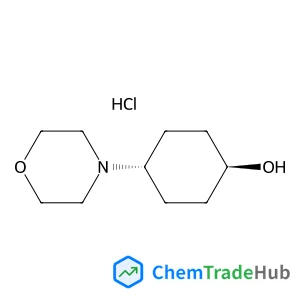
trans-4-(4-Morpholinyl)cyclohexanol hydrochloride (1:1)
CAS Number:
1588441-09-1
Molecular Formula:
C10H20ClNO2
Tobias Lünskens, Alexander von Weber, Thomas Leoni, Alain Ranguis, Anthony D'Aléo, Frédéric Fages, Aras Kartouzian, Conrad Becker, Ulrich Heiz
1,4-Di-n-octyloxy-2,5-bis(pyren-1-ylethenyl)benzene (bis-pyrene) has been studied by the means of surface cavity ring-down (s-CRD) spectroscopy on an amorphous BK7 glass substrate and scanning tunnelling microscopy (STM) on Au(111). Absorption spectra show a modification of the optical properties as a function of coverage, i.e. appearance of a shoulder around 505 nm followed by a saturation of the intensity of this signal observed at higher coverages. We attribute this shoulder to the change of the molecular orientation between the first and the second monolayer and thus to an interfacial effect. These results are confirmed by scanning tunnelling microscopy (STM) measurements where the bis-pyrene molecules have been deposited on Au(111) at room temperature (RT) and onto a cold substrate. Independently of the temperature in the range from 210 K to RT, the first monolayer is always highly organized. At low temperature bis-pyrene molecules constituting the second monolayer are randomly distributed, suggesting that self-organisation is kinetically hindered. Deposited at room temperature, the molecular diffusion is enhanced and the formation of an organized second layer takes place after storing the sample for 150 minutes at room temperature. A HOMO–LUMO gap of 2.85 eV has been determined by scanning tunnelling spectroscopy, which is in very good agreement with the observed optical transition at 434 nm (2.86 eV) in s-CRD spectroscopy.
DOI: 10.1039/B924048A
Elna Deglint, Heather Martens, Essex Edwards, Nicholas Boon, Paul Dance
DOI: 10.1039/C0CP01570A
Stas Burov, Jae-Hyung Jeon, Ralf Metzler, Eli Barkai
DOI: 10.1039/C0CP01879A
Françoise Delbecq, Yosslen Aray, Philippe Sautet
DOI: 10.1039/C0CP00858C
Bo Albinsson, Jerker Mårtensson
DOI: 10.1039/C003805A
Seiji Takahashi, Yuki Kitahara, Megumi Nakamura, Yoshiro Shiokawa, Toshihiro Fujii
DOI: 10.1039/B923454C
Yoshihiro Takeda, Tamotsu Kondow, Fumitaka Mafuné
DOI: 10.1039/C0CP00770F
Satoshi Kokubu, Ryoji Kusaka, Yoshiya Inokuchi, Takeharu Haino, Takayuki Ebata
DOI: 10.1039/B924822F
1-(2,4,6-Trifluorophenyl)ethanol is an organic compound with the CAS number 1250...
1-(2,4-Dimethoxybenzyl)-4-(hydroxymethyl)-2-pyrrolidinone (CAS: 919111-34-5) is ...
(7S,15R)-6β,15-Diacetoxy-7α,20-epoxy-7-hydroxykaura-2,16-dien-1-one is a crystal...
The compound rac-ethyl (1r,4r)-4-hydroxycyclohexane-1-carboxylate, trans (CAS: 3...
The market for 2-(2,4-Difluorophenoxy)-3-nitropyridine (CAS: 175135-62-3) is cur...
The main uses of 6-Diazo-5-oxo-L-norleucine (CAS: 157-03-9) include research in ...
When handling 2-Aminoethyl-mono-amide-DOTA-tris(tBu ester) (CAS: 173308-19-5), i...
5-Methylimidazo[1,2-a]pyridine-3-carbaldehyde (CAS: 178488-37-4) can be synthesi...
There are alternative reagents that can be used in the synthesis of 2,4,6-Trihyd...
(2Z)-3-(5-Fluoro-1H-indol-3-yl)-2-sulfanylacrylic acid is a chemical compound wi...

Physical Chemistry Chemical Physics (PCCP) is an international journal co-owned by 19 physical chemistry and physics societies from around the world. This journal publishes original, cutting-edge research in physical chemistry, chemical physics and biophysical chemistry. To be suitable for publication in PCCP, articles must include significant innovation and/or insight into physical chemistry; this is the most important criterion that reviewers and Editors will judge against when evaluating submissions. The journal has a broad scope and welcomes contributions spanning experiment, theory, computation and data science. Topical coverage includes spectroscopy, dynamics, kinetics, statistical mechanics, thermodynamics, electrochemistry, catalysis, surface science, quantum mechanics, quantum computing and machine learning. Interdisciplinary research areas such as polymers and soft matter, materials, nanoscience, energy, surfaces/interfaces, and biophysical chemistry are welcomed if they demonstrate significant innovation and/or insight into physical chemistry. Joined experimental/theoretical studies are particularly appreciated when complementary and based on up-to-date approaches.
![4-[(1-Methyl-1H-pyrrol-2-yl)methylene]-1,3(2H,4H)-isoquinolinedione structure](https://static.chemtradehub.com/structs/110/1104546-89-5-a600.webp "4-[(1-Methyl-1H-pyrrol-2-yl)methylene]-1,3(2H,4H)-isoquinolinedione structure")