













The tricyanomethanide anion favors low viscosity of the pure ionic liquid and its aqueous mixtures
Literature Information
Publication Date
2015-11-05
DOI
10.1039/C5CP05666G
Impact Factor
3.676
Authors
View Original
Abstract
Ionic liquids (ILs) constitute a broad research interest. One of the serious drawbacks of ILs is their high shear viscosity, which originates from bulky particles and strong cation–anion coordination. A continuous molecular design is being done to develop low-viscosity ILs. Low-viscosity ILs are also expected to exhibit an increased ionic conductivity. We investigate such an IL composed using a new anion (to the IL field) tricyanomethanide [C(CN)3]− and the cation 1-ethyl-3-methylimidazolium [EMIM]+. Having developed the force field for [EMIM][C(CN)3], we simulate molecular dynamics (MD) of the pure IL and its mixtures with water over an entire range of compositions. According to MD simulations, [EMIM][C(CN)3] exhibits unusually low shear viscosity (for the imidazolium family) and high ionic conductivity. This is achieved thanks to weak cation–anion coordination and no hydrogen bonding between them. Furthermore, cation–water and anion–water hydrogen bonds were detected in the [EMIM][C(CN)3]/water mixtures. We correlate the structure and dynamics of [EMIM][C(CN)3] in aqueous mixtures to provide guidelines for future development of low-viscosity and highly conductive ILs.
Related Literature
Chalcogen bonding catalysis
Govindasamy Sekar, Vysakh Venugopalan Nair, Jieping Zhu
2023-12-07
Tutorial Review
DOI: 10.1039/D3CS00503H
Stimulus-responsive polymer materials toward multi-mode and multi-level information anti-counterfeiting: recent advances and future challenges
2023-12-15
Tutorial Review
DOI: 10.1039/D3CS00753G
Strengths of covalent bonds in LnO2 determined from O K-edge XANES spectra using a Hubbard model
Wayne W. Lukens, Jr, Stefan G. Minasian, Corwin H. Booth
2023-11-03
Edge Article
DOI: 10.1039/D3SC03304J
Pursuing excitonic energy transfer with programmable DNA-based optical breadboards
Divita Mathur, Sebastián A. Díaz, Ryan D. Pensack, Bernard Yurke, Austin Biaggne, Joseph S. Melinger, William B. Knowlton, Igor L. Medintz
2023-10-24
Review Article
DOI: 10.1039/D0CS00936A
Stimuli-responsive synthetic helical polymers
María Lago-Silva, Manuel Fernández-Míguez, Rafael Rodríguez, Emilio Quiñoá, Félix Freire
2023-12-18
Review Article
DOI: 10.1039/D3CS00952A
Heterogenization of molecular catalysts within porous solids: the case of Ni-catalyzed ethylene oligomerization from zeolites to metal–organic frameworks
Rémy Rajapaksha, Partha Samanta, Elsje Alessandra Quadrelli, Jérôme Canivet
2023-10-30
Review Article
DOI: 10.1039/D3CS00188A
Discovery of a selective TC-PTP degrader for cancer immunotherapy
Jinmin Miao, Jiajun Dong, Yiming Miao, Yunpeng Bai, Zihan Qu, Brenson A. Jassim, Bo Huang, Quyen Nguyen, Yuan Ma, Allison A. Murray, Jinyue Li
2023-10-24
Edge Article
DOI: 10.1039/D3SC04541B
A CuICoII cryptate for the visible light-driven reduction of CO2
Julia Jökel, Esma Birsen Boydas, Joël Wellauer, Oliver S. Wenger, Michael Römelt
2023-10-27
Edge Article
DOI: 10.1039/D3SC02679E
Metallosupramolecular polymers: current status and future prospects
Rahul Dev Mukhopadhyay
2023-11-14
Review Article
DOI: 10.1039/D3CS00692A
You might also like
Compound Q&A
How should waste containing 6-Chloro-5-(2'-hydroxy-3'-methoxy-4-biphenylyl)-3-(3-methoxyphenyl)-1H-pyrrolo[3,2-d]pyrimidine-2,4(3H,5H)-dione (CAS: 1346607-05-3) be handled?
Waste containing 6-Chloro-5-(2'-hydroxy-3'-methoxy-4-biphenylyl)-3-(3-methoxyphe...
1346607-05-36-Chloro-5-(2'-hydro...
Compound Q&A
What are the main uses of (3alpha,5alpha)-3-Hydroxypregnane-11,20-dione (CAS: 23930-19-0)?
(3alpha,5alpha)-3-Hydroxypregnane-11,20-dione is primarily used in the pharmaceu...
23930-19-0(3alpha,5alpha)-3-Hy...
Compound Q&A
What is the market or research trend for 4-Amino-6-chloro-2-pyridinecarboxylic acid (CAS: 546141-56-4)?
The market for 4-Amino-6-chloro-2-pyridinecarboxylic acid (CAS: 546141-56-4) is ...
546141-56-44-Amino-6-chloro-2-p...
Compound Q&A
Are there alternatives to (2-Benzoylethyl)trimethylammonium chloride (CAS: 24472-88-6) in synthesis?
Alternatives to (2-Benzoylethyl)trimethylammonium chloride (CAS: 24472-88-6) in ...
24472-88-6(2-Benzoylethyl)trim...
Compound Q&A
Is N-[4-Nitro-3-(trifluoromethyl)phenyl]acetamide (CAS: 393-12-4) safe?
N-[4-Nitro-3-(trifluoromethyl)phenyl]acetamide (CAS: 393-12-4) is generally safe...
393-12-4N-[4-Nitro-3-(triflu...
Compound Q&A
Are there alternatives to [(4R,5R,6S)-5-hydroxy-10-imino-3,7-dioxa-1,9-diazatricyclo[6.4.0.02,6]dodeca-8,11-dien-4-yl]methyl dihydrogen phosphate (CAS: 39679-56-6) in synthesis?
Alternative reagents such as other phosphates or similar functional groups can b...
39679-56-6[(4R,5R,6S)-5-hydrox...
Compound Q&A
Are there alternatives to N,N'-Bis(3-aminopropyl)-1,3-propanediamine (CAS: 4605-14-5) in synthesis?
There are alternatives to N,N'-Bis(3-aminopropyl)-1,3-propanediamine (CAS: 4605-...
4605-14-5N,N'-Bis(3-aminoprop...
Compound Q&A
What precautions should be taken when handling Aluminium trihexadecanoate (CAS: 555-35-1)?
When handling Aluminium trihexadecanoate, it is important to use appropriate per...
555-35-1Aluminium trihexadec...
Compound Q&A
What is (1,1-Dioxido-3-oxo-1,2-benzothiazol-2(3H)-yl)acetic acid (CAS: 52188-11-1)?
(1,1-Dioxido-3-oxo-1,2-benzothiazol-2(3H)-yl)acetic acid is a chemical compound ...
52188-11-1(1,1-Dioxido-3-oxo-1...
Compound Q&A
Are there alternatives to 5,5-dimethyloxolan-2-one (CAS: 3123-97-5) in synthesis?
Several alternatives to 5,5-dimethyloxolan-2-one (CAS: 3123-97-5) can be used in...
3123-97-55,5-dimethyloxolan-2...
Source Journal
Physical Chemistry Chemical Physics

CiteScore:
5.5
Self-citation Rate:
10.3%
Articles per Year:
3036
Physical Chemistry Chemical Physics (PCCP) is an international journal co-owned by 19 physical chemistry and physics societies from around the world. This journal publishes original, cutting-edge research in physical chemistry, chemical physics and biophysical chemistry. To be suitable for publication in PCCP, articles must include significant innovation and/or insight into physical chemistry; this is the most important criterion that reviewers and Editors will judge against when evaluating submissions. The journal has a broad scope and welcomes contributions spanning experiment, theory, computation and data science. Topical coverage includes spectroscopy, dynamics, kinetics, statistical mechanics, thermodynamics, electrochemistry, catalysis, surface science, quantum mechanics, quantum computing and machine learning. Interdisciplinary research areas such as polymers and soft matter, materials, nanoscience, energy, surfaces/interfaces, and biophysical chemistry are welcomed if they demonstrate significant innovation and/or insight into physical chemistry. Joined experimental/theoretical studies are particularly appreciated when complementary and based on up-to-date approaches.
Recommended Compounds
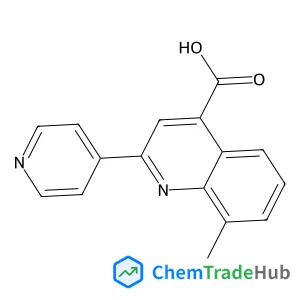
8-Methyl-2-pyridin-4-ylquinoline-4-carboxylic acid
CAS Number:
107027-42-9
Molecular Formula:
C16H12N2O2
![2-morpholino-2-[2-(trifluoromethyl)pyrimidin-5-yl]ethanamine structure](https://static.chemtradehub.com/structs/119/1192570-20-9-2810.webp "2-morpholino-2-[2-(trifluoromethyl)pyrimidin-5-yl]ethanamine structure")
2-morpholino-2-[2-(trifluoromethyl)pyrimidin-5-yl]ethanamine
CAS Number:
1192570-20-9
Molecular Formula:
C11H15F3N4O

![(3-{[4-(Aminomethyl)-6-(trifluoromethyl)-2-pyridinyl]oxy}phenyl)[(3R,4R)-3-fluoro-4-hydroxy-1-pyrrolidinyl]methanone structure](https://static.chemtradehub.com/structs/200/2007885-39-2-affc.webp "(3-{[4-(Aminomethyl)-6-(trifluoromethyl)-2-pyridinyl]oxy}phenyl)[(3R,4R)-3-fluoro-4-hydroxy-1-pyrrolidinyl]methanone structure")
(3-{[4-(Aminomethyl)-6-(trifluoromethyl)-2-pyridinyl]oxy}phenyl)[(3R,4R)-3-fluoro-4-hydroxy-1-pyrrolidinyl]methanone
CAS Number:
2007885-39-2
Molecular Formula:
C18H17F4N3O3
Recommended Suppliers





Disclaimer
This page provides academic journal information for reference and research purposes only. We are not affiliated with any journal publishers and do not handle publication submissions. For publication-related inquiries, please contact the respective journal publishers directly.
If you notice any inaccuracies in the information displayed, please contact us at support@chemtradehub.com. We will promptly review and address your concerns.