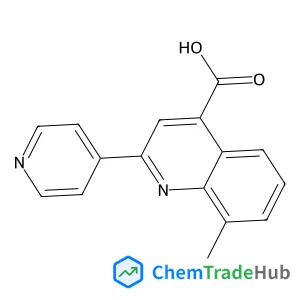
8-Methyl-2-pyridin-4-ylquinoline-4-carboxylic acid
CAS Number:
107027-42-9
Molecular Formula:
C16H12N2O2
Sayali B. Kale, Manjiri A. Mahadadalkar, Harsharaj S. Jadhav, Ashwini P. Bhirud, Jalinder D. Ambekar, Chan-Jin Park
Hierarchical 3D ZnIn2S4/graphene (ZnIn2S4/Gr) nano-heterostructures were successfully synthesized using an in-situ hydrothermal method. The dual functionality of these nano-heterostructures i.e. for solar hydrogen production and lithium ion batteries has been demonstrated for the first time. The ZnIn2S4/Gr nano-heterostructures were optimized by varying the concentrations of graphene for utmost hydrogen production. An inspection of the structure shows the existence of layered hexagonal ZnIn2S4 wrapped in graphene. The reduction of graphene oxide (GO) to graphene was confirmed by Raman and XPS analyses. The morphological analysis demonstrated that ultrathin ZnIn2S4 nanopetals are dispersed on graphene sheets. The optical study reveals the extended absorption edge to the visible region due to the presence of graphene and hence is used as a photocatalyst to transform H2S into eco-friendly hydrogen using solar light. The ZnIn2S4/Gr nano-heterostructure that is comprised of graphene and ZnIn2S4 in a weight ratio of 1 : 99 exhibits enhanced photocatalytically stable hydrogen production i.e. ∼6365 μmole h−1 under visible light irradiation using just 0.2 g of nano-heterostructure, which is much higher as compared to bare hierarchical 3D ZnIn2S4. The heightened photocatalytic activity is attributed to the enhanced charge carrier separation due to graphene which acts as an excellent electron collector and transporter. Furthermore, the usage of nano-heterostructures and pristine ZnIn2S4 as anodes in lithium ion batteries confers the charge capacities of 590 and 320 mA h g−1 after 220 cycles as compared to their initial reversible capacities of 645 and 523 mA h g−1, respectively. These nano-heterostructures show high reversible capacity, excellent cycling stability, and high-rate capability indicating their potential as promising anode materials for LIBs. The excellent performance is due to the nanostructuring of ZnIn2S4 and the presence of a graphene layer, which works as a channel for the supply of electrons during the charge–discharge process. More significantly, their dual functionality in energy generation and storage is quite unique and commendable.
Divita Mathur, Sebastián A. Díaz, Ryan D. Pensack, Bernard Yurke, Austin Biaggne, Joseph S. Melinger, William B. Knowlton, Igor L. Medintz
DOI: 10.1039/D0CS00936A
Virender K. Sharma, Xingmao Ma
DOI: 10.1039/D3CS00627A
Xinlu Zheng, Ziwei Ye, Zeeshan Akmal, Chun He, Jinlong Zhang, Lingzhi Wang
DOI: 10.1039/D3CS00462G
Fulong Zhu, Wei Guo, Yongzhu Fu
DOI: 10.1039/D3CS00703K
Xiaoyao Chen, Héctor Soria-Carrera, Oleksii Zozulia, Job Boekhoven
DOI: 10.1039/D3SC04281B
David E. Salazar Marcano, Nada D. Savić, Kilian Declerck, Shorok A. M. Abdelhameed, Tatjana N. Parac-Vogt
DOI: 10.1039/D3CS00195D
Govindasamy Sekar, Vysakh Venugopalan Nair, Jieping Zhu
DOI: 10.1039/D3CS00503H
Mohammad Rafiee, Dylan J. Abrams, Luana Cardinale, Zachary Goss, Shannon S. Stahl
DOI: 10.1039/D2CS00706A
Yong Jiang, Zhong Liang, Qian Zhang, Yaping Du
DOI: 10.1039/D3CS00708A
Waste containing 6-Chloro-5-(2'-hydroxy-3'-methoxy-4-biphenylyl)-3-(3-methoxyphe...
(3alpha,5alpha)-3-Hydroxypregnane-11,20-dione is primarily used in the pharmaceu...
The market for 4-Amino-6-chloro-2-pyridinecarboxylic acid (CAS: 546141-56-4) is ...
Alternatives to (2-Benzoylethyl)trimethylammonium chloride (CAS: 24472-88-6) in ...
N-[4-Nitro-3-(trifluoromethyl)phenyl]acetamide (CAS: 393-12-4) is generally safe...
Alternative reagents such as other phosphates or similar functional groups can b...
There are alternatives to N,N'-Bis(3-aminopropyl)-1,3-propanediamine (CAS: 4605-...
When handling Aluminium trihexadecanoate, it is important to use appropriate per...
(1,1-Dioxido-3-oxo-1,2-benzothiazol-2(3H)-yl)acetic acid is a chemical compound ...
Several alternatives to 5,5-dimethyloxolan-2-one (CAS: 3123-97-5) can be used in...

Physical Chemistry Chemical Physics (PCCP) is an international journal co-owned by 19 physical chemistry and physics societies from around the world. This journal publishes original, cutting-edge research in physical chemistry, chemical physics and biophysical chemistry. To be suitable for publication in PCCP, articles must include significant innovation and/or insight into physical chemistry; this is the most important criterion that reviewers and Editors will judge against when evaluating submissions. The journal has a broad scope and welcomes contributions spanning experiment, theory, computation and data science. Topical coverage includes spectroscopy, dynamics, kinetics, statistical mechanics, thermodynamics, electrochemistry, catalysis, surface science, quantum mechanics, quantum computing and machine learning. Interdisciplinary research areas such as polymers and soft matter, materials, nanoscience, energy, surfaces/interfaces, and biophysical chemistry are welcomed if they demonstrate significant innovation and/or insight into physical chemistry. Joined experimental/theoretical studies are particularly appreciated when complementary and based on up-to-date approaches.
![2-Methyl-2-propanyl [2-(2-oxa-6-azaspiro[3.3]hept-6-yl)ethyl]carbamate structure](https://static.chemtradehub.com/structs/141/1415562-38-7-c0a4.webp "2-Methyl-2-propanyl [2-(2-oxa-6-azaspiro[3.3]hept-6-yl)ethyl]carbamate structure")