












![Benzo[b]naphtho[2,1-d]thiophene structure](https://static.chemtradehub.com/structs/239/239-35-0-ff90.webp "Benzo[b]naphtho[2,1-d]thiophene structure")
Fluorescence of N-acylated dansylamide with a long hydrophobic tail: sensitive response to premicellar aggregation of sodium deoxycholate
Literature Information
Publication Date
2015-10-12
DOI
10.1039/C5CP04263A
Impact Factor
3.676
Authors
Alok Kumar Tripathi, Monalisa Mohapatra, Ashok Kumar Mishra
View Original
Abstract
The present work describes the synthesis and photophysical studies of two fluorescent dansylamide derivatives, in which the amine group is acylated by a long hydrophobic chain (a part of a biologically relevant palmitic acid) and by a short hydrophobic tail (a part of acetic acid). The long chain tethered dansyl analogue is successfully utilized in estimating critical micellar concentration (CMC) of bile salts (NaDC, NaC) as well as anionic and cationic surfactants (SDS, CTAB) with the help of enhanced fluorescence intensity facilitated by better solubilization of the molecule in microheterogeneous media. The long chain tethered dansylamide derivative shows significant fluorescence solvatochromism with a red shift (ca. 4000 cm−1) from hexane to water. In contrast, the solvatochromism exhibited by the parent/short acyl chain analogue is much less (ca. 2230 cm−1 from hexane to water) and the fluorescence is not sensitive to micellization. Interestingly, the long chain tethered fluorescent probe shows high sensitivity towards premicellar aggregation of sodium deoxycholate (NaDC) bile salt, through a clear blue shift of emission maxima and concomitant enhancement of fluorescent intensity. Such an observation of fluorescence sensing of premicellar aggregation is unusual.
Related Literature
Azaphosphinines and their derivatives
J. Nolan McNeill, Jeremy P. Bard, Darren W. Johnson, Michael M. Haley
2023-11-24
Review Article
DOI: 10.1039/D3CS00737E
Photoswitchable and long-lived seven-membered cyclic singlet diradicals for the bioorthogonal photoclick reaction
Fuqiang Hu, Cefei Zhang, Zhihao Liu, Xinyu Xie, Xiaohu Zhao, Yanju Luo, Jielin Fu, Baolin Li, Changwei Hu, Zhishan Su, Zhipeng Yu
2023-11-02
Edge Article
DOI: 10.1039/D3SC03675H
Chalcogen bonding catalysis
Govindasamy Sekar, Vysakh Venugopalan Nair, Jieping Zhu
2023-12-07
Tutorial Review
DOI: 10.1039/D3CS00503H
Hybrid classical/machine-learning force fields for the accurate description of molecular condensed-phase systems
Moritz Thürlemann, Sereina Riniker
2023-10-31
Edge Article
DOI: 10.1039/D3SC04317G
Stimulus-responsive polymer materials toward multi-mode and multi-level information anti-counterfeiting: recent advances and future challenges
2023-12-15
Tutorial Review
DOI: 10.1039/D3CS00753G
Electron transport through supercrystals of atomically precise gold nanoclusters: a thermal bi-stability effect
Tatsuya Higaki, Jake C. Russell, Daniel W. Paley, Xavier Roy, Rongchao Jin
2023-11-09
Edge Article
DOI: 10.1039/D3SC02753H
Visible light-mediated halogenation of organic compounds
Alexey A. Festa, Olga A. Storozhenko, Leonid G. Voskressensky
2023-11-17
Review Article
DOI: 10.1039/D3CS00366C
Virus-mimicking nanosystems: from design to biomedical applications
Hao-Yang Liu, Xiao Li, Zhi-Gang Wang
2023-11-06
Tutorial Review
DOI: 10.1039/D3CS00138E
Recent progress in SERS monitoring of photocatalytic reactions
Xinlu Zheng, Ziwei Ye, Zeeshan Akmal, Chun He, Jinlong Zhang, Lingzhi Wang
2024-01-02
Review Article
DOI: 10.1039/D3CS00462G
Correction: A tutorial on asymmetric electrocatalysis
Jonas Rein, Samson B. Zacate, Kaining Mao, Song Lin
2023-12-05
Correction
DOI: 10.1039/D3CS90096G
You might also like
Compound Q&A
How should waste containing 6-Chloro-5-(2'-hydroxy-3'-methoxy-4-biphenylyl)-3-(3-methoxyphenyl)-1H-pyrrolo[3,2-d]pyrimidine-2,4(3H,5H)-dione (CAS: 1346607-05-3) be handled?
Waste containing 6-Chloro-5-(2'-hydroxy-3'-methoxy-4-biphenylyl)-3-(3-methoxyphe...
1346607-05-36-Chloro-5-(2'-hydro...
Compound Q&A
What are the main uses of (3alpha,5alpha)-3-Hydroxypregnane-11,20-dione (CAS: 23930-19-0)?
(3alpha,5alpha)-3-Hydroxypregnane-11,20-dione is primarily used in the pharmaceu...
23930-19-0(3alpha,5alpha)-3-Hy...
Compound Q&A
What is the market or research trend for 4-Amino-6-chloro-2-pyridinecarboxylic acid (CAS: 546141-56-4)?
The market for 4-Amino-6-chloro-2-pyridinecarboxylic acid (CAS: 546141-56-4) is ...
546141-56-44-Amino-6-chloro-2-p...
Compound Q&A
Are there alternatives to (2-Benzoylethyl)trimethylammonium chloride (CAS: 24472-88-6) in synthesis?
Alternatives to (2-Benzoylethyl)trimethylammonium chloride (CAS: 24472-88-6) in ...
24472-88-6(2-Benzoylethyl)trim...
Compound Q&A
Is N-[4-Nitro-3-(trifluoromethyl)phenyl]acetamide (CAS: 393-12-4) safe?
N-[4-Nitro-3-(trifluoromethyl)phenyl]acetamide (CAS: 393-12-4) is generally safe...
393-12-4N-[4-Nitro-3-(triflu...
Compound Q&A
Are there alternatives to [(4R,5R,6S)-5-hydroxy-10-imino-3,7-dioxa-1,9-diazatricyclo[6.4.0.02,6]dodeca-8,11-dien-4-yl]methyl dihydrogen phosphate (CAS: 39679-56-6) in synthesis?
Alternative reagents such as other phosphates or similar functional groups can b...
39679-56-6[(4R,5R,6S)-5-hydrox...
Compound Q&A
Are there alternatives to N,N'-Bis(3-aminopropyl)-1,3-propanediamine (CAS: 4605-14-5) in synthesis?
There are alternatives to N,N'-Bis(3-aminopropyl)-1,3-propanediamine (CAS: 4605-...
4605-14-5N,N'-Bis(3-aminoprop...
Compound Q&A
What precautions should be taken when handling Aluminium trihexadecanoate (CAS: 555-35-1)?
When handling Aluminium trihexadecanoate, it is important to use appropriate per...
555-35-1Aluminium trihexadec...
Compound Q&A
What is (1,1-Dioxido-3-oxo-1,2-benzothiazol-2(3H)-yl)acetic acid (CAS: 52188-11-1)?
(1,1-Dioxido-3-oxo-1,2-benzothiazol-2(3H)-yl)acetic acid is a chemical compound ...
52188-11-1(1,1-Dioxido-3-oxo-1...
Compound Q&A
Are there alternatives to 5,5-dimethyloxolan-2-one (CAS: 3123-97-5) in synthesis?
Several alternatives to 5,5-dimethyloxolan-2-one (CAS: 3123-97-5) can be used in...
3123-97-55,5-dimethyloxolan-2...
Source Journal
Physical Chemistry Chemical Physics

CiteScore:
5.5
Self-citation Rate:
10.3%
Articles per Year:
3036
Physical Chemistry Chemical Physics (PCCP) is an international journal co-owned by 19 physical chemistry and physics societies from around the world. This journal publishes original, cutting-edge research in physical chemistry, chemical physics and biophysical chemistry. To be suitable for publication in PCCP, articles must include significant innovation and/or insight into physical chemistry; this is the most important criterion that reviewers and Editors will judge against when evaluating submissions. The journal has a broad scope and welcomes contributions spanning experiment, theory, computation and data science. Topical coverage includes spectroscopy, dynamics, kinetics, statistical mechanics, thermodynamics, electrochemistry, catalysis, surface science, quantum mechanics, quantum computing and machine learning. Interdisciplinary research areas such as polymers and soft matter, materials, nanoscience, energy, surfaces/interfaces, and biophysical chemistry are welcomed if they demonstrate significant innovation and/or insight into physical chemistry. Joined experimental/theoretical studies are particularly appreciated when complementary and based on up-to-date approaches.
Recommended Compounds
![(3-{[4-(Aminomethyl)-6-(trifluoromethyl)-2-pyridinyl]oxy}phenyl)[(3R,4R)-3-fluoro-4-hydroxy-1-pyrrolidinyl]methanone structure](https://static.chemtradehub.com/structs/200/2007885-39-2-affc.webp "(3-{[4-(Aminomethyl)-6-(trifluoromethyl)-2-pyridinyl]oxy}phenyl)[(3R,4R)-3-fluoro-4-hydroxy-1-pyrrolidinyl]methanone structure")
(3-{[4-(Aminomethyl)-6-(trifluoromethyl)-2-pyridinyl]oxy}phenyl)[(3R,4R)-3-fluoro-4-hydroxy-1-pyrrolidinyl]methanone
CAS Number:
2007885-39-2
Molecular Formula:
C18H17F4N3O3
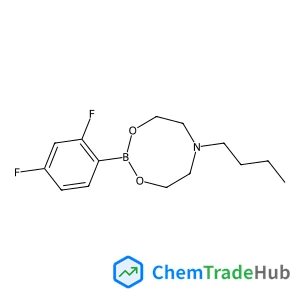
6-Butyl-2-(2,4-difluorophenyl)-1,3,6,2-dioxazaborocane
CAS Number:
1190988-98-7
Molecular Formula:
C14H20BF2NO2

Recommended Suppliers





Disclaimer
This page provides academic journal information for reference and research purposes only. We are not affiliated with any journal publishers and do not handle publication submissions. For publication-related inquiries, please contact the respective journal publishers directly.
If you notice any inaccuracies in the information displayed, please contact us at support@chemtradehub.com. We will promptly review and address your concerns.