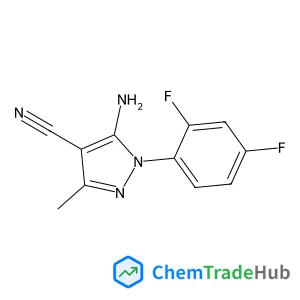
5-Amino-1-(2,4-difluorophenyl)-3-methyl-1H-pyrazole-4-carbonitrile
CAS Number:
1020057-92-4
Molecular Formula:
C11H8F2N4
Jeongho Kim, Jae Hyuk Lee, Daniel Grolimund, Thomas J. Penfold, Steven L. Johnson, Andreas Galler, Jiwon Moon, Joonghan Kim, Kiryong Hong, Laurent Guérin, Tae Kyu Kim, Michael Wulff, Christian Bressler
Identifying the intermediate species along a reaction pathway is a first step towards a complete understanding of the reaction mechanism, but often this task is not trivial. There has been a strong on-going debate: which of the three intermediates, the CHI2 radical, the CHI2–I isomer, and the CHI2+ ion, is the dominant intermediate species formed in the photolysis of iodoform (CHI3)? Herein, by combining time-resolved X-ray liquidography (TRXL) and time-resolved X-ray absorption spectroscopy (TR-XAS), we present strong evidence that the CHI2 radical is dominantly formed from the photolysis of CHI3 in methanol at 267 nm within the available time resolution of the techniques (∼20 ps for TRXL and ∼100 ps for TR-XAS). The TRXL measurement, conducted using the time-slicing scheme, detected no CHI2–I isomer within our signal-to-noise ratio, indicating that, if formed, the CHI2–I isomer must be a minor intermediate. The TR-XAS transient spectra measured at the iodine L1 and L3 edges support the same conclusion. The present work demonstrates that the application of these two complementary time-resolved X-ray methods to the same system can provide a detailed understanding of the reaction mechanism.
Magdalena Stobiecka, Maria Hepel
DOI: 10.1039/C0CP00553C
Marion Jasnin, Lambert van Eijck, Michael Marek Koza, Cédric Laguri, Hugues Lortat-Jacob
DOI: 10.1039/B923878F
Françoise Delbecq, Yosslen Aray, Philippe Sautet
DOI: 10.1039/C0CP00858C
Feng Liu, Caroline Maynard, Gregory Scott, Artem Melnykov, Kathleen B. Hall
DOI: 10.1039/B925033F
Hui Zhu, Martine Blom, Isabel Compagnon, Anouk M. Rijs, Santanu Roy, Gert von Helden, Burkhard Schmidt
DOI: 10.1039/B926413B
DOI: 10.1039/C0CP00726A
Maxim V. Fedorov, Jonathan M. Goodman, Dmitry Nerukh, Stephan Schumm
DOI: 10.1039/C0CP01705A
Carlos A. Silvera-Batista, Randy K. Wang, Philip Weinberg
DOI: 10.1039/B927053A
1-(2,4,6-Trifluorophenyl)ethanol is an organic compound with the CAS number 1250...
1-(2,4-Dimethoxybenzyl)-4-(hydroxymethyl)-2-pyrrolidinone (CAS: 919111-34-5) is ...
(7S,15R)-6β,15-Diacetoxy-7α,20-epoxy-7-hydroxykaura-2,16-dien-1-one is a crystal...
The compound rac-ethyl (1r,4r)-4-hydroxycyclohexane-1-carboxylate, trans (CAS: 3...
The market for 2-(2,4-Difluorophenoxy)-3-nitropyridine (CAS: 175135-62-3) is cur...
The main uses of 6-Diazo-5-oxo-L-norleucine (CAS: 157-03-9) include research in ...
When handling 2-Aminoethyl-mono-amide-DOTA-tris(tBu ester) (CAS: 173308-19-5), i...
5-Methylimidazo[1,2-a]pyridine-3-carbaldehyde (CAS: 178488-37-4) can be synthesi...
There are alternative reagents that can be used in the synthesis of 2,4,6-Trihyd...
(2Z)-3-(5-Fluoro-1H-indol-3-yl)-2-sulfanylacrylic acid is a chemical compound wi...

Physical Chemistry Chemical Physics (PCCP) is an international journal co-owned by 19 physical chemistry and physics societies from around the world. This journal publishes original, cutting-edge research in physical chemistry, chemical physics and biophysical chemistry. To be suitable for publication in PCCP, articles must include significant innovation and/or insight into physical chemistry; this is the most important criterion that reviewers and Editors will judge against when evaluating submissions. The journal has a broad scope and welcomes contributions spanning experiment, theory, computation and data science. Topical coverage includes spectroscopy, dynamics, kinetics, statistical mechanics, thermodynamics, electrochemistry, catalysis, surface science, quantum mechanics, quantum computing and machine learning. Interdisciplinary research areas such as polymers and soft matter, materials, nanoscience, energy, surfaces/interfaces, and biophysical chemistry are welcomed if they demonstrate significant innovation and/or insight into physical chemistry. Joined experimental/theoretical studies are particularly appreciated when complementary and based on up-to-date approaches.