












Tip-enhanced Raman spectroscopy of bradykinin and its B2 receptor antagonists adsorbed onto colloidal suspended Ag nanowires
Literature Information
Publication Date
2015-08-05
DOI
10.1039/C5CP03438H
Impact Factor
3.676
Authors
D. Święch, I. Tanabe, S. Vantasin, D. Sobolewski, Y. Ozaki, A. Prahl, E. Proniewicz
View Original
Abstract
The tip-enhanced Raman scattering (TERS) spectra of bradykinin (BK) and its potent B2 BK receptor antagonists, [D-Arg0,Hyp3,Thi5,8,L-Pip7]BK and [D-Arg0,Hyp3,Thi5,D-Phe7,L-Pip8]BK, approximately with a size of about 40 nm, adsorbed onto colloidal suspended Ag nanowires with diameter in the range of 350–500 nm and length of 2–50 μm were recorded. The metal surface plasmon resonance and morphology of the Ag nanowires were studied by ultraviolet-visible (UV-Vis) spectroscopy and scanning electron microscopy (SEM). Briefly, it was shown that two C-terminal amino acids of BK and [D-Arg0,Hyp3,Thi5,8,L-Pip7]BK are involved in the interaction with the colloidal suspended Ag nanowire surface, whereas three last amino acids of the [D-Arg0,Hyp3,Thi5,D-Phe7,L-Pip8]BK sequence attached the Ag surface. Thus, BK adsorbs on the colloidal suspended Ag nanowires mainly through the Phe5/8 ring (tilted orientation) and the one oxygen atom of the carboxylate group and the H2N–C–NH–CH2– fragment of Arg9. In the case of [D-Arg0,Hyp3,Thi5,8,L-Pip7]BK, the Thi8 ring (through the lone electron pair on the sulfur atom) and the both oxygen atoms of the carboxylate group and the amine group of Arg9 mainly participated in the interaction with the Ag nanowire surface. For [D-Arg0,Hyp3,Thi5,D-Phe7,L-Pip8]BK, the D-Phe7 ring, the Pip8 ring, and the Arg9 side-chain assisted in the peptide interaction with the Ag surface. The obtained results emphasize the importance of the C-terminal part of these peptides in the adsorption process onto the colloidal suspended Ag nanowires.
Related Literature
Aggregation induced emission enhancement of 4,4′-bis(diethylamino)benzophenone with an exceptionally large blue shift and its potential use as glucose sensor
Prativa Mazumdar, Debasish Das, Gobinda Prasad Sahoo, Guillermo Salgado-Morán, Ajay Misra
2014-11-26
Paper
DOI: 10.1039/C4CP03772C
Fundamental frequency from classical molecular dynamics
Tomonori Yamada, Misako Aida
2014-12-03
Paper
DOI: 10.1039/C4CP04068F
The effect of sugar stereochemistry on protein self-assembly: the case of β-casein micellization in different aldohexose solutions
Ofer Setter
2014-12-16
Paper
DOI: 10.1039/C4CP03686G
A mechanistic study of hydrogen gas sensing by PdO nanoflake thin films at temperatures below 250 °C
Yu-Ju Chiang, Kuang-Chung Li, Yi-Chieh Lin, Fu-Ming Pan
2014-12-09
Paper
DOI: 10.1039/C4CP04527K
A practical guide to using boron doped diamond in electrochemical research
2014-12-18
Perspective
DOI: 10.1039/C4CP04022H
Galvanic deposition of Rh and Ru on randomly structured Ti felts for the electrochemical NH3 synthesis
Kurt Kugler, Mareike Luhn, Jean André Schramm, Khosrow Rahimi
2014-12-16
Paper
DOI: 10.1039/C4CP05501B
Pressure-induced phase transition of BiOF: novel two-dimensional layered structures
Dawei Zhou, Chunying Pu, Chaozheng He, Cheng Lu, Gang Bao
2015-01-06
Paper
DOI: 10.1039/C4CP05142D
Performance improvement of multilayer InSe transistors with optimized metal contacts
Xin Zhou, Wei Quan Tian, PingAn Hu
2014-12-11
Paper
DOI: 10.1039/C4CP04968C
Probing a chemical compass: novel variants of low-frequency reaction yield detected magnetic resonance
Kiminori Maeda, Jonathan G. Storey, Paul A. Liddell, Devens Gust, P. J. Hore, C. J. Wedge, Christiane R. Timmel
2014-12-24
Paper
DOI: 10.1039/C4CP04095C
The adsorption of a mixture of particles with non-additive interactions: a Monte Carlo study
O. A. Pinto, P. M. Pasinetti, A. J. Ramirez-Pastor, F. D. Nieto
2014-12-16
Paper
DOI: 10.1039/C4CP04428B
You might also like
Compound Q&A
What precautions should be taken when handling 4-(2-Furylmethyl)thiomorpholine 1,1-dioxide (CAS: 79206-94-3)?
When handling 4-(2-Furylmethyl)thiomorpholine 1,1-dioxide (CAS: 79206-94-3), it ...
79206-94-34-(2-Furylmethyl)thi...
Compound Q&A
What precautions should be taken when handling 4-Chloro-N-[2-(4-morpholinyl)ethyl]benzamide (CAS: 71320-77-9)?
When handling 4-Chloro-N-[2-(4-morpholinyl)ethyl]benzamide (CAS: 71320-77-9), it...
71320-77-94-Chloro-N-[2-(4-mor...
Compound Q&A
How should waste containing 2-[2-(2-Methoxyethoxy)ethoxy]ethyl 4-methylbenzenesulfonate (CAS: 62921-74-8) be handled?
Waste containing this compound (CAS: 62921-74-8) should be handled according to ...
62921-74-82-[2-(2-Methoxyethox...
Compound Q&A
How should waste containing (S)-Methyl 2-amino-3-cyclohexylpropanoate be handled?
Waste containing (S)-Methyl 2-amino-3-cyclohexylpropanoate should be collected i...
40056-18-6(S)-Methyl 2-amino-3...
Compound Q&A
How is 5-({4-[(2S,4R)-4-Hydroxy-2-methyltetrahydro-2H-pyran-4-yl]-2-thienyl}sulfanyl)-1-methyl-1,3-dihydro-2H-indol-2-one (CAS: 166882-70-8) typically synthesized?
This compound can be synthesized using a multi-step process involving the conjug...
166882-70-85-({4-[(2S,4R)-4-Hyd...
Compound Q&A
Are there alternatives to (2E)-3-(3,4-Dichlorophenyl)acrylic acid (CAS: 7312-27-8) in synthesis?
There are several alternatives to (2E)-3-(3,4-Dichlorophenyl)acrylic acid in syn...
7312-27-8(2E)-3-(3,4-Dichloro...
Compound Q&A
How should Ethyl 6-(2-nitrophenyl)imidazo[2,1-b][1,3]thiazole-3-carboxylate (CAS: 925437-84-9) be stored?
Ethyl 6-(2-nitrophenyl)imidazo[2,1-b][1,3]thiazole-3-carboxylate (CAS: 925437-84...
925437-84-9Ethyl 6-(2-nitrophen...
Compound Q&A
How should waste containing 2-(1,3-Thiazol-2-yl)ethanamine (CAS: 18453-07-1) be handled?
Waste containing 2-(1,3-Thiazol-2-yl)ethanamine (CAS: 18453-07-1) should be coll...
18453-07-12-(1,3-Thiazol-2-yl)...
Compound Q&A
How is Methyl 5-iodo-2-methylbenzoate (CAS: 103440-54-6) typically synthesized?
Methyl 5-iodo-2-methylbenzoate can be synthesized through the iodination of meth...
103440-54-6Methyl 5-iodo-2-meth...
Compound Q&A
How is 5-Chloro[1,2,4]triazolo[1,5-a]pyridine (CAS: 1427399-34-5) typically synthesized?
5-Chloro[1,2,4]triazolo[1,5-a]pyridine is commonly synthesized via the condensat...
1427399-34-55-Chloro[1,2,4]triaz...
Source Journal
Physical Chemistry Chemical Physics

CiteScore:
5.5
Self-citation Rate:
10.3%
Articles per Year:
3036
Physical Chemistry Chemical Physics (PCCP) is an international journal co-owned by 19 physical chemistry and physics societies from around the world. This journal publishes original, cutting-edge research in physical chemistry, chemical physics and biophysical chemistry. To be suitable for publication in PCCP, articles must include significant innovation and/or insight into physical chemistry; this is the most important criterion that reviewers and Editors will judge against when evaluating submissions. The journal has a broad scope and welcomes contributions spanning experiment, theory, computation and data science. Topical coverage includes spectroscopy, dynamics, kinetics, statistical mechanics, thermodynamics, electrochemistry, catalysis, surface science, quantum mechanics, quantum computing and machine learning. Interdisciplinary research areas such as polymers and soft matter, materials, nanoscience, energy, surfaces/interfaces, and biophysical chemistry are welcomed if they demonstrate significant innovation and/or insight into physical chemistry. Joined experimental/theoretical studies are particularly appreciated when complementary and based on up-to-date approaches.
Recommended Compounds

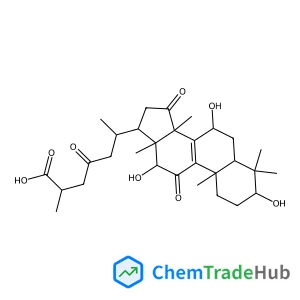
(3beta,7beta,12beta)-3,7,12-Trihydroxy-11,15,23-trioxolanost-8-en-26-oic acid
CAS Number:
98665-22-6
Molecular Formula:
C30H44O8
Recommended Suppliers




Disclaimer
This page provides academic journal information for reference and research purposes only. We are not affiliated with any journal publishers and do not handle publication submissions. For publication-related inquiries, please contact the respective journal publishers directly.
If you notice any inaccuracies in the information displayed, please contact us at support@chemtradehub.com. We will promptly review and address your concerns.