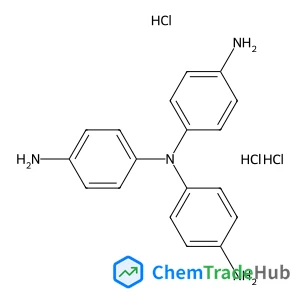
N1,N1-Bis(4-aminophenyl)benzene-1,4-diamine trihydrochloride
CAS Number:
114254-48-7
Molecular Formula:
C18H21Cl3N4
Chaoyuan Zhu
Based on a newly developed algorithm to compute global nonadiabatic switching probability by using only electronic adiabatic potential energy surfaces and gradients, we performed on-the-fly, trajectory-surface hopping simulations at the 5SA-CASSCF(6,6)/6-31G quantum level to probe the π → π* photoisomerization mechanism of the azobenzene within four singlet low-lying electronic states (S0, S1, S2, and S3) coupled with a complicated conical intersection network. We found that four conical intersections between the S1 and S2 states (one is near the cis-isomer region, another near the trans-isomer region, and two others between cis and trans) play the most important roles for understanding the photoisomerization mechanism of azobenzene upon S2 and S3 ππ* excitation. We studied six cases to demonstrate the photoisomerization mechanism in detail by choosing eight (six) typical reactive (nonreactive) trajectories, namely, two-step fast–fast processes having lifetimes of several tenths to one hundred femtoseconds and two-step, fast–slow and slow–slow processes having lifetimes of several hundred to one thousand femtoseconds. We found for the first time from simulation that once a trajectory visits the conical intersection near the trans-isomer after ππ* excitation, it could rapidly go through the inversion pathway to trans-azobenzene, and confirms the most recent experimental observations. We performed 536 sampling trajectories (336 from S2 and 200 from S3), initially starting from the Franck–Condon region of cis-azobenzene, and obtained a total reactive quantum yield of 0.3–0.45 in very good agreement with recent experimental results of 0.24–0.50. Moreover, the current method can estimate overall nonadiabatic transition probability for each sampling trajectory from beginning to end. This can greatly accelerate convergence of nonadiabatic molecular dynamic simulation, and, for instance, results in a quantum yield of 0.53 estimated from only eight typical reactive trajectories.

Nature Reviews Drug Discovery

Coloration Technology

European Journal of Organic Chemistry

Mini-Reviews in Medicinal Chemistry

Journal of Enzyme inhibition and Medicinal Chemistry

Foundations of Chemistry

Photochemical & Photobiological Sciences

Current Pharmaceutical Biotechnology

Journal of Medical Biochemistry

CrystEngComm
Vsevolod Dubovik, Anna Dalinova, Alexander Berestetskiy
DOI: 10.1039/D3NP00013C
Dunren He, Wanyi Nie, Huihui Huang
DOI: 10.1039/D3TA06080B
Hongde Zhu, Junlan Liang, Sanlong Wang
DOI: 10.1039/D3TA04690G
Balamurugan Selvaraj, Balaji Sambandam, Sungjin Kim, Vinod Mathew, Sehong Seo, Moonsu Song, Jaekook Kim
DOI: 10.1039/D3TA03912A
Munazza Munshi, Tanzila Khan, Madhuri Bhakare, Ankita Kadam, Surajit Some
DOI: 10.1039/D3NJ05351B
Christina Braun, Lukas Martin Wingen, Dirk Menche
DOI: 10.1039/D3NP00018D
Yansheng Liu, Xiaobo Jia, Jin Zhou, Hongli Li, Xiaohong Wang, Yating Chen, Zhenle Qin, Zhichen Jin, Guofu Wang
DOI: 10.1039/D3NJ05083A
Mincai Zhao, Junjie Fu, Daoping Cai, Chaoqi Zhang, Yinggan Zhang, Baisheng Sa, Qidi Chen, Hongbing Zhan
DOI: 10.1039/D3TA04930B
Waste containing N-Methoxy-N-methyl-1,3-thiazole-5-carboxamide (CAS: 898825-89-3...
N-(4-Biphenylyl)dibenzo[b,d]furan-4-amine should be stored in a tightly sealed c...
The market for 3-Acetamido-5-amino-2,4,6-triiodobenzoic acid (CAS: 1713-07-1) is...
Benzyl 2-O-acetyl-3,4,6-tri-O-benzyl-beta-D-galactopyranoside (CAS: 61820-03-9) ...
2-Ethylpiperazine dihydrochloride (CAS: 438050-52-3) is regulated under the Glob...
1,1'-[1,3-Phenylenebis(methylene)]bis(3-methyl-1H-pyrrole-2,5-dione) (CAS: 11946...
Several alternatives can be used in the synthesis of 5-Fluoro-2-(1-pyrrolidinyl)...
Proper personal protective equipment (PPE) must be worn when handling this compo...
When handling 6-Bromoimidazo[1,2-a]pyridin-8-amine, it is important to wear appr...
Alternatives to (2S,4R)-4-(4-Nitrobenzyl)pyrrolidine-2-carboxylic acid hydrochlo...

Physical Chemistry Chemical Physics (PCCP) is an international journal co-owned by 19 physical chemistry and physics societies from around the world. This journal publishes original, cutting-edge research in physical chemistry, chemical physics and biophysical chemistry. To be suitable for publication in PCCP, articles must include significant innovation and/or insight into physical chemistry; this is the most important criterion that reviewers and Editors will judge against when evaluating submissions. The journal has a broad scope and welcomes contributions spanning experiment, theory, computation and data science. Topical coverage includes spectroscopy, dynamics, kinetics, statistical mechanics, thermodynamics, electrochemistry, catalysis, surface science, quantum mechanics, quantum computing and machine learning. Interdisciplinary research areas such as polymers and soft matter, materials, nanoscience, energy, surfaces/interfaces, and biophysical chemistry are welcomed if they demonstrate significant innovation and/or insight into physical chemistry. Joined experimental/theoretical studies are particularly appreciated when complementary and based on up-to-date approaches.
![[(5-Methyl-1,3,4-thiadiazol-2-yl)sulfanyl]acetic acid structure](https://static.chemtradehub.com/structs/509/50918-26-8-4ce8.webp "[(5-Methyl-1,3,4-thiadiazol-2-yl)sulfanyl]acetic acid structure")
![[5-fluoro-2-(morpholine-4-carbonyl)phenyl]boronic acid structure](https://static.chemtradehub.com/structs/121/1217501-26-2-505c.webp "[5-fluoro-2-(morpholine-4-carbonyl)phenyl]boronic acid structure")