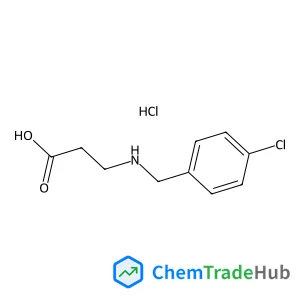
N-(4-Chlorobenzyl)-beta-alanine hydrochloride (1:1)
CAS Number:
1172479-10-5
Molecular Formula:
C10H13Cl2NO2
Laszlo Jicsinszky, Katia Martina, Marina Caporaso, Pedro Cintas, Andrea Zanichelli, Giancarlo Cravotto
This paper describes the interaction between aromatic esters and peracetylated cyclodextrins (CDs) studied by NMR spectroscopy in deuterochloroform (CDCl3). The observed chemical shift changes highlight the existence of interactions between an aromatic alkyl ester, water and peracetylated CDs. In some cases, substituent chemical shift determination was influenced by the low water content of CDCl3 and/or the host molecule. Higher CD concentrations resulted in water signal drifts in all studied cases. It was not possible to obtain a completely dry sample of peracetyl γCD: ∼1 mol of water remained and the water signal showed reversed movement, with respect to the other two CD analogues, upon increasing host concentration. The estimated 1 : 1 stability constants for the water : peracetyl CD complexes are in the 50–150 M−1 range in CDCl3, but show a relatively large calculation error. The calculated 1 : 1 stability constants for the peracetyl CD : ester complexes are also in this range, but 1 : 2 and 2 : 1 complex compositions are also possible. Overall, our results highlight dynamic aspects of water nanoconfined in a highly hydrophobic environment, thus mimicking biological recognition where a few water molecules often play a pivotal role.
Yi-Rong Liu, Yan Jiang
DOI: 10.1039/D3CP04702D
Srinivas Pattipaka, Tae Wan Park, Young Min Bae, Yujin Na, Kyeongwoon Chung, Kwi-Il Park, Jungho Ryu, Woon Ik Park, Geon-Tae Hwang
DOI: 10.1039/D3SE01206A
Chengyong Zhong, Shuo Li
DOI: 10.1039/D3CP05005J
Alessandro Grottesi
DOI: 10.1039/D3CP05530B
Naixia Lv, Hongshun Ran, Jinrui Zhang, Jie Yin, Yuan Zhang, Hongping Li, Linhua Zhu
DOI: 10.1039/D3CP04963A
Sergey S. Nikitin, Alexander D. Koryakov, Elizaveta A. Antipinskaya, Mikhail V. Patrakeev
DOI: 10.1039/D3CP05421G
Akira Yamaguchi, Tomoki Kujirai, Takeshi Fujita, Hideki Abe, Masahiro Miyauchi
DOI: 10.1039/D3SE01346D
Nivedita Dutta, Joanna Sarzynska, Indrajit Deb, Ansuman Lahiri
DOI: 10.1039/D3CP02442C
Sitong Liu, Bo Liu, Meidong Yu, Hanyu Gao, Haipeng Guo, Daguo Jiang, Shenbo Yang, Yufeng Wen, Yabei Wu
DOI: 10.1039/D3CP04721K
Waste containing N-Methoxy-N-methyl-1,3-thiazole-5-carboxamide (CAS: 898825-89-3...
N-(4-Biphenylyl)dibenzo[b,d]furan-4-amine should be stored in a tightly sealed c...
The market for 3-Acetamido-5-amino-2,4,6-triiodobenzoic acid (CAS: 1713-07-1) is...
Benzyl 2-O-acetyl-3,4,6-tri-O-benzyl-beta-D-galactopyranoside (CAS: 61820-03-9) ...
2-Ethylpiperazine dihydrochloride (CAS: 438050-52-3) is regulated under the Glob...
1,1'-[1,3-Phenylenebis(methylene)]bis(3-methyl-1H-pyrrole-2,5-dione) (CAS: 11946...
Several alternatives can be used in the synthesis of 5-Fluoro-2-(1-pyrrolidinyl)...
Proper personal protective equipment (PPE) must be worn when handling this compo...
When handling 6-Bromoimidazo[1,2-a]pyridin-8-amine, it is important to wear appr...
Alternatives to (2S,4R)-4-(4-Nitrobenzyl)pyrrolidine-2-carboxylic acid hydrochlo...

Physical Chemistry Chemical Physics (PCCP) is an international journal co-owned by 19 physical chemistry and physics societies from around the world. This journal publishes original, cutting-edge research in physical chemistry, chemical physics and biophysical chemistry. To be suitable for publication in PCCP, articles must include significant innovation and/or insight into physical chemistry; this is the most important criterion that reviewers and Editors will judge against when evaluating submissions. The journal has a broad scope and welcomes contributions spanning experiment, theory, computation and data science. Topical coverage includes spectroscopy, dynamics, kinetics, statistical mechanics, thermodynamics, electrochemistry, catalysis, surface science, quantum mechanics, quantum computing and machine learning. Interdisciplinary research areas such as polymers and soft matter, materials, nanoscience, energy, surfaces/interfaces, and biophysical chemistry are welcomed if they demonstrate significant innovation and/or insight into physical chemistry. Joined experimental/theoretical studies are particularly appreciated when complementary and based on up-to-date approaches.
![4-Chloro-2-{[(2-chlorophenoxy)acetyl]amino}benzoic acid structure](https://static.chemtradehub.com/structs/351/351424-20-9-9467.webp "4-Chloro-2-{[(2-chlorophenoxy)acetyl]amino}benzoic acid structure")

![2-Methylbenzo[h]quinoline structure](https://static.chemtradehub.com/structs/605/605-88-9-ac43.webp "2-Methylbenzo[h]quinoline structure")