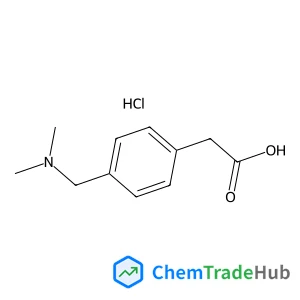
4-(Dimethylaminomethyl)phenylacetic acid hydrochloride
CAS Number:
99985-52-1
Molecular Formula:
C11H16ClNO2
Tran B. Nguyen, Kelvin H. Bates, John D. Crounse, Rebecca H. Schwantes, Xuan Zhang, Henrik G. Kjaergaard, Jason D. Surratt, Peng Lin, Alexander Laskin
Methacryloyl peroxynitrate (MPAN), the acyl peroxynitrate of methacrolein, has been suggested to be an important secondary organic aerosol (SOA) precursor from isoprene oxidation. Yet, the mechanism by which MPAN produces SOA through reaction with the hydroxyl radical (OH) is unclear. We systematically evaluate three proposed mechanisms in controlled chamber experiments and provide the first experimental support for the theoretically-predicted lactone formation pathway from the MPAN + OH reaction, producing hydroxymethyl-methyl-α-lactone (HMML). The decomposition of the MPAN–OH adduct yields HMML + NO3 (∼75%) and hydroxyacetone + CO + NO3 (∼25%), out-competing its reaction with atmospheric oxygen. The production of other proposed SOA precursors, e.g., methacrylic acid epoxide (MAE), from MPAN and methacrolein are negligible (<2%). Furthermore, we show that the beta-alkenyl moiety of MPAN is critical for lactone formation. Alkyl radicals formed cold via H-abstraction by OH do not decompose to HMML, even if they are structurally identical to the MPAN–OH adduct. The SOA formation from HMML, from polyaddition of the lactone to organic compounds at the particle interface or in the condensed phase, is close to unity under dry conditions. However, the SOA yield is sensitive to particle liquid water and solvated ions. In hydrated inorganic particles, HMML reacts primarily with H2O to produce the monomeric 2-methylglyceric acid (2MGA) or with aqueous sulfate and nitrate to produce the associated organosulfate and organonitrate, respectively. 2MGA, a tracer for isoprene SOA, is semivolatile and its accommodation in aerosol water decreases with decreasing pH. Conditions that enhance the production of neutral 2MGA suppress SOA mass from the HMML channel. Considering the liquid water content and pH ranges of ambient particles, 2MGA will exist largely as a gaseous compound in some parts of the atmosphere.
Yue Lou
DOI: 10.1039/D3CP04958B
Qian Wang, Yu Zhuang, Abuduwayiti Aierken, Qiaogang Song, Qin Zhang, Youbo Dou, Qiuli Zhang, Shuyi Zhang
DOI: 10.1039/D3CP05309A
Vikki Anand Varma, Simmie Jaglan, Mohd Yasir Khan, Sujin B. Babu
DOI: 10.1039/D3CP03681B
Meixin Cheng
DOI: 10.1039/D3CP04975B
Qifeng Mu, Jian Hu
DOI: 10.1039/D3CP04160C
Siqi Wang, Mingmin Zhong, Haibo Liu, Meng Ju
DOI: 10.1039/D3CP03678B
Ekaterina A. Konopkina, Alexander V. Gopin, Anton S. Pozdeev, Maria G. Chernysheva, Paulina Kalle, Elizaveta A. Pavlova, Stepan N. Kalmykov, Vladimir G. Petrov, Nataliya E. Borisova, Alexander A. Guda, Petr I. Matveev
DOI: 10.1039/D3CP05081E
Yu Qiu, Yanxin Yang, Enkang Fu, Rui Xiao
DOI: 10.1039/D3SE01168B
Akira Yamaguchi, Tomoki Kujirai, Takeshi Fujita, Hideki Abe, Masahiro Miyauchi
DOI: 10.1039/D3SE01346D
Waste containing N-Methoxy-N-methyl-1,3-thiazole-5-carboxamide (CAS: 898825-89-3...
N-(4-Biphenylyl)dibenzo[b,d]furan-4-amine should be stored in a tightly sealed c...
The market for 3-Acetamido-5-amino-2,4,6-triiodobenzoic acid (CAS: 1713-07-1) is...
Benzyl 2-O-acetyl-3,4,6-tri-O-benzyl-beta-D-galactopyranoside (CAS: 61820-03-9) ...
2-Ethylpiperazine dihydrochloride (CAS: 438050-52-3) is regulated under the Glob...
1,1'-[1,3-Phenylenebis(methylene)]bis(3-methyl-1H-pyrrole-2,5-dione) (CAS: 11946...
Several alternatives can be used in the synthesis of 5-Fluoro-2-(1-pyrrolidinyl)...
Proper personal protective equipment (PPE) must be worn when handling this compo...
When handling 6-Bromoimidazo[1,2-a]pyridin-8-amine, it is important to wear appr...
Alternatives to (2S,4R)-4-(4-Nitrobenzyl)pyrrolidine-2-carboxylic acid hydrochlo...

Physical Chemistry Chemical Physics (PCCP) is an international journal co-owned by 19 physical chemistry and physics societies from around the world. This journal publishes original, cutting-edge research in physical chemistry, chemical physics and biophysical chemistry. To be suitable for publication in PCCP, articles must include significant innovation and/or insight into physical chemistry; this is the most important criterion that reviewers and Editors will judge against when evaluating submissions. The journal has a broad scope and welcomes contributions spanning experiment, theory, computation and data science. Topical coverage includes spectroscopy, dynamics, kinetics, statistical mechanics, thermodynamics, electrochemistry, catalysis, surface science, quantum mechanics, quantum computing and machine learning. Interdisciplinary research areas such as polymers and soft matter, materials, nanoscience, energy, surfaces/interfaces, and biophysical chemistry are welcomed if they demonstrate significant innovation and/or insight into physical chemistry. Joined experimental/theoretical studies are particularly appreciated when complementary and based on up-to-date approaches.
![4-[(2-{2-[2-(2-Aminoethoxy)ethoxy]ethoxy}ethyl)amino]-2-(2,6-dioxo-3-piperidinyl)-1H-isoindole-1,3(2H)-dione structure](https://static.chemtradehub.com/structs/209/2093416-31-8-3162.webp "4-[(2-{2-[2-(2-Aminoethoxy)ethoxy]ethoxy}ethyl)amino]-2-(2,6-dioxo-3-piperidinyl)-1H-isoindole-1,3(2H)-dione structure")