












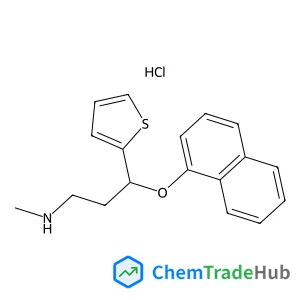
N-Methyl-3-(1-naphthyloxy)-3-(2-thienyl)-1-propanamine hydrochloride (1:1)
CAS Number:
1188266-11-6
Molecular Formula:
C18H20ClNOS
William P. Bricker, Cynthia Lo, Elodie Jouin, Alexander V. Ruban, Christopher D. P. Duffy
The rapid, photoprotective down-regulation of plant light-harvesting in bright light proceeds via the non-photochemical quenching of chlorophyll excitation energy in the major photosystem II light-harvesting complex LHCII. However, there is currently no consensus regarding the precise mechanism by which excess energy is quenched. Current X-ray structures of this complex correspond to a dissipative conformation and therefore correct microscopic theoretical modelling should capture this property. Despite their accuracy in explaining the steady state spectroscopy of this complex, chlorophyll-only models (those that neglect the energetic role of carotenoids) do not explain the observed fluorescence quenching. To address this gap, we have used a combination of the semi-empirical MNDO-CAS-CI and the Transition Density Cube method to model all chlorophyll–carotenoid energy transfer pathways in the highly quenched LHCII X-ray structure. Our simulations reveal that the inclusion of carotenoids in this microscopic model results in profound excitation quenching, reducing the predicted excitation lifetime of the complex from 4 ns (chlorophyll-only) to 67 ps. The model indicates that energy dissipation proceeds via slow excitation transfer (>20 ps) from chlorophyll to the forbidden S1 excited state of the centrally bound lutein molecules followed by the rapid (∼10 ps) radiationless decay to the ground state, with the latter being assumed from experimental measurements of carotenoid excited state lifetimes. Violaxanthin and neoxanthin do not contribute to this quenching. This work presents the first all-pigment microscopic model of LHCII and the first attempt to capture the dissipative character of the known structure.
DOI: 10.1039/D3CS00753G
Tatsuya Higaki, Jake C. Russell, Daniel W. Paley, Xavier Roy, Rongchao Jin
DOI: 10.1039/D3SC02753H
Alexey A. Festa, Olga A. Storozhenko, Leonid G. Voskressensky
DOI: 10.1039/D3CS00366C
Daniel M. Adrion, Waruni V. Karunaratne, Steven A. Lopez
DOI: 10.1039/D3SC03805J
Govindasamy Sekar, Vysakh Venugopalan Nair, Jieping Zhu
DOI: 10.1039/D3CS00503H
Moritz Thürlemann, Sereina Riniker
DOI: 10.1039/D3SC04317G
Xiuwen Xu
DOI: 10.1039/D3CS00611E
Javier A. Cabeza, Javier F. Reynes, Pablo García-Álvarez, Rubén García-Soriano
DOI: 10.1039/D3SC90211K
Waste containing 6-Chloro-5-(2'-hydroxy-3'-methoxy-4-biphenylyl)-3-(3-methoxyphe...
(3alpha,5alpha)-3-Hydroxypregnane-11,20-dione is primarily used in the pharmaceu...
The market for 4-Amino-6-chloro-2-pyridinecarboxylic acid (CAS: 546141-56-4) is ...
Alternatives to (2-Benzoylethyl)trimethylammonium chloride (CAS: 24472-88-6) in ...
N-[4-Nitro-3-(trifluoromethyl)phenyl]acetamide (CAS: 393-12-4) is generally safe...
Alternative reagents such as other phosphates or similar functional groups can b...
There are alternatives to N,N'-Bis(3-aminopropyl)-1,3-propanediamine (CAS: 4605-...
When handling Aluminium trihexadecanoate, it is important to use appropriate per...
(1,1-Dioxido-3-oxo-1,2-benzothiazol-2(3H)-yl)acetic acid is a chemical compound ...
Several alternatives to 5,5-dimethyloxolan-2-one (CAS: 3123-97-5) can be used in...

Physical Chemistry Chemical Physics (PCCP) is an international journal co-owned by 19 physical chemistry and physics societies from around the world. This journal publishes original, cutting-edge research in physical chemistry, chemical physics and biophysical chemistry. To be suitable for publication in PCCP, articles must include significant innovation and/or insight into physical chemistry; this is the most important criterion that reviewers and Editors will judge against when evaluating submissions. The journal has a broad scope and welcomes contributions spanning experiment, theory, computation and data science. Topical coverage includes spectroscopy, dynamics, kinetics, statistical mechanics, thermodynamics, electrochemistry, catalysis, surface science, quantum mechanics, quantum computing and machine learning. Interdisciplinary research areas such as polymers and soft matter, materials, nanoscience, energy, surfaces/interfaces, and biophysical chemistry are welcomed if they demonstrate significant innovation and/or insight into physical chemistry. Joined experimental/theoretical studies are particularly appreciated when complementary and based on up-to-date approaches.
![5'-Fluoro-[2,3'-biindolinylidene]-2',3-dione structure](https://static.chemtradehub.com/structs/251/251903-00-1-9cb1.webp "5'-Fluoro-[2,3'-biindolinylidene]-2',3-dione structure")



