












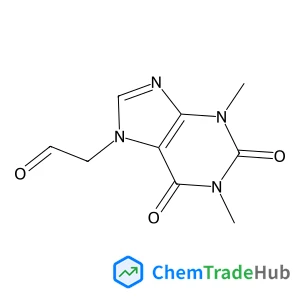
(1,3-Dimethyl-2,6-dioxo-1,2,3,6-tetrahydro-7H-purin-7-yl)acetaldehyde
CAS Number:
5614-53-9
Molecular Formula:
C9H10N4O3
Sini Kuriakose, Biswarup Satpati, Satyabrata Mohapatra
Copper doped ZnO nanostructures have been synthesized by a facile wet chemical method. Structural properties of as-synthesized nanomaterials have been studied by X-ray diffraction (XRD), field emission scanning electron microscopy (FESEM) and transmission electron microscopy (TEM) with energy dispersive X-ray spectroscopy, while UV-visible absorption spectroscopy and Raman spectroscopy have been used to study their optical properties. Sunlight driven photocatalytic degradation of methylene blue (MB) and methyl orange (MO) dyes in water was used to evaluate the photocatalytic activities of Cu doped ZnO nanostructures using UV-visible absorption spectroscopy. The results showed that there is an optimum Cu doping level which leads to the highly enhanced photocatalytic activity of Cu doped ZnO nanostructures, as compared to pure ZnO nanostructures. A mechanism for the enhanced photocatalytic activity of Cu–ZnO nanostructures is tentatively proposed. The enhanced photocatalytic activity of Cu–ZnO nanostructures is attributed to the combined effects of improved separation of photogenerated charge carriers due to optimal Cu doping in ZnO nanostructures and the formation of ZnO–CuO nanoheterojunctions.
Muhieddine S. Safa, Michael C. Jennings, Richard J. Puddephatt
DOI: 10.1039/B822683K
Magdalena A. Skopek, Mohamoud A. Mohamoud, Karl S. Ryder, A. Robert Hillman
DOI: 10.1039/B819084D
Juan Peng, Alejandra Garcia Marcos, Seong-Jun Jeong, Holger Frey, Dong Ha Kim
DOI: 10.1039/B816398G
Feng Zheng, Xingang Zhang, Feng-Ling Qing
DOI: 10.1039/B819289H
José Luis García Ruano, Alejandro Parra, José Alemán, Francisco Yuste, Virginia M. Mastranzo
DOI: 10.1039/B816846F
Xiaolong Wang, Miao Chen, Feng Zhou, Weimin Liu, Qunji Xue
DOI: 10.1039/B818633B
Karolina Kasperkiewicz, Jan-Willem G. Bos, Andrew N. Fitch, Kosmas Prassides, Serena Margadonna
DOI: 10.1039/B815830D
Zhixun Luo, Yi Luo, Jie Li, Kai Liu, Hongbing Fu, Ying Ma, Jiannian Yao
DOI: 10.1039/B819402E
Enbo Wang
DOI: 10.1039/B812573B
When handling 2-Methyl-2-propanyl 5-amino-2-thiophenecarboxylate (CAS: 1498311-5...
5-Bromo-1,2-dichloro-3-fluorobenzene (CAS: 1000572-93-9) is a crystalline solid ...
(2R)-2-Amino-2-(4-bromophenyl)ethanol (CAS: 354153-64-3) should be stored in a c...
Methyl 4-(aminomethyl)tetrahydro-2H-pyran-4-carboxylate hydrochloride (CAS: 3627...
1,4-Dimethyl-1H-pyrazole-5-sulfonyl chloride is primarily used as an intermediat...
Dinaphtho[1,2-b:2',1'-d]furan is generally safe when handled with appropriate pe...
The market for 7-Methyl-7,9-dihydro-1H-purine-2,6,8(3H)-trione (CAS: 612-37-3) i...
2-(4-Chlorophenyl)malonaldehyde (CAS: 205676-17-1) is a colorless or light yello...
2-Methylchrysene (CAS: 3351-32-4) is typically synthesized via the reaction of c...
N-(6-aminopyrimidin-4-yl)acetamide (CAS: 89533-23-3) is generally considered saf...

Physical Chemistry Chemical Physics (PCCP) is an international journal co-owned by 19 physical chemistry and physics societies from around the world. This journal publishes original, cutting-edge research in physical chemistry, chemical physics and biophysical chemistry. To be suitable for publication in PCCP, articles must include significant innovation and/or insight into physical chemistry; this is the most important criterion that reviewers and Editors will judge against when evaluating submissions. The journal has a broad scope and welcomes contributions spanning experiment, theory, computation and data science. Topical coverage includes spectroscopy, dynamics, kinetics, statistical mechanics, thermodynamics, electrochemistry, catalysis, surface science, quantum mechanics, quantum computing and machine learning. Interdisciplinary research areas such as polymers and soft matter, materials, nanoscience, energy, surfaces/interfaces, and biophysical chemistry are welcomed if they demonstrate significant innovation and/or insight into physical chemistry. Joined experimental/theoretical studies are particularly appreciated when complementary and based on up-to-date approaches.



![2,5-Dichloro-1H-pyrrolo[3,2-b]pyridine structure](https://static.chemtradehub.com/structs/100/1000342-87-9-f632.webp "2,5-Dichloro-1H-pyrrolo[3,2-b]pyridine structure")





