












![1H-Imidazo[4,5-c]pyridine-7-carboxylic acid structure](https://static.chemtradehub.com/structs/123/1234616-39-7-1344.webp "1H-Imidazo[4,5-c]pyridine-7-carboxylic acid structure")
Hybrid QTAIM and electrostatic potential-based quantum topology phase diagrams for water clusters
Literature Information
Publication Date
2015-05-18
DOI
10.1039/C5CP01039J
Impact Factor
3.676
Authors
Anmol Kumar, Shridhar R. Gadre, Xiao Chenxia, Xu Tianlv, Steven Robert Kirk, Samantha Jenkins
View Original
Abstract
The topological diversity of sets of isomers of water clusters (W = H2O)n, 7 ≤ n ≤ 10, is analyzed employing the scalar fields of total electronic charge density ρ(r) and the molecular electrostatic potential (MESP). The features uncovered by the MESP are shown to be complementary to those revealed by the theory of atoms in molecules (QTAIM) analysis. The MESP is known to exhibit the electron localizations such as lone pairs that are central to water cluster behavior. Therefore, a ‘hybrid’ QTAIM and MESP quantum topology phase diagram (QTPD) for Wn, 7 ≤ n ≤ 10, is introduced in addition to the QTPD. The ‘spanning’ QTPD with upper and lower bounds is constructed from the solutions of the Poincaré–Hopf relation involving the non-degenerate critical points. The changing subtle balance between the planar and three dimensional character of the growing water clusters Wn, 4 ≤ n ≤ 10, is revealed. Characterization of the structure of the QTPDs, possible with new tools, demonstrated the migration of the position of the global minimum on the spanning QTPD from the lower bound to upper bound as the Wn, 4 ≤ n ≤ 10, cluster grows in size. Differences in the structure of the QTPD are found between the clusters containing even versus odd monomers for Wn, n = 7–10. The energetic stability of the clusters which possess even number of monomers viz. n = 8, 10 is higher than that of the n = 7, 9 clusters due to relatively higher numbers of hydrogen-bond BCPs in the n = 8, 10 clusters, in agreement with energetic results reported in the literature. A ‘hybrid’ QTPD is created from a new chemical relation bHB + l ≥ 2n for Wn that relates the number of hydrogen-bond bond critical points (bHB) with the number of oxygen lone pairs exclusively specified by the negative valued MESP (3,+3) critical points (l). The topologies of the subset bHB + l = 2n for Wn, point the way to the discovery of unknown ‘missing’ lower energy isomers. A discussion of the relative merits and range of applicability of the QTAIM and hybrid-QTPD analyses is included and concludes that the hybrid-QTPD analysis for Wn, is more useful for the association with the energy minima on the potential energy surface.
Related Literature
Charge-induced structural transition between seashell-like B29− and B29+ in 18 π-electron configurations
Hai-Ru Li, Miao Yan, Qiang Chen, Yue-Wen Mu, Hai-Gang Lu, Yan-Bo Wu, Si-Dian Li
2018-05-02
Paper
DOI: 10.1039/C8CP01078A
Anchoring of carboxyl-functionalized porphyrins on MgO, TiO2, and Co3O4 nanoparticles
Fabian Kollhoff, Johannes Schneider, Gao Li, Sami Barkaoui, Wenjie Shen, Thomas Berger, Oliver Diwald
2018-09-11
Paper
DOI: 10.1039/C8CP04873H
Shape transition of water-in-CO2 reverse micelles controlled by the surfactant midpiece
Muhan Wang, Junfeng Wang, Timing Fang, Youguo Yan, Zhiyuan Wang, Jun Zhang
2018-05-19
Paper
DOI: 10.1039/C8CP01844H
Electrocatalytic studies on imidazolium based ionic liquids: defining experimental conditions
Miguel A. Montiel, José Solla-Gullón, Vicente Montiel, Carlos M. Sánchez-Sánchez
2018-06-22
Paper
DOI: 10.1039/C8CP02662A
Reversible DNA compaction induced by partial intercalation of 16-Ph-16 gemini surfactants: evidence of triple helix formation
Elia Grueso, Emilio Roldan, Pilar Perez-Tejeda, Edyta Kuliszewska, Blanca Molero, Lothar Brecker, R. M. Giráldez-Pérez
2018-09-14
Paper
DOI: 10.1039/C8CP02791A
Hydrogen bond network structures of protonated short-chain alcohol clusters
Asuka Fujii, Natsuko Sugawara, Po-Jen Hsu, Takuto Shimamori, Ying-Cheng Li, Toru Hamashima, Jer-Lai Kuo
2018-03-05
Perspective
DOI: 10.1039/C7CP08072G
Thermodynamics and defect chemistry of substitutional and interstitial cation doping in layered α-V2O5
Kit McColl, Ian Johnson, Furio Corà
2018-05-11
Communication
DOI: 10.1039/C8CP02187B
Ion collision-induced chemistry in pure and mixed loosely bound clusters of coronene and C60 molecules
Alicja Domaracka, Rudy Delaunay, Arkadiusz Mika, Michael Gatchell, Henning Zettergren, Henrik Cederquist, Patrick Rousseau, Bernd A. Huber
2018-05-02
Paper
DOI: 10.1039/C8CP01179F
You might also like
Compound Q&A
How should 2-Methylbenzene-1,4-diamine dihydrochloride (CAS: 615-45-2) be stored?
2-Methylbenzene-1,4-diamine dihydrochloride (CAS: 615-45-2) should be stored in ...
615-45-22-Methylbenzene-1,4-...
Compound Q&A
Is (1S,4S)-2,5-Diazabicyclo[2.2.1]heptane dihydrobromide (CAS: 132747-20-7) safe?
(1S,4S)-2,5-Diazabicyclo[2.2.1]heptane dihydrobromide is generally considered sa...
132747-20-7(1S,4S)-2,5-Diazabic...
Compound Q&A
What industries use (6-Chloropyridazin-3-YL)methanamine (CAS: 871826-15-2)?
(6-Chloropyridazin-3-YL)methanamine finds applications in the pharmaceutical ind...
871826-15-2(6-Chloropyridazin-3...
Compound Q&A
What are the main uses of 2-Fluoro-3-methylphenol (CAS: 77772-72-6)?
2-Fluoro-3-methylphenol is primarily used in the synthesis of pharmaceuticals, p...
77772-72-62-Fluoro-3-methylphe...
Compound Q&A
What precautions should be taken when handling 3-Methoxy-4-nitrobenzonitrile (CAS: 177476-75-4)?
When handling 3-Methoxy-4-nitrobenzonitrile, it is important to wear appropriate...
177476-75-43-Methoxy-4-nitroben...
Compound Q&A
What precautions should be taken when handling 1,3-Oxazolo[4,5-b]pyridine-2(3H)-thione (CAS: 211949-57-4)?
When handling 1,3-Oxazolo[4,5-b]pyridine-2(3H)-thione (CAS: 211949-57-4), it is ...
211949-57-4[1,3]Oxazolo[4,5-b]p...
Compound Q&A
What regulatory guidelines apply to 4-Ethynylbenzamide (CAS: 90347-86-7)?
4-Ethynylbenzamide (CAS: 90347-86-7) falls under various regulatory guidelines i...
90347-86-74-Ethynylbenzamide
Compound Q&A
What are the main uses of 3-(2-Ethylphenyl)-2-thioxo-4-imidazolidinone (CAS: 186822-57-1)?
3-(2-Ethylphenyl)-2-thioxo-4-imidazolidinone is primarily used as an intermediat...
186822-57-13-(2-Ethylphenyl)-2-...
Compound Q&A
What is (2-Fluoro-6-methoxyphenyl)acetic acid (CAS: 500912-19-6)?
(2-Fluoro-6-methoxyphenyl)acetic acid, also known as 4-fluoro-3-methoxybenzoic a...
500912-19-6(2-Fluoro-6-methoxyp...
Compound Q&A
What is the market or research trend for 2-[4-(Hydroxymethyl)phenoxy]ethanol (CAS: 102196-18-9)?
Market trends for 2-[4-(Hydroxymethyl)phenoxy]ethanol (CAS: 102196-18-9) indicat...
102196-18-92-[4-(Hydroxymethyl)...
Source Journal
Physical Chemistry Chemical Physics

CiteScore:
5.5
Self-citation Rate:
10.3%
Articles per Year:
3036
Physical Chemistry Chemical Physics (PCCP) is an international journal co-owned by 19 physical chemistry and physics societies from around the world. This journal publishes original, cutting-edge research in physical chemistry, chemical physics and biophysical chemistry. To be suitable for publication in PCCP, articles must include significant innovation and/or insight into physical chemistry; this is the most important criterion that reviewers and Editors will judge against when evaluating submissions. The journal has a broad scope and welcomes contributions spanning experiment, theory, computation and data science. Topical coverage includes spectroscopy, dynamics, kinetics, statistical mechanics, thermodynamics, electrochemistry, catalysis, surface science, quantum mechanics, quantum computing and machine learning. Interdisciplinary research areas such as polymers and soft matter, materials, nanoscience, energy, surfaces/interfaces, and biophysical chemistry are welcomed if they demonstrate significant innovation and/or insight into physical chemistry. Joined experimental/theoretical studies are particularly appreciated when complementary and based on up-to-date approaches.
Recommended Compounds
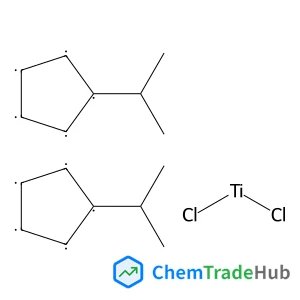
BIS(I-PROPYLCYCLOPENTADIENYL)TITANIUM DICHLORIDE
CAS Number:
12130-65-3
Molecular Formula:
C16H22Cl2Ti

Recommended Suppliers






Disclaimer
This page provides academic journal information for reference and research purposes only. We are not affiliated with any journal publishers and do not handle publication submissions. For publication-related inquiries, please contact the respective journal publishers directly.
If you notice any inaccuracies in the information displayed, please contact us at support@chemtradehub.com. We will promptly review and address your concerns.