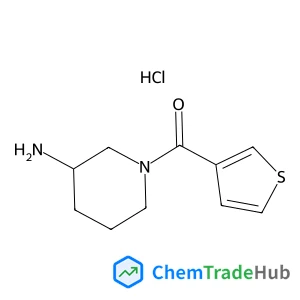
(3-Amino-piperidin-1-yl)-thiophen-3-yl-methanone hydrochloride
CAS Number:
1185316-70-4
Molecular Formula:
C10H15ClN2OS
Sean Doran
In this work, we describe the use of the one-pot, photoinduced but photoinitiator-free combined copper-catalyzed azide–alkyne click cycloaddition (CuAAC) and atom-transfer radical polymerization (ATRP) protocol to provide a graft copolymer of polystyrene-g-poly(methyl methacrylate) (PS-g-PMMA) in desirable conversion and polydispersity. Poly(styrene-co-4-chloromethylstyrene) (poly(S-co-4-CMS)) was prepared using nitroxide mediated polymerization (NMP). The benzylic chloride functional groups of poly(S-co-4-CMS) were substituted for azide functional groups using a conventional azidation procedure to provide poly(styrene-co-4-azidomethylstyrene) (poly(S-co-4-AMS)). Poly(S-co-4-AMS) was then used as the backbone of the graft copolymer. The alkyne-bearing ATRP initiator propargyl 2-bromoisobutyrate (PgBiB) could then be grafted to the backbone via photoinduced CuAAC, while meanwhile initiating in tandem the poly(methyl methacrylate) (PMMA) chain growth via the ATRP mechanism. The graft polymer was provided in good conversion and polydispersity and was characterized appropriately using 1H NMR, FT-IR and GPC.
Mohd Taukeer Khan, Naveen Harindu Hemasiri
DOI: 10.1039/D1SE01398J
Farzaneh Hekmat, Mahdiyeh Shahi
DOI: 10.1039/D1SE00905B
Jian Bao, Xin-Yang Yue, Rui-Jie Luo, Yong-Ning Zhou
DOI: 10.1039/D1SE01263K
Rachael H. Dolan, James E. Anderson, Timothy J. Wallington
DOI: 10.1039/D1SE00979F
Yulia Galagan, Hamid Ez-Zahraouy
DOI: 10.1039/D1SE00687H
Huiping Wu, Libao Chen, Yuejiao Chen
DOI: 10.1039/D1SE01152A
Dena Z. Khater, R. S. Amin, Amani E. Fetohi, K. M. El-Khatib, Mohamed Mahmoud
DOI: 10.1039/D1SE01479J
Nirmal Prashanth Maria Joseph Raj, Abisegapriyan KS, Gaurav Khandelwal, Sang-Jae Kim
DOI: 10.1039/D1SE01139A
Wenxue Guo, Xiujuan Luan, Peng Sun, Tao Wang, Haotian Luo, Xiaotong Li, Chengde Li, Wei Tan, Jingkun Bai, Qiang Wang
DOI: 10.1039/D1SE01225H
DOI: 10.1039/D1SE01400E
When handling 2-Methyl-2-propanyl 5-amino-2-thiophenecarboxylate (CAS: 1498311-5...
5-Bromo-1,2-dichloro-3-fluorobenzene (CAS: 1000572-93-9) is a crystalline solid ...
(2R)-2-Amino-2-(4-bromophenyl)ethanol (CAS: 354153-64-3) should be stored in a c...
Methyl 4-(aminomethyl)tetrahydro-2H-pyran-4-carboxylate hydrochloride (CAS: 3627...
1,4-Dimethyl-1H-pyrazole-5-sulfonyl chloride is primarily used as an intermediat...
Dinaphtho[1,2-b:2',1'-d]furan is generally safe when handled with appropriate pe...
The market for 7-Methyl-7,9-dihydro-1H-purine-2,6,8(3H)-trione (CAS: 612-37-3) i...
2-(4-Chlorophenyl)malonaldehyde (CAS: 205676-17-1) is a colorless or light yello...
2-Methylchrysene (CAS: 3351-32-4) is typically synthesized via the reaction of c...
N-(6-aminopyrimidin-4-yl)acetamide (CAS: 89533-23-3) is generally considered saf...

Polymer Chemistry welcomes submissions in all areas of polymer science that have a strong focus on macromolecular chemistry. Manuscripts may cover a broad range of fields, yet no direct application focus is required.
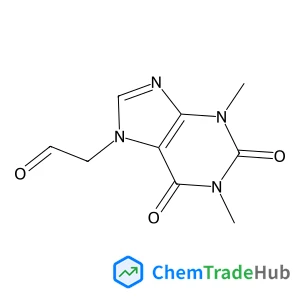
![4-Chloro-N-{[4-(dimethylamino)phenyl]carbamoyl}benzenesulfonamide structure](https://static.chemtradehub.com/structs/558/5581-42-0-7dcb.webp "4-Chloro-N-{[4-(dimethylamino)phenyl]carbamoyl}benzenesulfonamide structure")