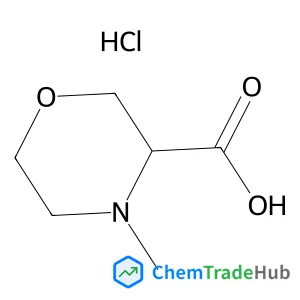
4-Methyl-3-morpholinecarboxylic acid hydrochloride (1:1)
CAS Number:
1240518-90-4
Molecular Formula:
C6H12ClNO3
A well-defined ABC triblock terpolymer, poly(ethylene oxide)-block-poly(furfuryl glycidyl ether)-block-poly(allyl glycidyl ether) (PEO-b-PFGE-b-PAGE), was synthesized via sequential living anionic ring-opening polymerization, and subsequently functionalized by thiol–ene click chemistry. In that way, either a fluorocarbon chain or carboxy groups were introduced into the C segment (PAGE). The self-assembly of the resulting materials in water as selective solvent was studied in detail by asymmetric flow field-flow fractionation (AF4) coupled to multi-angle laser light scattering and dynamic light scattering (DLS). The obtained results were compared with batch DLS and cryogenic transmission electron microscopy (cryo-TEM) results. The influence of the separation conditions on the retention behavior of the triblock terpolymers was evaluated to reveal possible limitations associated with AF4 measurements. The influence of pH value and ionic strength on the solution behavior of the materials, in particular for PEO-b-PFGE-b-PAGECOOH, was investigated as well. Crosslinking of the PAGECOOH by chelating metal ions (Fe3+) was studied under different conditions. In case of PEO-b-PFGE-b-PAGE, spherical micelles of approximately 20 nm (Rh) were observed, whereas the introduction of a fluorocarbon chain led to an increase in size (30 nm, Rh) and the formation of worm-like structures. Carboxy functionalization rendered small (5 nm) disk-like structures. In the latter case, subsequent addition of FeCl3 resulted in the formation of spherical nanostructures ranging from 10 to 60 nm in size, depending on the pH value and the polymer/metal ion ratio.
Shixin Cai, Xin Chen, Haohan Chen, Yuting Zhang, Xiaoli Wang, Nandi Zhou
DOI: 10.1039/D2AN02006H
Neha Jain, Prasad M. Sonawane, Haoyan Liu, Arkaprava Roychaudhury, Youngseob Lee, Jongkeol An, Donghyeon Kim, Dongwook Kim, Yunsu Kim, Yeu-Chun Kim, Kyung-Bin Cho, Hee-Sung Park, Cheol-Hee Kim
DOI: 10.1039/D3AN00646H
Ruhi Desai, Weidong Cui, John J. Harrahy, Alexander R. Ivanov
DOI: 10.1039/D2AN01724E
Zehang Gao
DOI: 10.1039/D3AN00271C
Yongliang Dong, Jiali Zhai, Ziwei Zhang, Can Peng, Yunjing Zhang, Zipin Zhang
DOI: 10.1039/D2AN01859D
Xiaoli Qian, Zhuoyang Wu, Tingting Han, Wanlu Sun, Li Liu, Yi Liu
DOI: 10.1039/D2AN01977A
Rong Deng, Xiaoxin Chao, Haiqin Li, Xiaochun Li, Zehua Yang
DOI: 10.1039/D2AN01571D
Zi-Xuan Wang, Shou-Nian Ding
DOI: 10.1039/D2AN01929A
Shang-Ting Tsai, Hsu-Chen Hsu
DOI: 10.1039/D3AN00068K
Lin Jiang, Hang Yang, Weiqi Cheng, Zhonghua Ni, Nan Xiang
DOI: 10.1039/D2AN01747D
4-Nitrophenyl phosphate disodium salt hexahydrate is primarily used as a substra...
2-(Trifluoromethyl)-1,3-oxazole-4-carboxylic Acid (CAS: 1060816-01-4) is widely ...
2-Fluoro-4-biphenylcarboxylic acid should be stored in a cool, dry place at room...
Prednisolone-21-Carboxylic Acid is primarily used in the pharmaceutical industry...
4-(Hydrazinomethyl)-1,2,3-benzenetriol (CAS: 3614-72-0) should be stored in a co...
4-Amino-1-methyl-1H-pyrazole-5-carboxylic acid hydrochloride (CAS: 92534-70-8) i...
Dehydropachymic acid (CAS: 77012-31-8) is regulated by various agencies. It fall...
The market and research trends for 6-[(2,2-Dimethylpropanoyl)amino]nicotinic aci...
1,10-Phenanthroline-2,9-dicarbaldehyde should be stored in a cool, dry place awa...
5-Carbamoyl-11-oxo-10,11-dihydro-5H-dibenzo[b,f]azepin-10-yl acetate can be synt...

Polymer Chemistry welcomes submissions in all areas of polymer science that have a strong focus on macromolecular chemistry. Manuscripts may cover a broad range of fields, yet no direct application focus is required.