












Interaction of alcohols with the calcite surface
Literature Information
Publication Date
2014-12-23
DOI
10.1039/C4CP05235H
Impact Factor
3.676
Authors
N. Bovet, M. S. Javadi, S. L. S. Stipp
View Original
Abstract
A clearer understanding of calcite interactions with organic molecules would contribute to a range of fields including harnessing the secrets of biomineralisation where organisms produce hard parts, increasing oil production from spent reservoirs, remediating contaminated soils and drinking water aquifers and improving manufacturing methods for industrial products such as pigments, soft abrasives, building materials and optical devices. Biomineralisation by some species of blue green algae produces beautifully elaborate platelets of calcite where the individual crystals are of nanometer scale. Controlling their growth requires complex polysaccharides. Polysaccharide activity depends on the functionality of OH groups, so to simplify the system in order to get closer to a molecular level understanding, we investigated the interaction of OH from a suite of alcohols with clean, freshly cleaved calcite surfaces. X-ray photoelectron spectroscopy (XPS) provided binding energies and revealed the extent of surface coverage. Molecular dynamics (MD) simulations supplemented with information about molecule ordering, orientation and packing density. The results show that all alcohols studied bond with the calcite surface through the OH group, with their carbon chains sticking away in a standing-up orientation. Alcohol molecules are closely packed and form a well-ordered monolayer on the surface.
Related Literature
Mechanistic insight into highly efficient gas permeation and separation in a shape-persistent ladder polymer membrane
Jianhai Zhou, Xiang Zhu, Jun Hu, Honglai Liu, Ying Hu, Jianwen Jiang
2014-02-03
Paper
DOI: 10.1039/C3CP55498H
Diffusional correlations among multiple active sites in a single enzyme
Raymond Kapral
2014-02-24
Paper
DOI: 10.1039/C3CP55252G
Boron doped defective graphene as a potential anode material for Li-ion batteries
Rahul P. Hardikar, Deya Das, Sang Soo Han, Kwang-Ryeol Lee, Abhishek K. Singh
2014-06-27
Paper
DOI: 10.1039/C4CP01412J
Design considerations for enhancing absorption in semiconductors on metals through surface plasmon polaritons
Christopher D. Bohn, Amit Agrawal, Youngmin Lee, Charles J. Choi, Matthew S. Davis, Paul M. Haney, Henri J. Lezec, Veronika A. Szalai
2014-02-07
Paper
DOI: 10.1039/C4CP00017J
Ionic liquid clusters: structure, formation mechanism, and effect on the behavior of ionic liquids
Shimou Chen, Suojiang Zhang, Xiaomin Liu, Jinquan Wang, Jianji Wang, Kun Dong, Jian Sun, Baohua Xu
2013-10-17
Perspective
DOI: 10.1039/C3CP53116C
Visible light induced hydrogen generation using a hollow photocatalyst with two cocatalysts separated on two surface sides
Minh-Hao Pham, Cao-Thang Dinh, Gia-Thanh Vuong, Ngoc-Don Ta, Trong-On Do
2014-01-09
Communication
DOI: 10.1039/C3CP54629B
Diffusive and rotational dynamics of condensed n-H2 confined in MCM-41
T. R. Prisk, M. S. Bryan, P. E. Sokol
2014-07-10
Paper
DOI: 10.1039/C4CP02281E
Diffusion of finite-size particles in two-dimensional channels with random wall configurations
2014-02-06
Paper
DOI: 10.1039/C3CP55160A
You might also like
Compound Q&A
What are the main uses of (5-Sulfamoyl-3-pyridinyl)boronic acid (CAS: 951233-61-7)?
(5-Sulfamoyl-3-pyridinyl)boronic acid is primarily used in chemical synthesis, p...
951233-61-7(5-Sulfamoyl-3-pyrid...
Compound Q&A
How is Benzyl 2-methyl-2-(methylsulfonyl)-4-pentenoate (CAS: 1942858-50-5) typically synthesized?
Benzyl 2-methyl-2-(methylsulfonyl)-4-pentenoate is typically synthesized via est...
1942858-50-5Benzyl 2-methyl-2-(m...
Compound Q&A
What precautions should be taken when handling 8-Fluoroquinolin-6-ol (CAS: 209353-22-0)?
When handling 8-Fluoroquinolin-6-ol (CAS: 209353-22-0), it is important to use p...
209353-22-08-Fluoroquinolin-6-o...
Compound Q&A
What are the physical and chemical properties of 1,3-Dibromo-5-(2-methyl-2-propanyl)benzene (CAS: 129316-09-2)?
1,3-Dibromo-5-(2-methyl-2-propanyl)benzene (CAS: 129316-09-2) is a crystalline c...
129316-09-21,3-Dibromo-5-(2-met...
Compound Q&A
What industries use Ethyl 7-chloro-4-oxo-1-(1,3-thiazol-2-yl)-1,4-dihydro-1,8-naphthyridine-3-carboxylate (CAS: 174726-87-5)?
Ethyl 7-chloro-4-oxo-1-(1,3-thiazol-2-yl)-1,4-dihydro-1,8-naphthyridine-3-carbox...
174726-87-5Ethyl 7-chloro-4-oxo...
Compound Q&A
What precautions should be taken when handling Delta-7-Avenasterol (CAS: 23290-26-8)?
When handling Delta-7-Avenasterol (CAS: 23290-26-8), it is important to wear app...
23290-26-8Delta-7-Avenasterol
Compound Q&A
What precautions should be taken when handling N-({(5R)-3-[3-Fluoro-4-(4-morpholinyl)phenyl]-2-oxo-1,3-oxazolidin-5-yl}methyl)acetamide (CAS: 872992-20-6)?
Proper handling involves the use of personal protective equipment such as gloves...
872992-20-6N-({(5R)-3-[3-Fluoro...
Compound Q&A
What precautions should be taken when handling 2-Methyl-2-proanyl 4-[(2-aminophenyl)amino]-1-piperidinecarboxylate (CAS: 79099-00-6)?
When handling 2-Methyl-2-proanyl 4-[(2-aminophenyl)amino]-1-piperidinecarboxylat...
79099-00-62-Methyl-2-propanyl ...
Compound Q&A
What is N-Methyl-4-chlorobenzylamine hydrochloride (CAS: 65542-24-7)?
N-Methyl-4-chlorobenzylamine hydrochloride (CAS: 65542-24-7) is a organic compou...
65542-24-7N-Methyl-4-chloroben...
Compound Q&A
Is [2-(Dodecyloxy)ethoxy]acetic acid (CAS: 27306-90-7) safe?
[2-(Dodecyloxy)ethoxy]acetic acid (CAS: 27306-90-7) is generally considered safe...
27306-90-7[2-(Dodecyloxy)ethox...
Source Journal
Physical Chemistry Chemical Physics

CiteScore:
5.5
Self-citation Rate:
10.3%
Articles per Year:
3036
Physical Chemistry Chemical Physics (PCCP) is an international journal co-owned by 19 physical chemistry and physics societies from around the world. This journal publishes original, cutting-edge research in physical chemistry, chemical physics and biophysical chemistry. To be suitable for publication in PCCP, articles must include significant innovation and/or insight into physical chemistry; this is the most important criterion that reviewers and Editors will judge against when evaluating submissions. The journal has a broad scope and welcomes contributions spanning experiment, theory, computation and data science. Topical coverage includes spectroscopy, dynamics, kinetics, statistical mechanics, thermodynamics, electrochemistry, catalysis, surface science, quantum mechanics, quantum computing and machine learning. Interdisciplinary research areas such as polymers and soft matter, materials, nanoscience, energy, surfaces/interfaces, and biophysical chemistry are welcomed if they demonstrate significant innovation and/or insight into physical chemistry. Joined experimental/theoretical studies are particularly appreciated when complementary and based on up-to-date approaches.
Recommended Compounds
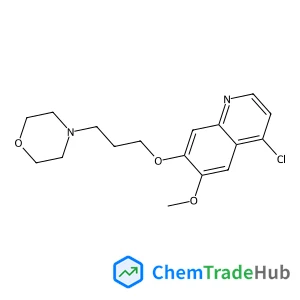
4-(3-((4-Chloro-6-methoxyquinolin-7-yl)oxy)propyl)morpholine
CAS Number:
205448-32-4
Molecular Formula:
C17H21ClN2O3
Recommended Suppliers






Disclaimer
This page provides academic journal information for reference and research purposes only. We are not affiliated with any journal publishers and do not handle publication submissions. For publication-related inquiries, please contact the respective journal publishers directly.
If you notice any inaccuracies in the information displayed, please contact us at support@chemtradehub.com. We will promptly review and address your concerns.