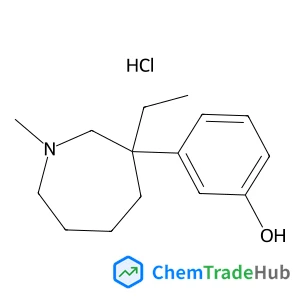
3-(3-Ethyl-1-methyl-3-azepanyl)phenol hydrochloride (1:1)
CAS Number:
59263-76-2
Molecular Formula:
C15H24ClNO
Md. Tamez Uddin, Yohann Nicolas, Céline Olivier, Laurent Servant, Thierry Toupance, Shunyi Li, Andreas Klein, Wolfram Jaegermann
New 2–6 wt% RuO2–ZnO heterojunction nanocatalysts were synthesized by a straightforward two-step procedure. They were composed of a porous network of aggregated 25 nm wurtzite ZnO nanocrystallites modified with RuO2 and showed enhanced light absorption in the visible region due to surface plasmon resonance. In order to investigate the energetic structure of the photocatalyst XPS core line and valence band spectra of in situ in UHV prepared heterointerfaces were compared to results obtained from the particles. The shift of Zn 2p3/2 and O 1s core level spectra was determined to be at least 0.80 ± 0.05 eV for the in situ prepared heterojunction whereas it was found to be 0.40 ± 0.05 and 0.45 ± 0.05 eV, respectively, in the photocatalysts. The different values were ascribed to the reduced size of the particles and the different measurability of band bending at the interface of the heterojunction RuO2–ZnO compared to the nanoparticles. The RuO2/ZnO photocatalysts showed higher photocatalytic activity and recyclability than pure ZnO for the degradation of various dyes under UV light irradiation due to vectorial charge separation of photogenerated electrons and holes resulting from internal electric field, the ruthenium oxide acting as a quasi-metallic contact.
Qiang Xiao, Dallin S. Ashton, Zachary B. Jones, Katherine P. Thompson, Joshua L. Price
DOI: 10.1039/D0CB00075B
Grace E. Hubbell, Jetze J. Tepe
DOI: 10.1039/D0CB00111B
M. Rhia L. Stone, Urszula Łapińska, Stefano Pagliara, Muriel Masi, Joanne T. Blanchfield, Matthew A. Cooper, Mark A. T. Blaskovich
DOI: 10.1039/D0CB00118J
Lesley Ann Howell, Andrew Michael Beekman
DOI: 10.1039/D0CB00148A
Frank Kozielski, Céleste Sele, Vladimir O. Talibov, Jiaqi Lou, Danni Dong, Qian Wang, Xinyue Shi, Maria Nyblom, Annika Rogstam, Tobias Krojer, Wolfgang Knecht
DOI: 10.1039/D1CB00135C
Daniel Clayton, Sameer S. Kulkarni, Jessica Sayers, Luke J. Dowman, Jorge Ripoll-Rozada, Pedro José Barbosa Pereira
DOI: 10.1039/D0CB00146E
Dominic W. P. Collis, Yichen Yuan, Guy Ochbaum, Yejiao Shi, Veselina Uzunova, Richard Napier, Ronit Bitton
DOI: 10.1039/D0CB00223B
Zhangjie Wang, Katelyn Arnold, Vijay Manohar Dhurandhare, Yongmei Xu, Jian Liu
DOI: 10.1039/D0CB00199F
Waste containing N-Methoxy-N-methyl-1,3-thiazole-5-carboxamide (CAS: 898825-89-3...
N-(4-Biphenylyl)dibenzo[b,d]furan-4-amine should be stored in a tightly sealed c...
The market for 3-Acetamido-5-amino-2,4,6-triiodobenzoic acid (CAS: 1713-07-1) is...
Benzyl 2-O-acetyl-3,4,6-tri-O-benzyl-beta-D-galactopyranoside (CAS: 61820-03-9) ...
2-Ethylpiperazine dihydrochloride (CAS: 438050-52-3) is regulated under the Glob...
1,1'-[1,3-Phenylenebis(methylene)]bis(3-methyl-1H-pyrrole-2,5-dione) (CAS: 11946...
Several alternatives can be used in the synthesis of 5-Fluoro-2-(1-pyrrolidinyl)...
Proper personal protective equipment (PPE) must be worn when handling this compo...
When handling 6-Bromoimidazo[1,2-a]pyridin-8-amine, it is important to wear appr...
Alternatives to (2S,4R)-4-(4-Nitrobenzyl)pyrrolidine-2-carboxylic acid hydrochlo...

Physical Chemistry Chemical Physics (PCCP) is an international journal co-owned by 19 physical chemistry and physics societies from around the world. This journal publishes original, cutting-edge research in physical chemistry, chemical physics and biophysical chemistry. To be suitable for publication in PCCP, articles must include significant innovation and/or insight into physical chemistry; this is the most important criterion that reviewers and Editors will judge against when evaluating submissions. The journal has a broad scope and welcomes contributions spanning experiment, theory, computation and data science. Topical coverage includes spectroscopy, dynamics, kinetics, statistical mechanics, thermodynamics, electrochemistry, catalysis, surface science, quantum mechanics, quantum computing and machine learning. Interdisciplinary research areas such as polymers and soft matter, materials, nanoscience, energy, surfaces/interfaces, and biophysical chemistry are welcomed if they demonstrate significant innovation and/or insight into physical chemistry. Joined experimental/theoretical studies are particularly appreciated when complementary and based on up-to-date approaches.