













Improved photoactivity of TiO2–Fe2O3 nanocomposites for visible-light water splitting after phosphate bridging and its mechanism
Literature Information
Publication Date
2014-12-11
DOI
10.1039/C4CP04631E
Impact Factor
3.676
Authors
Peng Luan, Mingzheng Xie, Xuedong Fu, Yang Qu, Xiaojun Sun, Liqiang Jing
View Original
Abstract
In this work, we have successfully constructed phosphate bridges in a TiO2–Fe2O3 nanocomposite using wet-chemical processes. Based on FTIR, XPS and TEM measurements it is confirmed that phosphate groups form bridges that effectively connect TiO2 and α-Fe2O3. From steady-state surface photovoltage spectra (SS-SPS) and transient-state surface photovoltage (TS-SPV) measurements in N2, it is clearly demonstrated that the separation and lifetime of the photogenerated charge carriers in the TiO2–Fe2O3 nanocomposite are greatly enhanced by the introduction of the phosphate bridges. As a consequence, the visible light photocatalytic activity in water reduction by methanol and the photoelectrochemical water oxidation were obviously improved after phosphate bridging. It is concluded mainly on the basis of ultra-low-temperature EPR signals, EIS spectra, and the normalized photocurrent action spectra that the photogenerated electrons of α-Fe2O3 under irradiation with visible light would transfer to TiO2 in the nanocomposite, and the built phosphate bridges are favorable for charge transportation, leading to the greatly-increased separation and lifetime of visible-light excited charge carriers. This work provides a feasible route to improve the photoactivity of other visible-response nanocomposites for water splitting.
Related Literature
Zeolitic polyoxometalates metal organic frameworks (Z-POMOF) with imidazole ligands and ε-Keggin ions as building blocks; computational evaluation of hypothetical polymorphs and a synthesis approach
L. Marleny Rodriguez Albelo, A. Rabdel Ruiz-Salvador, Dewi W. Lewis, Ariel Gómez, Pierre Mialane, Jérome Marrot, Anne Dolbecq, Alvaro Sampieri, Caroline Mellot-Draznieks
2010-06-30
Paper
DOI: 10.1039/C004234J
Experimental and theoretical investigations of CB8−: towards rational design of hypercoordinated planar chemical species
Boris B. Averkiev, Alexander I. Boldyrev
2009-09-09
Paper
DOI: 10.1039/B908973J
Conformation specific and charge directed reactivity of radical cation intermediates of α-substituted (amino, hydroxy, and keto) bioactive carboxylic acids
Atanu Bhattacharya, Joong-Won Shin, Keven J. Clawson, Elliot R. Bernstein
2010-06-11
Paper
DOI: 10.1039/C003416A
Influence of surfactants and viscosity in the preparation process of battery electrodes containing nanoparticles
A. Hintennach, P. Novák
2009-08-18
Paper
DOI: 10.1039/B911674E
A new ZnO nanotetrapods/SnO2nanoparticles composite photoanode for high efficiency flexible dye-sensitized solar cells
Wei Chen, Yongcai Qiu, Shihe Yang
2010-07-06
Paper
DOI: 10.1039/C000584C
Cyanide leaching of Au/CeO2: highly active gold clusters for 1,3-butadiene hydrogenation
Y. Guan, E. J. M. Hensen
2009-08-19
Paper
DOI: 10.1039/B909487C
Depolarisation of rotational orientation and alignment in OH (X2Π) + Xe collisions
Grant Paterson, Sarandis Marinakis, Jacek Kłos, Matthew L. Costen, Kenneth G. McKendrick
2009-07-31
Paper
DOI: 10.1039/B909050A
Franck–Condon simulation of the photoelectron spectrum of AsF2 and the photodetachment spectrum of AsF2− using ab initio calculations: Ionization energy and electron affinity of AsF2
Daniel K. W. Mok, Foo-tim Chau, John M. Dyke
2010-06-08
Paper
DOI: 10.1039/C003688A
Electromagnetic field effects on binary dimethylimidazolium-based ionic liquid/water solutions
Niall J. English, Damian A. Mooney
2009-09-15
Paper
DOI: 10.1039/B910462C
You might also like
Compound Q&A
How should waste containing N-Methoxy-N-methyl-1,3-thiazole-5-carboxamide (CAS: 898825-89-3) be handled?
Waste containing N-Methoxy-N-methyl-1,3-thiazole-5-carboxamide (CAS: 898825-89-3...
898825-89-3N-Methoxy-N-methyl-1...
Compound Q&A
How should N-(4-Biphenylyl)dibenzo[b,d]furan-4-amine (CAS: 1318338-47-4) be stored?
N-(4-Biphenylyl)dibenzo[b,d]furan-4-amine should be stored in a tightly sealed c...
1318338-47-4N-(4-Biphenylyl)dibe...
Compound Q&A
What is the market or research trend for 3-Acetamido-5-amino-2,4,6-triiodobenzoic acid (CAS: 1713-07-1)?
The market for 3-Acetamido-5-amino-2,4,6-triiodobenzoic acid (CAS: 1713-07-1) is...
1713-07-13-Acetamido-5-amino-...
Compound Q&A
How should Benzyl 2-O-acetyl-3,4,6-tri-O-benzyl-beta-D-galactopyranoside (CAS: 61820-03-9) be stored?
Benzyl 2-O-acetyl-3,4,6-tri-O-benzyl-beta-D-galactopyranoside (CAS: 61820-03-9) ...
61820-03-9Benzyl 2-O-acetyl-3,...
Compound Q&A
What regulatory guidelines apply to 2-Ethylpiperazine dihydrochloride (CAS: 438050-52-3)?
2-Ethylpiperazine dihydrochloride (CAS: 438050-52-3) is regulated under the Glob...
438050-52-32-Ethylpiperazine di...
Compound Q&A
What regulatory guidelines apply to 1,1'-[1,3-Phenylenebis(methylene)]bis(3-methyl-1H-pyrrole-2,5-dione) (CAS: 119462-56-5)?
1,1'-[1,3-Phenylenebis(methylene)]bis(3-methyl-1H-pyrrole-2,5-dione) (CAS: 11946...
119462-56-51,1'-[1,3-Phenyleneb...
Compound Q&A
Are there alternatives to 5-Fluoro-2-(1-pyrrolidinyl)pyridine (CAS: 1287217-79-1) in synthesis?
Several alternatives can be used in the synthesis of 5-Fluoro-2-(1-pyrrolidinyl)...
1287217-79-15-Fluoro-2-(1-pyrrol...
Compound Q&A
What precautions should be taken when handling 1-((2R,3R,4R,5R)-5-((bis(4-methoxyphenyl)(phenyl)methoxy)methyl)-4-hydroxy-3-methoxytetrahydrofuran-2-yl)-5-methylpyrimidine-2,4(1H,3H)-dione (CAS: 153631-19-7)?
Proper personal protective equipment (PPE) must be worn when handling this compo...
153631-19-71-((2R,3R,4R,5R)-5-(...
Compound Q&A
What precautions should be taken when handling 6-Bromoimidazo[1,2-a]pyridin-8-amine (CAS: 676371-00-9)?
When handling 6-Bromoimidazo[1,2-a]pyridin-8-amine, it is important to wear appr...
676371-00-96-Bromoimidazo[1,2-a...
Compound Q&A
Are there alternatives to (2S,4R)-4-(4-Nitrobenzyl)pyrrolidine-2-carboxylic acid hydrochloride (CAS: 1049740-22-8) in synthesis?
Alternatives to (2S,4R)-4-(4-Nitrobenzyl)pyrrolidine-2-carboxylic acid hydrochlo...
1049740-22-8(2S,4R)-4-(4-Nitrobe...
Source Journal
Physical Chemistry Chemical Physics

CiteScore:
5.5
Self-citation Rate:
10.3%
Articles per Year:
3036
Physical Chemistry Chemical Physics (PCCP) is an international journal co-owned by 19 physical chemistry and physics societies from around the world. This journal publishes original, cutting-edge research in physical chemistry, chemical physics and biophysical chemistry. To be suitable for publication in PCCP, articles must include significant innovation and/or insight into physical chemistry; this is the most important criterion that reviewers and Editors will judge against when evaluating submissions. The journal has a broad scope and welcomes contributions spanning experiment, theory, computation and data science. Topical coverage includes spectroscopy, dynamics, kinetics, statistical mechanics, thermodynamics, electrochemistry, catalysis, surface science, quantum mechanics, quantum computing and machine learning. Interdisciplinary research areas such as polymers and soft matter, materials, nanoscience, energy, surfaces/interfaces, and biophysical chemistry are welcomed if they demonstrate significant innovation and/or insight into physical chemistry. Joined experimental/theoretical studies are particularly appreciated when complementary and based on up-to-date approaches.
Recommended Compounds
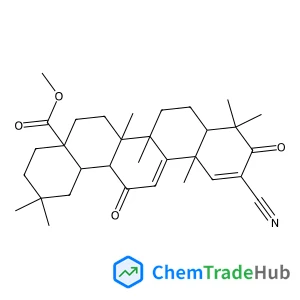
Methyl 2-cyano-3,12-dioxooleana-1,9(11)-dien-28-oate
CAS Number:
218600-53-4
Molecular Formula:
C32H43NO4
![5-Acetyl-2,3-dihydrobenzo[b]furan structure](https://static.chemtradehub.com/structs/908/90843-31-5-eea4.webp "5-Acetyl-2,3-dihydrobenzo[b]furan structure")
![[4-(Heptyloxy)phenyl]boronic acid structure](https://static.chemtradehub.com/structs/136/136370-19-9-ad33.webp "[4-(Heptyloxy)phenyl]boronic acid structure")
Recommended Suppliers





Disclaimer
This page provides academic journal information for reference and research purposes only. We are not affiliated with any journal publishers and do not handle publication submissions. For publication-related inquiries, please contact the respective journal publishers directly.
If you notice any inaccuracies in the information displayed, please contact us at support@chemtradehub.com. We will promptly review and address your concerns.