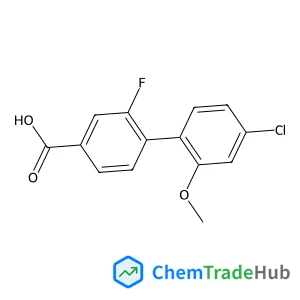
4-(4-Chloro-2-methoxyphenyl)-3-fluorobenzoic acid
CAS Number:
1261970-23-3
Molecular Formula:
C14H10ClFO3
Roman I. Zubatyuk, Svitlana V. Shishkina, Viktoriya V. Dyakonenko, Volodymyr V. Medviediev
Analysis of the strengths and directionality of intermolecular interactions in the crystals containing only one type of supramolecular synthon allows the suggestion of a general classification of molecular crystals depending on type of their basic structural motifs. All crystals may be divided on four classes namely (I) crystals with isotropic packing of the building units; (II) columnar crystals where the basic structural motif (BSM) is a chain/column; (III) layered crystals with layers as the BSM; (IV) columnar-layered crystals containing chains/columns as the primary basic structural motif and layers as the secondary BSM. Taking into account the participation of different supramolecular synthons in the formation of different levels of the organization of molecular crystals, they may be considered as basic (responsible for the formation of molecular complexes as building units of crystals), primary, secondary and auxiliary, which are involved in the agglomeration of molecules in primary or secondary basic structural motifs or in the packing of these motifs, respectively. The ranking of supramolecular synthons depends on values of energies of intermolecular interactions and it is individual for each crystal.
Ryansu Sai, Kazuhide Ueno, Kenta Fujii, Yohei Nakano, Naho Shigaki, Hiromori Tsutsumi
DOI: 10.1039/C6CP08386B
Marnik Bercx, Nasrin Sarmadian, Rolando Saniz, Bart Partoens, Dirk Lamoen
DOI: 10.1039/C7CP90033C
A. R. Alian, S. A. Meguid
DOI: 10.1039/C6CP07464B
Seung-Ik Jo, Young-In An, Kang-Yeong Kim, Seo-Yeong Choi, Jin-Su Kwak, Kyung-Ryul Oh, Young-Uk Kwon
DOI: 10.1039/C6CP07787K
Carlie M. Novak, Ryan C. Fortenberry
DOI: 10.1039/C6CP08140A
Weizhao Cai, Rong Zhang, Shanti Deemyad
DOI: 10.1039/C6CP08171A
Yue Tong, Xiaowen Yu, Gaoquan Shi
DOI: 10.1039/C6CP08176B
Guohai Deng, Xuelin Dong, Qifan Liu, Dingqing Li, Hongmin Li, Qiao Sun, Xiaoqing Zeng
DOI: 10.1039/C6CP08125H
Thomas J. McDonough, Lushuai Zhang, Susmit Singha Roy, Nicholas M. Kearns, Michael S. Arnold, Martin T. Zanni
DOI: 10.1039/C6CP06454J
(5-Sulfamoyl-3-pyridinyl)boronic acid is primarily used in chemical synthesis, p...
Benzyl 2-methyl-2-(methylsulfonyl)-4-pentenoate is typically synthesized via est...
When handling 8-Fluoroquinolin-6-ol (CAS: 209353-22-0), it is important to use p...
1,3-Dibromo-5-(2-methyl-2-propanyl)benzene (CAS: 129316-09-2) is a crystalline c...
Ethyl 7-chloro-4-oxo-1-(1,3-thiazol-2-yl)-1,4-dihydro-1,8-naphthyridine-3-carbox...
When handling Delta-7-Avenasterol (CAS: 23290-26-8), it is important to wear app...
Proper handling involves the use of personal protective equipment such as gloves...
When handling 2-Methyl-2-proanyl 4-[(2-aminophenyl)amino]-1-piperidinecarboxylat...
N-Methyl-4-chlorobenzylamine hydrochloride (CAS: 65542-24-7) is a organic compou...
[2-(Dodecyloxy)ethoxy]acetic acid (CAS: 27306-90-7) is generally considered safe...

Physical Chemistry Chemical Physics (PCCP) is an international journal co-owned by 19 physical chemistry and physics societies from around the world. This journal publishes original, cutting-edge research in physical chemistry, chemical physics and biophysical chemistry. To be suitable for publication in PCCP, articles must include significant innovation and/or insight into physical chemistry; this is the most important criterion that reviewers and Editors will judge against when evaluating submissions. The journal has a broad scope and welcomes contributions spanning experiment, theory, computation and data science. Topical coverage includes spectroscopy, dynamics, kinetics, statistical mechanics, thermodynamics, electrochemistry, catalysis, surface science, quantum mechanics, quantum computing and machine learning. Interdisciplinary research areas such as polymers and soft matter, materials, nanoscience, energy, surfaces/interfaces, and biophysical chemistry are welcomed if they demonstrate significant innovation and/or insight into physical chemistry. Joined experimental/theoretical studies are particularly appreciated when complementary and based on up-to-date approaches.