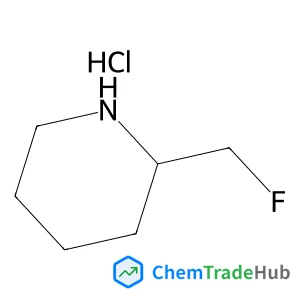
(2S)-2-(Fluoromethyl)piperidine hydrochloride (1:1)
CAS Number:
886216-73-5
Molecular Formula:
C6H13ClFN
Baharan Karamzadeh, Devendra Singh, Wonwoo Nam, Devesh Kumar, Sam P. de Visser
Recent work of Nam and co-workers [J. Yoon, S. A. Wilson, Y. K. Jang, M. S. Seo, K. Nehru, B. Hedman, K. O. Hodgson, E. Bill, E. I. Solomon and W. Nam, Angew. Chem., Int. Ed., 2009, 48, 1257] on a biomimetic iron complex implicated a mixture of iron(IV)–oxo and iron(V)–oxo intermediates but the latter could not be spectroscopically characterized, hence its involvement was postulated. To gain insight into the relative activity of these iron(IV)–oxo versus iron(V)–oxo intermediates, we have performed an extensive density functional theory (DFT) study on the chemical properties of the chemical system of Nam et al., namely [Fe(O)(BQEN)(NCCH3)]2+/3+ with BQEN = N,N′-dimethyl-N,N′-bis(8-quinolyl)ethane-1,2-diamine and their reactivity in hydrogen atom abstraction from ethylbenzene. We show that the perceived iron(V)–oxo species actually is an iron(IV)–oxo ligand cation radical, similar to cytochrome P450 compound I. Moreover, this intermediate has an extremely large electron affinity and therefore can abstract electrons from substrates readily. In our particular system, this means that prior to the hydrogen atom abstraction, an electron is abstracted to form an iron(IV)–oxo species, which subsequently abstracts a hydrogen atom from the substrate. Thus, our calculations show for the first time how some nonheme iron complexes react by long-range electron transfer and others directly via hydrogen atom abstraction. We have rationalized our results with detailed thermochemical cycles that explain the observed reactivity patterns.
Christian J. Baylies, John C. Jeffery, Tom A. Miller, Ryan Moon, Craig R. Rice, T. Riis-Johannessen
DOI: 10.1039/B506199G
Steven Dickson, Darrell Dean, Robert. D. Singer
DOI: 10.1039/B508400H
Naoto Hashimoto, Keiko Ninomiya, Takamasa Endo, Masahiko Sisido
DOI: 10.1039/B508194G
Tim Phillips, Chatna Rajput, Lance Twyman, Ihtshamul Haq, Jim A. Thomas
DOI: 10.1039/B506946G
Tao Yang, Guobao Li, Liping You, Jing Ju, Fuhui Liao, Jianhua Lin
DOI: 10.1039/B506901G
Liangru Yang, Alex von Zelewsky, Helen Stoeckli-Evans
DOI: 10.1039/B507769A
Edel M. Minogue, Tammy P. Taylor, Anthony K. Burrell, George J. Havrilla, Benjamin P. Warner, Michael T. Janicke
DOI: 10.1039/B506044C
Frank Hauke, Andrew J. Myles, Julius Rebek Jr.
DOI: 10.1039/B506048F
Dirk Jan V. C. van Steenis, Olivier R. P. David, Gino P. F. van Strijdonck, Jan H. van Maarseveen, Joost N. H. Reek
DOI: 10.1039/B507776A
Waste containing N-Methoxy-N-methyl-1,3-thiazole-5-carboxamide (CAS: 898825-89-3...
N-(4-Biphenylyl)dibenzo[b,d]furan-4-amine should be stored in a tightly sealed c...
The market for 3-Acetamido-5-amino-2,4,6-triiodobenzoic acid (CAS: 1713-07-1) is...
Benzyl 2-O-acetyl-3,4,6-tri-O-benzyl-beta-D-galactopyranoside (CAS: 61820-03-9) ...
2-Ethylpiperazine dihydrochloride (CAS: 438050-52-3) is regulated under the Glob...
1,1'-[1,3-Phenylenebis(methylene)]bis(3-methyl-1H-pyrrole-2,5-dione) (CAS: 11946...
Several alternatives can be used in the synthesis of 5-Fluoro-2-(1-pyrrolidinyl)...
Proper personal protective equipment (PPE) must be worn when handling this compo...
When handling 6-Bromoimidazo[1,2-a]pyridin-8-amine, it is important to wear appr...
Alternatives to (2S,4R)-4-(4-Nitrobenzyl)pyrrolidine-2-carboxylic acid hydrochlo...

Physical Chemistry Chemical Physics (PCCP) is an international journal co-owned by 19 physical chemistry and physics societies from around the world. This journal publishes original, cutting-edge research in physical chemistry, chemical physics and biophysical chemistry. To be suitable for publication in PCCP, articles must include significant innovation and/or insight into physical chemistry; this is the most important criterion that reviewers and Editors will judge against when evaluating submissions. The journal has a broad scope and welcomes contributions spanning experiment, theory, computation and data science. Topical coverage includes spectroscopy, dynamics, kinetics, statistical mechanics, thermodynamics, electrochemistry, catalysis, surface science, quantum mechanics, quantum computing and machine learning. Interdisciplinary research areas such as polymers and soft matter, materials, nanoscience, energy, surfaces/interfaces, and biophysical chemistry are welcomed if they demonstrate significant innovation and/or insight into physical chemistry. Joined experimental/theoretical studies are particularly appreciated when complementary and based on up-to-date approaches.
![[5-fluoro-2-(morpholine-4-carbonyl)phenyl]boronic acid structure](https://static.chemtradehub.com/structs/121/1217501-26-2-505c.webp "[5-fluoro-2-(morpholine-4-carbonyl)phenyl]boronic acid structure")