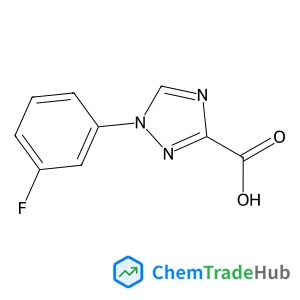
1-(3-Fluorophenyl)-1H-1,2,4-triazole-3-carboxylic acid
CAS Number:
1292369-51-7
Molecular Formula:
C9H6FN3O2
Sidney J. de Carvalho, Andrey G. Cherstvy
Based on extensive Monte Carlo simulations and analytical considerations we study the electrostatically driven adsorption of flexible polyelectrolyte chains onto charged Janus nanospheres. These net-neutral colloids are composed of two equally but oppositely charged hemispheres. The critical binding conditions for polyelectrolyte chains are analysed as function of the radius of the Janus particle and its surface charge density, as well as the salt concentration in the ambient solution. Specifically for the adsorption of finite-length polyelectrolyte chains onto Janus nanoparticles, we demonstrate that the critical adsorption conditions drastically differ when the size of the Janus particle or the screening length of the electrolyte are varied. We compare the scaling laws obtained for the adsorption–desorption threshold to the known results for uniformly charged spherical particles, observing significant disparities. We also contrast the changes to the polyelectrolyte chain conformations close to the surface of the Janus nanoparticles as compared to those for simple spherical particles. Finally, we discuss experimentally relevant physico-chemical systems for which our simulations results may become important. In particular, we observe similar trends with polyelectrolyte complexation with oppositely but heterogeneously charged proteins.

Faraday Discussions

CrystEngComm

Journal of Enzyme inhibition and Medicinal Chemistry

Angewandte Chemie International Edition

Journal of Medical Biochemistry

Advanced Engineering Materials

Environmental Toxicology and Pharmacology

Photochemical & Photobiological Sciences

Foundations of Chemistry

European Journal of Organic Chemistry
Lucas H. G. Kalinke, Mariany S. Silva, Ana K. Valdo, Felipe T. Martins, Nicolás Moliner, Miguel Julve, Francesc Lloret, Joan Cano, Danielle Cangussu
DOI: 10.1039/D3NJ04701F
Tao Ban, Maolian Guo, Yajie Wang, Jiawang Ma, Xinxin Wang, Zihui Wang, Xiuling Zhu
DOI: 10.1039/D3TA05382B
DOI: 10.1039/D3NJ03991A
Xu Wang, Yuhan Yang, Weifeng Zhao, Zhou Zhu, Xibo Pei
DOI: 10.1039/D3TB02355A
Sundararajan Parani, Eun-young Choi, Jang-Kun Song
DOI: 10.1039/D3TA03016D
DOI: 10.1039/D3NJ05137D
Sung-Jun Lee, Yoon-Gyung Sung, Santhia Kesavan, Chang-Lae Kim
DOI: 10.1039/D3NJ04802K
Padmini Gupta, Bholey Singh, Manjeet Dhama, Balaram Pani, Subho Mozumdar
DOI: 10.1039/D3NJ03812B
Rui Zhang, Xishang Song, Han Wu, Yunqi Zhai, Yina Qiao, Zhihao Yu, Jian Xiong, Xuebin Lu
DOI: 10.1039/D3NJ04771G
Waste containing N-Methoxy-N-methyl-1,3-thiazole-5-carboxamide (CAS: 898825-89-3...
N-(4-Biphenylyl)dibenzo[b,d]furan-4-amine should be stored in a tightly sealed c...
The market for 3-Acetamido-5-amino-2,4,6-triiodobenzoic acid (CAS: 1713-07-1) is...
Benzyl 2-O-acetyl-3,4,6-tri-O-benzyl-beta-D-galactopyranoside (CAS: 61820-03-9) ...
2-Ethylpiperazine dihydrochloride (CAS: 438050-52-3) is regulated under the Glob...
1,1'-[1,3-Phenylenebis(methylene)]bis(3-methyl-1H-pyrrole-2,5-dione) (CAS: 11946...
Several alternatives can be used in the synthesis of 5-Fluoro-2-(1-pyrrolidinyl)...
Proper personal protective equipment (PPE) must be worn when handling this compo...
When handling 6-Bromoimidazo[1,2-a]pyridin-8-amine, it is important to wear appr...
Alternatives to (2S,4R)-4-(4-Nitrobenzyl)pyrrolidine-2-carboxylic acid hydrochlo...

Physical Chemistry Chemical Physics (PCCP) is an international journal co-owned by 19 physical chemistry and physics societies from around the world. This journal publishes original, cutting-edge research in physical chemistry, chemical physics and biophysical chemistry. To be suitable for publication in PCCP, articles must include significant innovation and/or insight into physical chemistry; this is the most important criterion that reviewers and Editors will judge against when evaluating submissions. The journal has a broad scope and welcomes contributions spanning experiment, theory, computation and data science. Topical coverage includes spectroscopy, dynamics, kinetics, statistical mechanics, thermodynamics, electrochemistry, catalysis, surface science, quantum mechanics, quantum computing and machine learning. Interdisciplinary research areas such as polymers and soft matter, materials, nanoscience, energy, surfaces/interfaces, and biophysical chemistry are welcomed if they demonstrate significant innovation and/or insight into physical chemistry. Joined experimental/theoretical studies are particularly appreciated when complementary and based on up-to-date approaches.
![2-Methyl-2-propanyl {3-[4-(4,4,5,5-tetramethyl-1,3,2-dioxaborolan-2-yl)phenyl]-3-oxetanyl}carbamate structure](https://static.chemtradehub.com/structs/127/1279090-25-3-1b84.webp "2-Methyl-2-propanyl {3-[4-(4,4,5,5-tetramethyl-1,3,2-dioxaborolan-2-yl)phenyl]-3-oxetanyl}carbamate structure")