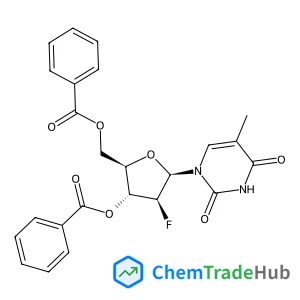
1-(3',5'-Di-O-benzoyl-2'-deoxy-2'-fluoro-b-D-arabinofuranosyl)thymine
CAS Number:
97614-47-6
Molecular Formula:
C24H21FN2O7
Pallavi Singhal, Hirendra N. Ghosh
Excited state dynamics of S2 and S1 states for a series of TPM dyes, pyrogallol red (PGR), bromopyrogallol red (Br-PGR) and aurin tricarboxylic acid (ATC), have been monitored by using ultrafast transient absorption and fluorescence up-conversion techniques. Optical absorption studies indicate that all the TPM dyes exist as keto–enol tautomers depending upon the pH of the solution. Interestingly, all the TPM dyes give S2 emission (major emitting state) in addition to weak S1 emission. S2 emission lifetimes as fast as ∼150–300 fs and S1 emission lifetimes of 2–5 ns were observed depending upon the molecular structure of the dyes. Femtosecond transient absorption studies suggest the presence of an ultrafast non-radiative decay channel from the S2 state in addition to S2 luminescence. The vibrational relaxation time from hot S1 state is found to be 2–6 ps. The heavy atom effect has been observed in ultrafast relaxation dynamics of Br-PGR.

Atomization and Sprays

Journal of Asian Natural Products Research

Herald of the Russian Academy of Sciences

Topics in Catalysis

Journal of Chemical Sciences

Journal of the Indian Institute of Science

Acta Metallurgica Sinica-English Letters

Cellulose

Bioorganic & Medicinal Chemistry

Chinese Journal of Chemistry
Bing-Kai Tao, Hua Yang, Yuan-Zhao Hua, Min-Can Wang
DOI: 10.1039/C9OB00544G
Kristýna Cagašová, Maryam Ghavami, Zhong-Ke Yao, Paul R. Carlier
DOI: 10.1039/C9OB01139K
Paige Dickson, Thomas Kodadek
DOI: 10.1039/C9OB00581A
Zhongwei Zhu, Alexander M. Genaev
DOI: 10.1039/C9OB00640K
Shota Yanagi, Tomoya Sugai, Takuma Noguchi, Masato Kawakami, Makoto Sasaki, Shinsuke Niwa, Asako Sugimoto, Haruhiko Fuwa
DOI: 10.1039/C9OB01276A
Mengjun Qiao, Ling Chen, Fengyi Zhou, Yali Zhang, Lingfei Zhou
DOI: 10.1039/C9OB00336C
Rajnish Budhwan, Suman Yadav, Sandip Murarka
DOI: 10.1039/C9OB00694J
Jian-Qiang Zhao, Lei Yang, Yong You, Zhen-Hua Wang, Ke-Xin Xie, Xiao-Mei Zhang, Xiao-Ying Xu, Wei-Cheng Yuan
DOI: 10.1039/C9OB00775J
Vinicius Sobral Silva, Terezinha Alves Tolentino, Tiago Costa Alves Fontoura Rodrigues, Fernanda Ferrari Martins Santos, Daniel Francisco Scalabrini Machado, Wender Alves Silva, Heibbe Cristhian Benedito de Oliveira, Angelo Henrique Lira Machado
DOI: 10.1039/C9OB00533A
(3.beta.)-3-Hydroxy-N,N-dimethyl-chol-5-en-24-amide (CAS: 79066-03-8) is primari...
5-(Aminomethyl)-2-methoxyphenol (CAS: 89702-89-6) is classified under GHS as a s...
Thieno[2,3-c]pyridin-7(6H)-one (CAS: 28981-13-7) is a heterocyclic organic compo...
1-[(6-Methoxy-3-pyridinyl)methyl]-4-piperidinamine dihydrochloride is generally ...
[(2E)-3-Phenyl-2-propen-1-yl]phosphonic acid (CAS: 146404-58-2) is regulated und...
6-Bromo-7-methoxyquinoline (CAS: 1620515-86-7) falls under the scope of the Glob...
This compound is primarily used in the pharmaceutical industry for the developme...
1-Ethyl-7-[2-methyl-6-(4H-1,2,4-triazol-3-yl)-3-pyridinyl]-3,5-dihydropyrazino[2...
Alternative reagents such as 2-[(dimethylamino)methyl]phenylboronic acid or rela...
3-(Piperidin-4-yloxy)pyridine (CAS: 310881-48-2) is an organic compound with the...

Physical Chemistry Chemical Physics (PCCP) is an international journal co-owned by 19 physical chemistry and physics societies from around the world. This journal publishes original, cutting-edge research in physical chemistry, chemical physics and biophysical chemistry. To be suitable for publication in PCCP, articles must include significant innovation and/or insight into physical chemistry; this is the most important criterion that reviewers and Editors will judge against when evaluating submissions. The journal has a broad scope and welcomes contributions spanning experiment, theory, computation and data science. Topical coverage includes spectroscopy, dynamics, kinetics, statistical mechanics, thermodynamics, electrochemistry, catalysis, surface science, quantum mechanics, quantum computing and machine learning. Interdisciplinary research areas such as polymers and soft matter, materials, nanoscience, energy, surfaces/interfaces, and biophysical chemistry are welcomed if they demonstrate significant innovation and/or insight into physical chemistry. Joined experimental/theoretical studies are particularly appreciated when complementary and based on up-to-date approaches.
![4,4-Difluoro-2-methyl-1-{[(2-methyl-2-propanyl)oxy]carbonyl}-L-proline structure](https://static.chemtradehub.com/structs/119/1194032-23-9-f426.webp "4,4-Difluoro-2-methyl-1-{[(2-methyl-2-propanyl)oxy]carbonyl}-L-proline structure")