













Predicting paramagnetic 1H NMR chemical shifts and state-energy separations in spin-crossover host–guest systems
Literature Information
Publication Date
2014-04-11
DOI
10.1039/C4CP01478B
Impact Factor
3.676
Authors
William C. Isley III, Salvatore Zarra, Rebecca K. Carlson, Rana A. Bilbeisi, Tanya K. Ronson, Jonathan R. Nitschke, Laura Gagliardi, Christopher J. Cramer
View Original
Abstract
The behaviour of metal–organic cages upon guest encapsulation can be difficult to elucidate in solution. Paramagnetic metal centres introduce additional dispersion of signals that is useful for characterisation of host–guest complexes in solution using nuclear magnetic resonance (NMR). However, paramagnetic centres also complicate spectral assignment due to line broadening, signal integration error, and large changes in chemical shifts, which can be difficult to assign even for known compounds. Quantum chemical predictions can provide information that greatly facilitates the assignment of NMR signals and identification of species present. Here we explore how the prediction of paramagnetic NMR spectra may be used to gain insight into the spin crossover (SCO) properties of iron(II)-based metal organic coordination cages, specifically examining how the structure of the local metal coordination environment affects SCO. To represent the tetrahedral metal–organic cage, a model system is generated by considering an isolated metal-ion vertex: fac-ML32+ (M = FeII, CoII; L = N-phenyl-2-pyridinaldimine). The sensitivity of the 1H paramagnetic chemical shifts to local coordination environments is assessed and utilised to shed light on spin crossover behaviour in iron complexes. Our data indicate that expansion of the metal coordination sphere must precede any thermal SCO. An attempt to correlate experimental enthalpies of SCO with static properties of bound guests shows that no simple relationship exists, and that effects are likely due to nuanced dynamic response to encapsulation.
Related Literature
Stranski-Krastanov growth of para-sexiphenyl on Cu(110)–(2×1)O revealed by optical spectroscopy
Lidong Sun, Günther Weidlinger, Mariella Denk, Richard Denk, Michael Hohage, Peter Zeppenfeld
2010-10-13
Paper
DOI: 10.1039/C0CP00443J
Identification of excited-state energy transfer and relaxation pathways in the peridinin–chlorophyll complex: an ultrafast mid-infrared study
Cosimo Bonetti, Maxime T. A. Alexandre, Ivo H. M. van Stokkum, Roger G. Hiller, Marie Louise Groot, Rienk van Grondelle, John T. M. Kennis
2010-06-29
Paper
DOI: 10.1039/B923695C
Selective adsorption and chiral amplification of amino acids in vermiculite clay-implications for the origin of biochirality
Daniel Fitz, T. Jakschitz, Bernd M. Rode
2010-10-28
Paper
DOI: 10.1039/C0CP01388A
Theoretical analysis based on X–H bonding strength and electronic properties in red- and blue-shifting hydrogen-bonded X–H⋯π complexes
Oscar Donoso-Tauda, Pablo Jaque, Juan C. Santos
2010-11-29
Paper
DOI: 10.1039/C0CP00928H
Stability and chemisorption properties of ultrathin TiOx/Pt(111) films and Au/TiOx/Pt(111) model catalysts in reactive atmospheres
Luca Artiglia, Thomas Diemant, Heinrich Hartmann, Joachim Bansmann, R. Jürgen Behm, Gaetano Granozzi
2010-05-11
Paper
DOI: 10.1039/C000884B
The hunt for HCO(aq)
Svend Knak Jensen, Søren Rud Keiding, Jan Thøgersen
2010-06-18
Paper
DOI: 10.1039/B924902H
Unraveling the similarity of the photoabsorption of deprotonated p-coumaric acid in the gas phase and within the photoactive yellow protein
Tomás Rocha-Rinza, Kristian Sneskov, Ove Christiansen, Ulf Ryde, Jacob Kongsted
2010-12-06
Paper
DOI: 10.1039/C0CP01075H
Ionic liquids and solids with paramagnetic anions‡
James F. Wishart
2010-06-18
Paper
DOI: 10.1039/B920652N
You might also like
Compound Q&A
How should waste containing N-Methoxy-N-methyl-1,3-thiazole-5-carboxamide (CAS: 898825-89-3) be handled?
Waste containing N-Methoxy-N-methyl-1,3-thiazole-5-carboxamide (CAS: 898825-89-3...
898825-89-3N-Methoxy-N-methyl-1...
Compound Q&A
How should N-(4-Biphenylyl)dibenzo[b,d]furan-4-amine (CAS: 1318338-47-4) be stored?
N-(4-Biphenylyl)dibenzo[b,d]furan-4-amine should be stored in a tightly sealed c...
1318338-47-4N-(4-Biphenylyl)dibe...
Compound Q&A
What is the market or research trend for 3-Acetamido-5-amino-2,4,6-triiodobenzoic acid (CAS: 1713-07-1)?
The market for 3-Acetamido-5-amino-2,4,6-triiodobenzoic acid (CAS: 1713-07-1) is...
1713-07-13-Acetamido-5-amino-...
Compound Q&A
How should Benzyl 2-O-acetyl-3,4,6-tri-O-benzyl-beta-D-galactopyranoside (CAS: 61820-03-9) be stored?
Benzyl 2-O-acetyl-3,4,6-tri-O-benzyl-beta-D-galactopyranoside (CAS: 61820-03-9) ...
61820-03-9Benzyl 2-O-acetyl-3,...
Compound Q&A
What regulatory guidelines apply to 2-Ethylpiperazine dihydrochloride (CAS: 438050-52-3)?
2-Ethylpiperazine dihydrochloride (CAS: 438050-52-3) is regulated under the Glob...
438050-52-32-Ethylpiperazine di...
Compound Q&A
What regulatory guidelines apply to 1,1'-[1,3-Phenylenebis(methylene)]bis(3-methyl-1H-pyrrole-2,5-dione) (CAS: 119462-56-5)?
1,1'-[1,3-Phenylenebis(methylene)]bis(3-methyl-1H-pyrrole-2,5-dione) (CAS: 11946...
119462-56-51,1'-[1,3-Phenyleneb...
Compound Q&A
Are there alternatives to 5-Fluoro-2-(1-pyrrolidinyl)pyridine (CAS: 1287217-79-1) in synthesis?
Several alternatives can be used in the synthesis of 5-Fluoro-2-(1-pyrrolidinyl)...
1287217-79-15-Fluoro-2-(1-pyrrol...
Compound Q&A
What precautions should be taken when handling 1-((2R,3R,4R,5R)-5-((bis(4-methoxyphenyl)(phenyl)methoxy)methyl)-4-hydroxy-3-methoxytetrahydrofuran-2-yl)-5-methylpyrimidine-2,4(1H,3H)-dione (CAS: 153631-19-7)?
Proper personal protective equipment (PPE) must be worn when handling this compo...
153631-19-71-((2R,3R,4R,5R)-5-(...
Compound Q&A
What precautions should be taken when handling 6-Bromoimidazo[1,2-a]pyridin-8-amine (CAS: 676371-00-9)?
When handling 6-Bromoimidazo[1,2-a]pyridin-8-amine, it is important to wear appr...
676371-00-96-Bromoimidazo[1,2-a...
Compound Q&A
Are there alternatives to (2S,4R)-4-(4-Nitrobenzyl)pyrrolidine-2-carboxylic acid hydrochloride (CAS: 1049740-22-8) in synthesis?
Alternatives to (2S,4R)-4-(4-Nitrobenzyl)pyrrolidine-2-carboxylic acid hydrochlo...
1049740-22-8(2S,4R)-4-(4-Nitrobe...
Source Journal
Physical Chemistry Chemical Physics

CiteScore:
5.5
Self-citation Rate:
10.3%
Articles per Year:
3036
Physical Chemistry Chemical Physics (PCCP) is an international journal co-owned by 19 physical chemistry and physics societies from around the world. This journal publishes original, cutting-edge research in physical chemistry, chemical physics and biophysical chemistry. To be suitable for publication in PCCP, articles must include significant innovation and/or insight into physical chemistry; this is the most important criterion that reviewers and Editors will judge against when evaluating submissions. The journal has a broad scope and welcomes contributions spanning experiment, theory, computation and data science. Topical coverage includes spectroscopy, dynamics, kinetics, statistical mechanics, thermodynamics, electrochemistry, catalysis, surface science, quantum mechanics, quantum computing and machine learning. Interdisciplinary research areas such as polymers and soft matter, materials, nanoscience, energy, surfaces/interfaces, and biophysical chemistry are welcomed if they demonstrate significant innovation and/or insight into physical chemistry. Joined experimental/theoretical studies are particularly appreciated when complementary and based on up-to-date approaches.
Recommended Compounds

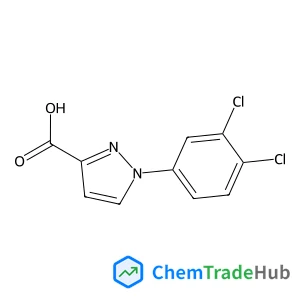
1-(3,4-Dichlorophenyl)-1H-pyrazole-3-carboxylic acid
CAS Number:
1152949-12-6
Molecular Formula:
C10H6Cl2N2O2

5,5',5''-(((2,4,6-Trimethylbenzene-1,3,5-triyl)tris(methylene))tris(oxy))triisophthalic acid
CAS Number:
1159974-70-5
Molecular Formula:
C36H30O15
Recommended Suppliers




Disclaimer
This page provides academic journal information for reference and research purposes only. We are not affiliated with any journal publishers and do not handle publication submissions. For publication-related inquiries, please contact the respective journal publishers directly.
If you notice any inaccuracies in the information displayed, please contact us at support@chemtradehub.com. We will promptly review and address your concerns.