












Isomer-selective infrared spectroscopy of the cationic trimethylamine dimer to reveal its charge sharing and enhanced acidity of the methyl groups
Literature Information
Publication Date
2014-04-08
DOI
10.1039/C4CP00659C
Impact Factor
3.676
Authors
Yuichiro Nakayama, Naohiko Mikami, Asuka Fujii
View Original
Abstract
Infrared predissociation spectroscopy of the trimethylamine dimer cation generated by the vacuum-ultraviolet photoionization is isomer-selectively carried out by monitoring two main fragment channels, protonated trimethylamine and the trimethylamine monomer cation. The spectral carriers monitored by these two channels are assigned to different isomers of the trimethylamine dimer cation. One is the charge-shared (hemibond) structure, in which the positive charge is intermolecularly delocalized over the dimer through the interaction between the nonbonding orbitals of the nitrogen atoms. In the other isomer, a proton of a methyl group in the ionized moiety is intermolecularly transferred to the nitrogen atom of the neutral moiety and is shared between the carbon and nitrogen atoms. The latter isomer shows that the methyl groups of cationic trimethylamine are highly acidic. This example demonstrates characteristic properties of radical cations with alkyl groups.
Related Literature
Investigation of the early stages in soraphen A biosynthesis
Alison M. Hill, Betty L. Thompson, Jonathan P. Harris, Roger Segret
2003-05-19
Communication
DOI: 10.1039/B303542P
Lyotropic liquid crystalline phases formed in an ionic liquid
Luyan Wang, Xiao Chen, Yongcun Chai, Jingcheng Hao, Zhenming Sui, Wenchang Zhuang, Zhenwen Sun
2004-10-28
Communication
DOI: 10.1039/B411163J
Nonpolar biphasic catalysis: Sonogashira and Suzuki coupling of aryl bromides and chlorides
Anupama Datta, Herbert Plenio
2003-05-21
Communication
DOI: 10.1039/B303602B
A novel synthetic route for negatively charged ordered mesoporous silica SBA-15
Chia-min Yang, Bodo Zibrowius, Ferdi Schüth
2003-06-16
Communication
DOI: 10.1039/B304626E
An apatite for fast oxide ion conduction
M. Saiful Islam, Julian R. Tolchard, Peter R. Slater
2003-05-21
Communication
DOI: 10.1039/B301179H
A method for the deposition of controllable chemical gradients
Morgan R. Alexander, Robert D. Short
2003-06-16
Communication
DOI: 10.1039/B305445B
Unprecedented preparation of pincer bis(oxazolinyl)phenyl ligands on solid support and their use in the first heterogeneously-catalyzed enantioselective allylation of aldehydes
Avi Weissberg, Moshe Portnoy
2003-05-29
Communication
DOI: 10.1039/B301308A
Nanocasting of carbon nanotubes: in-situgraphitization of a low-cost mesostructured silica templated by non-ionic surfactant micelles
Seong-Su Kim, Dong-Keun Lee, Jainisha Shah, Thomas J. Pinnavaia
2003-05-16
Communication
DOI: 10.1039/B301303K
Potential-controlled molecular machinery of bipyridinium monolayer-functionalized surfaces: an electrochemical and contact angle analysis
Xuemei Wang, Andrei B. Kharitonov, Eugenii Katz, Itamar Willner
2003-05-23
Communication
DOI: 10.1039/B303845A
Modular synthesis of block copolymers via cycloaddition of terminal azide and alkyne functionalized polymers
Joost A. Opsteen, Jan C. M. van Hest
2004-11-25
Communication
DOI: 10.1039/B412930J
You might also like
Compound Q&A
What are the main uses of (3.beta.)-3-Hydroxy-N,N-dimethyl-chol-5-en-24-amide (CAS: 79066-03-8)?
(3.beta.)-3-Hydroxy-N,N-dimethyl-chol-5-en-24-amide (CAS: 79066-03-8) is primari...
79066-03-8(3.beta.)-3-Hydroxy-...
Compound Q&A
What regulatory guidelines apply to 5-(aminomethyl)-2-methoxyphenol (CAS: 89702-89-6)?
5-(Aminomethyl)-2-methoxyphenol (CAS: 89702-89-6) is classified under GHS as a s...
89702-89-65-(aminomethyl)-2-me...
Compound Q&A
What is Thieno[2,3-c]pyridin-7(6H)-one (CAS: 28981-13-7)?
Thieno[2,3-c]pyridin-7(6H)-one (CAS: 28981-13-7) is a heterocyclic organic compo...
28981-13-7Thieno[2,3-c]pyridin...
Compound Q&A
Is 1-[(6-Methoxy-3-pyridinyl)methyl]-4-piperidinamine dihydrochloride (CAS: 1185311-28-7) safe?
1-[(6-Methoxy-3-pyridinyl)methyl]-4-piperidinamine dihydrochloride is generally ...
1185311-28-71-[(6-Methoxy-3-pyri...
Compound Q&A
What regulatory guidelines apply to [(2E)-3-Phenyl-2-propen-1-yl]phosphonic acid (CAS: 146404-58-2)?
[(2E)-3-Phenyl-2-propen-1-yl]phosphonic acid (CAS: 146404-58-2) is regulated und...
146404-58-2[(2E)-3-Phenyl-2-pro...
Compound Q&A
What regulatory guidelines apply to 6-Bromo-7-methoxyquinoline (CAS: 1620515-86-7)?
6-Bromo-7-methoxyquinoline (CAS: 1620515-86-7) falls under the scope of the Glob...
1620515-86-76-Bromo-7-methoxyqui...
Compound Q&A
What industries use (2R)-1-(1-Benzofuran-2-yl)-N-propyl-2-pentanamine (CAS: 260550-89-8)?
This compound is primarily used in the pharmaceutical industry for the developme...
260550-89-8(2R)-1-(1-Benzofuran...
Compound Q&A
What are the main uses of 1-Ethyl-7-[2-methyl-6-(4H-1,2,4-triazol-3-yl)-3-pyridinyl]-3,5-dihydropyrazino[2,3-b]pyrazin-2(1H)-one (CAS: 1228013-15-7)?
1-Ethyl-7-[2-methyl-6-(4H-1,2,4-triazol-3-yl)-3-pyridinyl]-3,5-dihydropyrazino[2...
1228013-15-71-Ethyl-7-[2-methyl-...
Compound Q&A
Are there alternatives to {5-(Acryloylamino)-2-[(dimethylamino)methyl]phenyl}boronic acid (CAS: 1217500-78-1) in synthesis?
Alternative reagents such as 2-[(dimethylamino)methyl]phenylboronic acid or rela...
1217500-78-1{5-(Acryloylamino)-2...
Compound Q&A
What is 3-(Piperidin-4-yloxy)pyridine (CAS: 310881-48-2)?
3-(Piperidin-4-yloxy)pyridine (CAS: 310881-48-2) is an organic compound with the...
310881-48-23-(Piperidin-4-yloxy...
Source Journal
Physical Chemistry Chemical Physics

CiteScore:
5.5
Self-citation Rate:
10.3%
Articles per Year:
3036
Physical Chemistry Chemical Physics (PCCP) is an international journal co-owned by 19 physical chemistry and physics societies from around the world. This journal publishes original, cutting-edge research in physical chemistry, chemical physics and biophysical chemistry. To be suitable for publication in PCCP, articles must include significant innovation and/or insight into physical chemistry; this is the most important criterion that reviewers and Editors will judge against when evaluating submissions. The journal has a broad scope and welcomes contributions spanning experiment, theory, computation and data science. Topical coverage includes spectroscopy, dynamics, kinetics, statistical mechanics, thermodynamics, electrochemistry, catalysis, surface science, quantum mechanics, quantum computing and machine learning. Interdisciplinary research areas such as polymers and soft matter, materials, nanoscience, energy, surfaces/interfaces, and biophysical chemistry are welcomed if they demonstrate significant innovation and/or insight into physical chemistry. Joined experimental/theoretical studies are particularly appreciated when complementary and based on up-to-date approaches.
Recommended Compounds
![7-Bromo-5-chloro-1H-pyrazolo[4,3-b]pyridine structure](https://static.chemtradehub.com/structs/135/1351813-70-1-a716.webp "7-Bromo-5-chloro-1H-pyrazolo[4,3-b]pyridine structure")
amine structure](https://static.chemtradehub.com/structs/629/62924-61-2-0728.webp "[(2-chlorophenyl)methyl](ethyl)amine structure")
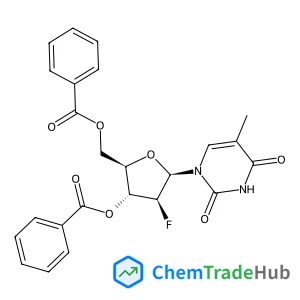
1-(3',5'-Di-O-benzoyl-2'-deoxy-2'-fluoro-b-D-arabinofuranosyl)thymine
CAS Number:
97614-47-6
Molecular Formula:
C24H21FN2O7
![Ethanone, 1-[4-chloro-2-(methylthio)-5-pyrimidinyl]- structure](https://static.chemtradehub.com/structs/661/66116-82-3-863e.webp "Ethanone, 1-[4-chloro-2-(methylthio)-5-pyrimidinyl]- structure")
Ethanone, 1-[4-chloro-2-(methylthio)-5-pyrimidinyl]-
CAS Number:
66116-82-3
Molecular Formula:
C7H7ClN2OS
Recommended Suppliers





Disclaimer
This page provides academic journal information for reference and research purposes only. We are not affiliated with any journal publishers and do not handle publication submissions. For publication-related inquiries, please contact the respective journal publishers directly.
If you notice any inaccuracies in the information displayed, please contact us at support@chemtradehub.com. We will promptly review and address your concerns.