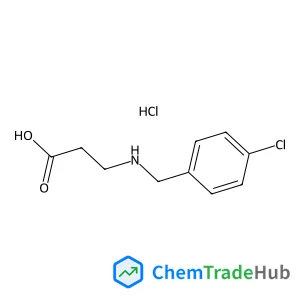
N-(4-Chlorobenzyl)-beta-alanine hydrochloride (1:1)
CAS Number:
1172479-10-5
Molecular Formula:
C10H13Cl2NO2
János Szanyi, Ja Hun Kwak
Alumina supported Pd catalysts with metal loadings of 0.5, 2.5 and 10 wt% were investigated by in situ FTIR spectroscopy in order to understand the nature of adsorbed species formed during their exposure to CO2 and CO. Exposing the annealed samples to CO2 at 295 K resulted in the formation of alumina support-bound surface species only: linear adsorbed CO2, bidentate carbonates and bicarbonates. Room temperature exposure of all three samples to CO produced IR features characteristic of both ionic and metallic Pd, as well as bands we observed upon CO2 adsorption (alumina support-bound species). Low temperature (100 K) adsorption of CO on the three samples provided information about the state of Pd after oxidation and reduction. Oxidized samples contained exclusively ionic Pd, while mostly metallic Pd was present in the reduced samples. Subsequent annealing of the CO-saturated samples revealed the facile (low temperature) reduction of PdOx species by adsorbed CO. This process was evidenced by the variations in IR bands characteristic of ionic and metallic Pd-bound CO, as well as by the appearance of IR bands associated with CO2 adsorption as a function of annealing temperature. Samples containing oxidized Pd species (oxidized, annealed or reduced) always produced CO2 upon their exposure to CO, while no CO2-related surface entities were observed on samples having only fully reduced (metallic) Pd.
Bratislav P. Marinković, Jaime Rosado, Francisco Blanco, Gustavo García, Jelena B. Maljković
DOI: 10.1039/D3CP05052A
Li Shen, Xiaobo Gao, Zhanqing Chang, Changhao Zhang, Yue Li, Jitao Lu, Qingguo Meng, Qian Wu
DOI: 10.1039/D3CP05199D
Meng Xia, Xinyao Liu, Zhaorong Shang, Fuqiang Fan
DOI: 10.1039/D3CP03879C
Bayram Deviren, Seyma Akkaya Deviren, Tevfik Fikret Yagmuroglu
DOI: 10.1039/D3CP04785G
D. C. Malaspina, J. P. Larentzos, J. K. Brennan, A. D. Mackie, J. Bonet Avalos
DOI: 10.1039/D3CP03791F
Hainan Jiang, Yaolong He, Xiaolin Li, Zhiyao Jin, Huijie Yu, Dawei Li
DOI: 10.1039/D3CP04274J
Iosif V. Leibin, Dmitry S. Bezrukov, Alexei A. Buchachenko
DOI: 10.1039/D3CP04178F
Safieh Nazari, Fatemeh Mohammad Dezashibi, Nadia Babaei Bidmeshki
DOI: 10.1039/D3CP04558G
Waste containing N-Methoxy-N-methyl-1,3-thiazole-5-carboxamide (CAS: 898825-89-3...
N-(4-Biphenylyl)dibenzo[b,d]furan-4-amine should be stored in a tightly sealed c...
The market for 3-Acetamido-5-amino-2,4,6-triiodobenzoic acid (CAS: 1713-07-1) is...
Benzyl 2-O-acetyl-3,4,6-tri-O-benzyl-beta-D-galactopyranoside (CAS: 61820-03-9) ...
2-Ethylpiperazine dihydrochloride (CAS: 438050-52-3) is regulated under the Glob...
1,1'-[1,3-Phenylenebis(methylene)]bis(3-methyl-1H-pyrrole-2,5-dione) (CAS: 11946...
Several alternatives can be used in the synthesis of 5-Fluoro-2-(1-pyrrolidinyl)...
Proper personal protective equipment (PPE) must be worn when handling this compo...
When handling 6-Bromoimidazo[1,2-a]pyridin-8-amine, it is important to wear appr...
Alternatives to (2S,4R)-4-(4-Nitrobenzyl)pyrrolidine-2-carboxylic acid hydrochlo...

Physical Chemistry Chemical Physics (PCCP) is an international journal co-owned by 19 physical chemistry and physics societies from around the world. This journal publishes original, cutting-edge research in physical chemistry, chemical physics and biophysical chemistry. To be suitable for publication in PCCP, articles must include significant innovation and/or insight into physical chemistry; this is the most important criterion that reviewers and Editors will judge against when evaluating submissions. The journal has a broad scope and welcomes contributions spanning experiment, theory, computation and data science. Topical coverage includes spectroscopy, dynamics, kinetics, statistical mechanics, thermodynamics, electrochemistry, catalysis, surface science, quantum mechanics, quantum computing and machine learning. Interdisciplinary research areas such as polymers and soft matter, materials, nanoscience, energy, surfaces/interfaces, and biophysical chemistry are welcomed if they demonstrate significant innovation and/or insight into physical chemistry. Joined experimental/theoretical studies are particularly appreciated when complementary and based on up-to-date approaches.
![4-Chloro-2-{[(2-chlorophenoxy)acetyl]amino}benzoic acid structure](https://static.chemtradehub.com/structs/351/351424-20-9-9467.webp "4-Chloro-2-{[(2-chlorophenoxy)acetyl]amino}benzoic acid structure")