












![5-Chloropyrrolo[2,1-f][1,2,4]triazin-4(3H)-one structure](https://static.chemtradehub.com/structs/888/888720-60-3-4f7c.webp "5-Chloropyrrolo[2,1-f][1,2,4]triazin-4(3H)-one structure")
Magnetic edge-states in nanographene, HNO3-doped nanographene and its residue compounds of nanographene-based nanoporous carbon
Literature Information
Publication Date
2014-02-07
DOI
10.1039/C4CP00199K
Impact Factor
3.676
Authors
Si-Jia Hao, V. L. Joseph Joly, Satoshi Kaneko, Jun-ichi Takashiro, Kazuyuki Takai, Hitoshi Hayashi, Toshiaki Enoki, Manabu Kiguchi
View Original
Abstract
We investigated the magnetic and electronic properties of nanographene and its charge transfer effect, using near edge X-ray absorption fine structure (NEXAFS), magnetic susceptibility and ESR measurements, and elemental analysis, with the employment of nanoporous carbon, which consists of a three dimensional disordered network of loosely stacked nanographene sheets, in relation to the host–guest interaction with HNO3 as the electron-accepting guest. The adsorption of electron acceptor HNO3 decreases the intensity of the edge state peak in NEXAFS as a result of the charge-transfer-induced Fermi energy downshift, in agreement with the decrease in the edge-state spin concentration, and it also induces the structural expansion, which makes the inter-nanographene sheet distance elongated, resulting in weakening of the inter-nanographene-sheet antiferromagnetic interaction as evidenced by the decrease in the Weiss temperature. In addition, the decomposition of HNO3, which takes place with the electron-rich edge state as an oxidation catalyst, results in the creation of oxygen/nitrogen-containing functional groups bonded to the periphery of the nanographene sheets. Heat-treatment of the HNO3-ACFs under evacuation desorbs the HNO3 molecules completely, though a part of the oxygen/nitrogen-containing species remains strongly bonded to the edge even at a high temperature of ∼800 °C, according to NEXAFS and elemental analysis results. These remaining species participate in the charge transfer, modifying the electronic structure as observed with the decrease in the orbital susceptibility and the strengthening of the inter-nanographene-sheet antiferromagnetic interaction.
Related Literature
Kinetics, mechanisms and ionic liquids in the uptake of n-butylamine onto low molecular weight dicarboxylic acids
Michelle C. Fairhurst, Michael J. Ezell, Carla Kidd, Pascale S. J. Lakey, Manabu Shiraiwa, Barbara J. Finlayson-Pitts
2017-01-24
Paper
DOI: 10.1039/C6CP08663B
Chemically induced topological zero mode at graphene armchair edges
M. Ziatdinov, H. Lim, S. Fujii, K. Kusakabe, M. Kiguchi, T. Enoki, Y. Kim
2017-01-17
Paper
DOI: 10.1039/C6CP08352H
WO3/W:BiVO4/BiVO4 graded photoabsorber electrode for enhanced photoelectrocatalytic solar light driven water oxidation
Junghyun Choi, Pitchaimuthu Sudhagar, Joo Hyun Kim, Jiseok Kwon, Jeonghyun Kim, Chiaki Terashima, Akira Fujishima, Taeseup Song, Ungyu Paik
2017-01-09
Paper
DOI: 10.1039/C6CP08199A
Probing the degradation and homogeneity of embedded perovskite semiconducting layers in photovoltaic devices by Raman spectroscopy
K. E. A. Hooper, H. K. H. Lee, M. J. Newman, S. Meroni, J. Baker, T. M. Watson, W. C. Tsoi
2017-02-02
Paper
DOI: 10.1039/C6CP05123E
Nanoparticle–nanoparticle vs. nanoparticle–substrate hot spot contributions to the SERS signal: studying Raman labelled monomers, dimers and trimers
Kamila Moor, Kristina Gudun, Zarina Yelemessova, Rostislav Bukasov
2016-12-15
Paper
DOI: 10.1039/C6CP08254H
Exploring experimental fitness landscapes for chemical synthesis and property optimization
Katharine Moore Tibbetts, Xiao-Jiang Feng, Herschel Rabitz
2017-01-18
Paper
DOI: 10.1039/C6CP06187G
Charge transport mechanisms in sol–gel grown La0.7Pb0.3MnO3/LaAlO3 manganite films
Eesh Vaghela, M. J. Keshvani, Keval Gadani, Zalak Joshi, Hetal Boricha, K. Asokan, D. Venkateshwarlu, V. Ganesan, N. A. Shah, P. S. Solanki
2017-01-31
Paper
DOI: 10.1039/C6CP07730G
Effects of the Hofmeister series of sodium salts on the solvent properties of water
L. A. Ferreira, V. N. Uversky, B. Y. Zaslavsky
2017-01-09
Paper
DOI: 10.1039/C6CP08214A
Charge transport in organic donor–acceptor mixed-stack crystals: the role of nonlocal electron–phonon couplings
Lingyun Zhu, Hua Geng, Yuanping Yi, Zhixiang Wei
2017-01-06
Paper
DOI: 10.1039/C6CP07417K
Understanding the influence of Mg doping for the stabilization of capacity and higher discharge voltage of Li- and Mn-rich cathodes for Li-ion batteries
Prasant Kumar Nayak, Judith Grinblat, Elena Levi, Mikhael Levi, Boris Markovsky, Doron Aurbach
2017-01-20
Paper
DOI: 10.1039/C6CP07383B
You might also like
Compound Q&A
What are the main uses of (5-Sulfamoyl-3-pyridinyl)boronic acid (CAS: 951233-61-7)?
(5-Sulfamoyl-3-pyridinyl)boronic acid is primarily used in chemical synthesis, p...
951233-61-7(5-Sulfamoyl-3-pyrid...
Compound Q&A
How is Benzyl 2-methyl-2-(methylsulfonyl)-4-pentenoate (CAS: 1942858-50-5) typically synthesized?
Benzyl 2-methyl-2-(methylsulfonyl)-4-pentenoate is typically synthesized via est...
1942858-50-5Benzyl 2-methyl-2-(m...
Compound Q&A
What precautions should be taken when handling 8-Fluoroquinolin-6-ol (CAS: 209353-22-0)?
When handling 8-Fluoroquinolin-6-ol (CAS: 209353-22-0), it is important to use p...
209353-22-08-Fluoroquinolin-6-o...
Compound Q&A
What are the physical and chemical properties of 1,3-Dibromo-5-(2-methyl-2-propanyl)benzene (CAS: 129316-09-2)?
1,3-Dibromo-5-(2-methyl-2-propanyl)benzene (CAS: 129316-09-2) is a crystalline c...
129316-09-21,3-Dibromo-5-(2-met...
Compound Q&A
What industries use Ethyl 7-chloro-4-oxo-1-(1,3-thiazol-2-yl)-1,4-dihydro-1,8-naphthyridine-3-carboxylate (CAS: 174726-87-5)?
Ethyl 7-chloro-4-oxo-1-(1,3-thiazol-2-yl)-1,4-dihydro-1,8-naphthyridine-3-carbox...
174726-87-5Ethyl 7-chloro-4-oxo...
Compound Q&A
What precautions should be taken when handling Delta-7-Avenasterol (CAS: 23290-26-8)?
When handling Delta-7-Avenasterol (CAS: 23290-26-8), it is important to wear app...
23290-26-8Delta-7-Avenasterol
Compound Q&A
What precautions should be taken when handling N-({(5R)-3-[3-Fluoro-4-(4-morpholinyl)phenyl]-2-oxo-1,3-oxazolidin-5-yl}methyl)acetamide (CAS: 872992-20-6)?
Proper handling involves the use of personal protective equipment such as gloves...
872992-20-6N-({(5R)-3-[3-Fluoro...
Compound Q&A
What precautions should be taken when handling 2-Methyl-2-proanyl 4-[(2-aminophenyl)amino]-1-piperidinecarboxylate (CAS: 79099-00-6)?
When handling 2-Methyl-2-proanyl 4-[(2-aminophenyl)amino]-1-piperidinecarboxylat...
79099-00-62-Methyl-2-propanyl ...
Compound Q&A
What is N-Methyl-4-chlorobenzylamine hydrochloride (CAS: 65542-24-7)?
N-Methyl-4-chlorobenzylamine hydrochloride (CAS: 65542-24-7) is a organic compou...
65542-24-7N-Methyl-4-chloroben...
Compound Q&A
Is [2-(Dodecyloxy)ethoxy]acetic acid (CAS: 27306-90-7) safe?
[2-(Dodecyloxy)ethoxy]acetic acid (CAS: 27306-90-7) is generally considered safe...
27306-90-7[2-(Dodecyloxy)ethox...
Source Journal
Physical Chemistry Chemical Physics

CiteScore:
5.5
Self-citation Rate:
10.3%
Articles per Year:
3036
Physical Chemistry Chemical Physics (PCCP) is an international journal co-owned by 19 physical chemistry and physics societies from around the world. This journal publishes original, cutting-edge research in physical chemistry, chemical physics and biophysical chemistry. To be suitable for publication in PCCP, articles must include significant innovation and/or insight into physical chemistry; this is the most important criterion that reviewers and Editors will judge against when evaluating submissions. The journal has a broad scope and welcomes contributions spanning experiment, theory, computation and data science. Topical coverage includes spectroscopy, dynamics, kinetics, statistical mechanics, thermodynamics, electrochemistry, catalysis, surface science, quantum mechanics, quantum computing and machine learning. Interdisciplinary research areas such as polymers and soft matter, materials, nanoscience, energy, surfaces/interfaces, and biophysical chemistry are welcomed if they demonstrate significant innovation and/or insight into physical chemistry. Joined experimental/theoretical studies are particularly appreciated when complementary and based on up-to-date approaches.
Recommended Compounds
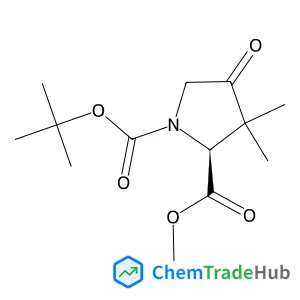
2-Methyl 1-(2-methyl-2-propanyl) (2S)-3,3-dimethyl-4-oxo-1,2-pyrrolidinedicarboxylate
CAS Number:
478698-30-5
Molecular Formula:
C13H21NO5
![[3-Fluoro-4-(1-pyrrolidinylcarbonyl)phenyl]boronic acid structure](https://static.chemtradehub.com/structs/874/874289-09-5-e3d4.webp "[3-Fluoro-4-(1-pyrrolidinylcarbonyl)phenyl]boronic acid structure")
[3-Fluoro-4-(1-pyrrolidinylcarbonyl)phenyl]boronic acid
CAS Number:
874289-09-5
Molecular Formula:
C11H13BFNO3
![4-Fluoro-2-(4-{[(3S,4R)-4-(2-hydroxy-2-propanyl)-3-pyrrolidinyl]amino}-6,7-dimethoxy-2-quinazolinyl)phenol hydrochloride (1:1) structure](https://static.chemtradehub.com/structs/143/1431697-96-9-619c.webp "4-Fluoro-2-(4-{[(3S,4R)-4-(2-hydroxy-2-propanyl)-3-pyrrolidinyl]amino}-6,7-dimethoxy-2-quinazolinyl)phenol hydrochloride (1:1) structure")
4-Fluoro-2-(4-{[(3S,4R)-4-(2-hydroxy-2-propanyl)-3-pyrrolidinyl]amino}-6,7-dimethoxy-2-quinazolinyl)phenol hydrochloride (1:1)
CAS Number:
1431697-96-9
Molecular Formula:
C23H28ClFN4O4
Recommended Suppliers



Disclaimer
This page provides academic journal information for reference and research purposes only. We are not affiliated with any journal publishers and do not handle publication submissions. For publication-related inquiries, please contact the respective journal publishers directly.
If you notice any inaccuracies in the information displayed, please contact us at support@chemtradehub.com. We will promptly review and address your concerns.