












A HPLC-SRM-MS based method for the detection and quantification of methotrexate in urine at doses used in clinical practice for patients with rheumatological disease: a potential measure of adherence
Literature Information
Publication Date
2015-02-02
DOI
10.1039/C4AN02321H
Impact Factor
4.616
Authors
S. M. M. Verstappen
View Original
Abstract
Rheumatoid arthritis (RA) is a common autoimmune disease that causes significant disability and reduced life expectancy. The folate antagonist methotrexate (MTX) is first-line therapy for RA when used weekly at low doses (5–25 mg). However, the true rate of adherence to MTX is uncertain. This is in part due to the different methods of measurement of adherence employed with no biochemical test currently available to determine adherence to low dose MTX. Common methods of MTX measurement include immunoassays in patients with high dose therapy, but these assays cross-react with MTX metabolites and lack the sensitivity required to measure adherence to low dose MTX. HPLC-SRM-MS (selected reaction monitoring-mass spectrometry) has several theoretical advantages over immunoassays with improved specificity, minimal cross-reaction and higher sensitivity. The aim of this study was to develop an assay to measure MTX and its major metabolite 7-OH-MTX in urine as a tool to monitor adherence to low dose MTX in clinic. As a proof of concept, urine samples from 4 participants with RA were measured after directly observed therapy. The assay showed improved sensitivity compared to that reported by immunoassays, with low carryover and high within-run precision. In participant samples, MTX was measurable in the urine for up to 105 hours after administration and 7-OH-MTX was detectable up to 98 hours after administration, suggesting that this assay is suitable for the measurement of adherence to therapy. The assay requires minimal sample preparation and can be adopted by other laboratories with minimal study set up.
Related Literature
Ionic liquids and solids with paramagnetic anions‡
James F. Wishart
2010-06-18
Paper
DOI: 10.1039/B920652N
Valence bond all the way: From the degenerate H-exchange to cytochrome P450
Sason Shaik
2010-06-24
Perspective
DOI: 10.1039/C001372M
Hydroxyapatite as a key biomaterial: quantum-mechanical simulation of its surfaces in interaction with biomolecules
Marta Corno, Albert Rimola, Vera Bolis, Piero Ugliengo
2010-05-18
Perspective
DOI: 10.1039/C002146F
Enhanced performance of a dye-sensitized solar cell with the incorporation of titanium carbide in the TiO2 matrix
Chuan-Pei Lee, Po-Yen Chen, R. Vittal
2010-06-23
Paper
DOI: 10.1039/B923477B
A DFT study of PtAu bimetallic clusters adsorbed on MgO/Ag(100) ultrathin films
Sabrina Sicolo, Gianfranco Pacchioni
2010-03-10
Paper
DOI: 10.1039/C000841A
Iodineoxidation by hydrogen peroxide in acidic solutions, Bray-Liebhafsky reaction and other related reactions
2010-04-23
Paper
DOI: 10.1039/B927432D
A facile chemical approach for preparing a SERS active silver substrate
Cheng Yang, Yu-Tao Xie, Matthew M. F. Yuen, Xiaomin Xiong, C. P. Wong
2010-09-30
Communication
DOI: 10.1039/C0CP00414F
Theoretical analysis based on X–H bonding strength and electronic properties in red- and blue-shifting hydrogen-bonded X–H⋯π complexes
Oscar Donoso-Tauda, Pablo Jaque, Juan C. Santos
2010-11-29
Paper
DOI: 10.1039/C0CP00928H
Ab initio simulation of proton spin diffusion
Jean-Nicolas Dumez, Mark C. Butler, Elodie Salager, Bénédicte Elena-Herrmann, Lyndon Emsley
2010-07-06
Communication
DOI: 10.1039/C0CP00050G
Large heterogeneity of Brønsted acid sites in ASA and USY zeolites: evidencing a third acidic component
Olivier Cairon
2010-05-14
Communication
DOI: 10.1039/C000991A
You might also like
Compound Q&A
How should waste containing N-Methoxy-N-methyl-1,3-thiazole-5-carboxamide (CAS: 898825-89-3) be handled?
Waste containing N-Methoxy-N-methyl-1,3-thiazole-5-carboxamide (CAS: 898825-89-3...
898825-89-3N-Methoxy-N-methyl-1...
Compound Q&A
How should N-(4-Biphenylyl)dibenzo[b,d]furan-4-amine (CAS: 1318338-47-4) be stored?
N-(4-Biphenylyl)dibenzo[b,d]furan-4-amine should be stored in a tightly sealed c...
1318338-47-4N-(4-Biphenylyl)dibe...
Compound Q&A
What is the market or research trend for 3-Acetamido-5-amino-2,4,6-triiodobenzoic acid (CAS: 1713-07-1)?
The market for 3-Acetamido-5-amino-2,4,6-triiodobenzoic acid (CAS: 1713-07-1) is...
1713-07-13-Acetamido-5-amino-...
Compound Q&A
How should Benzyl 2-O-acetyl-3,4,6-tri-O-benzyl-beta-D-galactopyranoside (CAS: 61820-03-9) be stored?
Benzyl 2-O-acetyl-3,4,6-tri-O-benzyl-beta-D-galactopyranoside (CAS: 61820-03-9) ...
61820-03-9Benzyl 2-O-acetyl-3,...
Compound Q&A
What regulatory guidelines apply to 2-Ethylpiperazine dihydrochloride (CAS: 438050-52-3)?
2-Ethylpiperazine dihydrochloride (CAS: 438050-52-3) is regulated under the Glob...
438050-52-32-Ethylpiperazine di...
Compound Q&A
What regulatory guidelines apply to 1,1'-[1,3-Phenylenebis(methylene)]bis(3-methyl-1H-pyrrole-2,5-dione) (CAS: 119462-56-5)?
1,1'-[1,3-Phenylenebis(methylene)]bis(3-methyl-1H-pyrrole-2,5-dione) (CAS: 11946...
119462-56-51,1'-[1,3-Phenyleneb...
Compound Q&A
Are there alternatives to 5-Fluoro-2-(1-pyrrolidinyl)pyridine (CAS: 1287217-79-1) in synthesis?
Several alternatives can be used in the synthesis of 5-Fluoro-2-(1-pyrrolidinyl)...
1287217-79-15-Fluoro-2-(1-pyrrol...
Compound Q&A
What precautions should be taken when handling 1-((2R,3R,4R,5R)-5-((bis(4-methoxyphenyl)(phenyl)methoxy)methyl)-4-hydroxy-3-methoxytetrahydrofuran-2-yl)-5-methylpyrimidine-2,4(1H,3H)-dione (CAS: 153631-19-7)?
Proper personal protective equipment (PPE) must be worn when handling this compo...
153631-19-71-((2R,3R,4R,5R)-5-(...
Compound Q&A
What precautions should be taken when handling 6-Bromoimidazo[1,2-a]pyridin-8-amine (CAS: 676371-00-9)?
When handling 6-Bromoimidazo[1,2-a]pyridin-8-amine, it is important to wear appr...
676371-00-96-Bromoimidazo[1,2-a...
Compound Q&A
Are there alternatives to (2S,4R)-4-(4-Nitrobenzyl)pyrrolidine-2-carboxylic acid hydrochloride (CAS: 1049740-22-8) in synthesis?
Alternatives to (2S,4R)-4-(4-Nitrobenzyl)pyrrolidine-2-carboxylic acid hydrochlo...
1049740-22-8(2S,4R)-4-(4-Nitrobe...
Source Journal
Analyst

CiteScore:
7.8
Self-citation Rate:
5.6%
Articles per Year:
653
Analyst publishes analytical and bioanalytical research that reports premier fundamental discoveries and inventions, and the applications of those discoveries, unconfined by traditional discipline barriers.
Recommended Compounds
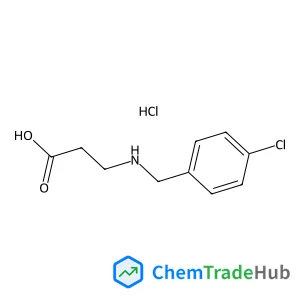
N-(4-Chlorobenzyl)-beta-alanine hydrochloride (1:1)
CAS Number:
1172479-10-5
Molecular Formula:
C10H13Cl2NO2
![2-Methylbenzo[h]quinoline structure](https://static.chemtradehub.com/structs/605/605-88-9-ac43.webp "2-Methylbenzo[h]quinoline structure")

Recommended Suppliers






Disclaimer
This page provides academic journal information for reference and research purposes only. We are not affiliated with any journal publishers and do not handle publication submissions. For publication-related inquiries, please contact the respective journal publishers directly.
If you notice any inaccuracies in the information displayed, please contact us at support@chemtradehub.com. We will promptly review and address your concerns.