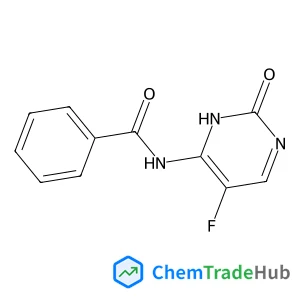
N-(5-Fluoro-2-oxo-2,3-dihydro-4-pyrimidinyl)benzamide
CAS Number:
10357-07-0
Molecular Formula:
C11H8FN3O2
Wei Wang, Na Zhao, Xiaoxiao Li, Jun Wan, Xiliang Luo
A novel controlled-release biosensor for isothermal amplified detection of ATP using Au nanocages (AuNCs) capped with a DNA molecular gate is reported for the first time, and has been successfully tested in intracellular ATP detection. Two kinds of SH-modified short strand DNAs S1 and S2 were assembled on the surface of the AuNCs by means of Au–thiolate bonding. The hybridization of a long-strand DNA S3 with the two immobilized SH-DNAs leads to the formation of molecular gates. The molecular gates were designed to inhibit the release of the fluorescent molecules such as Rhodamine-B (RhB), which were filled in the hollow interiors of AuNCs. The primer S4 was employed to play the role of a recognition moiety. The specificity recognition reaction between ATP and ATP aptamer gave rise to the primer S4 released from a double-stranded hybrid formed with the ATP aptamer. The released S4 will initiate the autonomous replication–scission–displacement process with the assistance of DNA polymerase and nicking endonuclease. As a result, the DNA synthesis and the DNA cycle achieved the opening of the DNA-based molecular gates and the significant amplification of the release of the guest molecules from AuNCs. In order to realize the cyclic enzymatic amplification of the release of the guest molecules from AuNCs, the long-strand S3 is ingeniously designed in such a way that it contains a Nb.Bpu10I nicking endonuclease recognition sequence and a sequence complementary to the primer S4. The fabricated system was demonstrated to be an efficient biosensor for target molecule detection qualitatively and quantitatively.
Vikki Anand Varma, Simmie Jaglan, Mohd Yasir Khan, Sujin B. Babu
DOI: 10.1039/D3CP03681B
Licheng Liu, Deepak Pant
DOI: 10.1039/D3SE00876B
Riku Okamoto, Akira Kimura, Yuhi Nakayasu, Akira Yamakata, Ryota Tomizawa, Taizo Masuda, Koichiro Nakatani
DOI: 10.1039/D3SE01408H
Zhichao Liu, Tianle Zhou, Gui Jin, Jiangbin Su, Bin Tang
DOI: 10.1039/D3CP05095E
Waste containing N-Methoxy-N-methyl-1,3-thiazole-5-carboxamide (CAS: 898825-89-3...
N-(4-Biphenylyl)dibenzo[b,d]furan-4-amine should be stored in a tightly sealed c...
The market for 3-Acetamido-5-amino-2,4,6-triiodobenzoic acid (CAS: 1713-07-1) is...
Benzyl 2-O-acetyl-3,4,6-tri-O-benzyl-beta-D-galactopyranoside (CAS: 61820-03-9) ...
2-Ethylpiperazine dihydrochloride (CAS: 438050-52-3) is regulated under the Glob...
1,1'-[1,3-Phenylenebis(methylene)]bis(3-methyl-1H-pyrrole-2,5-dione) (CAS: 11946...
Several alternatives can be used in the synthesis of 5-Fluoro-2-(1-pyrrolidinyl)...
Proper personal protective equipment (PPE) must be worn when handling this compo...
When handling 6-Bromoimidazo[1,2-a]pyridin-8-amine, it is important to wear appr...
Alternatives to (2S,4R)-4-(4-Nitrobenzyl)pyrrolidine-2-carboxylic acid hydrochlo...

Analyst publishes analytical and bioanalytical research that reports premier fundamental discoveries and inventions, and the applications of those discoveries, unconfined by traditional discipline barriers.
![4-Chloro-2-{[(2-chlorophenoxy)acetyl]amino}benzoic acid structure](https://static.chemtradehub.com/structs/351/351424-20-9-9467.webp "4-Chloro-2-{[(2-chlorophenoxy)acetyl]amino}benzoic acid structure")