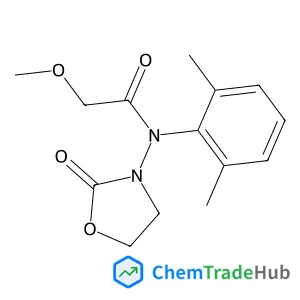
N-(2,6-Dimethylphenyl)-2-methoxy-N-(2-oxo-1,3-oxazolidin-3-yl)acetamide
CAS Number:
77732-09-3
Molecular Formula:
C14H18N2O4
Dapeng Wang, Henghui Sun
The hierarchically nanosheet-assembled NiCo@SiO2@Ag (NSA) core–shell microspheres have been synthesized by a layer-by-layer procedure at ambient temperature. The mean particle size of NSA microspheres is about 1.7 μm, which is made up of some nanosheets with an average thickness of ∼20 nm. The outer silver shell surface structures can be controlled well by adjusting the concentration of Ag+ ions and the reaction times. The obtained NSA 3D micro/nanostructures show a structure enhanced SERS performance, which can be attributed to the special nanoscale configuration with wedge-shaped surface architecture. We find that NSA microspheres with nanosheet-assembled shell structure exhibit the highest enhancement efficiency and high SERS sensitivity to p-ATP and MBA molecules. We show that the detection limits for both p-ATP and MBA of the optimized NSA microsphere substrates can approach 10−7 M. And the relative standard deviation of the Raman peak maximum is ∼13%, which indicates good uniformity of the substrate. In addition, the magnetic NSA microspheres with high saturation magnetization show a quick magnetic response, good recoverability and recyclability. Therefore, such NSA microspheres may have great practical potential applications in rapid and reproducible trace detection of chemical, biological and environment pollutants with a simple portable Raman instrument.
DOI: 10.1039/C7CP08239H
Pedro Augusto Franco Pinheiro Moreira, Roberto Gomes de Aguiar Veiga, Ingrid de Almeida Ribeiro, Julian Helfferich
DOI: 10.1039/C8CP00933C
Yu Tang, Jian Dou, Christopher M. Andolina, Yuting Li, Hongbin Ma, Stephen D. House, Xiaoyan Zhang, Judith Yang, Franklin (Feng) Tao
DOI: 10.1039/C7CP07407G
Mateusz Rebarz, Martin Rohrmüller, Shirly Espinoza, Miroslav Kloz, Norman Kretzschmar, Adam Neuba, Jochen Ortmeyer, Roland Schoch, Matthias Bauer, Wolf Gero Schmidt, Gerald Henkel
DOI: 10.1039/C7CP04880G
Palash Jana, Mithun Radhakrishna, Saumyakanti Khatua, Sriram Kanvah
DOI: 10.1039/C7CP06300H
Lin-Yan Feng, Hua-Jin Zhai
DOI: 10.1039/C7CP08420J
Sulgiye Park, Cameron L. Tracy, Fuxiang Zhang, Changyong Park, Sergey N. Tkachev, Maik Lang, Rodney C. Ewing
DOI: 10.1039/C7CP08664D
Min Cheng, Yikui Du, Qihe Zhu
DOI: 10.1039/C7CP07854D
Satyajit Patra, Christian Anders, Paul Hendrik Schummel, Roland Winter
DOI: 10.1039/C8CP00907D
Yong-Dao Chen, Song Yu, Wen-Hui Zhao, Shun-Fang Li, Xiang-Mei Duan
DOI: 10.1039/C8CP01145A
When handling 2-Chloro-1,2-bis(4-methylphenyl)ethanone (CAS: 71193-32-3), it is ...
4-Ethoxy-3-(5-methyl-4-oxo-7-propyl-1,4-dihydroimidazo[5,1-f][1,2,4]triazin-2-yl...
Methyl 3-Oxo-4-Androsten-17-Carboxylate (CAS: 2681-55-2) should be stored in a c...
(R)-3-Amino-4-(3-hexylphenylamino)-4-oxobutylphosphonic acid is primarily used i...
2-Methyl-2-propanyl 3-amino-3-carbamoyl-1-azetidinecarboxylate (CAS: 1254120-14-...
There are alternative reagents that can be used in synthesis instead of (E)-4-(t...
[2-(3-Chlorophenyl)-1,3-thiazol-4-yl]methanol (CAS: 121202-20-8) is a crystallin...
The market and research trends for Methyl (2S)-[(4S)-2,2-dimethyl-1,3-dioxolan-4...
The market for 1-Bromo-2-isocyanatoethane (CAS: 42865-19-0) is driven by its use...
4-Nitro-D-phenylalanine hydrochloride (CAS: 147065-06-3) is primarily used in re...

Analyst publishes analytical and bioanalytical research that reports premier fundamental discoveries and inventions, and the applications of those discoveries, unconfined by traditional discipline barriers.