












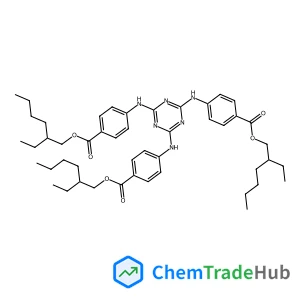
Tris(2-ethylhexyl) 4,4',4''-(1,3,5-triazine-2,4,6-triyltriimino)tribenzoate
CAS Number:
88122-99-0
Molecular Formula:
C48H66N6O6
William Guerin, Martine Slawinski, Jean-Michel Brusson, Sophie M. Guillaume, Jean-François Carpentier
Copolymerization of L-LA and TMC has been achieved with binary systems, associating either a metal-based (pre)catalyst or an organocatalyst with benzyl alcohol (BnOH) acting as a co-initiator and a chain transfer agent. Kinetic monitoring indicated that copolymerizations mediated by the zinc-β-diketiminate system [(BDI)Zn{N(SiMe3)2}]/BnOH proceed by preferential consumption of L-LA first and then of TMC, in contrast to homopolymerizations of the individual monomers that progress roughly at the same rate. In striking contrast, systems based on metal triflates, M(OTf)3/BnOH (M = Al, Bi, Yb), copolymerize TMC faster than L-LA, as established for the first time, while these systems also homopolymerize the individual monomers at about the same rate. Eventually, the [(BDI)Zn{N(SiMe3)2}]/BnOH and M(OTf)3/BnOH systems produce P(LLA-grad-TMC) gradient copolymers featuring PLLA and PTMC blocks of significant length (ca. 10 units with Al-, Yb-; ca. 6 units with Zn-, Bi-based systems), as confirmed by 13C NMR analyses. On the other hand, copolymerizations mediated by the guanidine-based organocatalyst system TBD/BnOH (TBD = 1,5,7-triazabicyclo[4.4.0]dec-5-ene) gave P(LLA-ran-TMC) random copolymers. Optimal control of molar masses and dispersities, along with minimized transesterifications, is achieved with the zinc and ytterbium systems. While metal triflates induce partial decarboxylation of TMC units, the zinc and TBD systems are perfectly chemoselective. Kinetic and microstructural control in random copolymerization of L-LA and TMC can thus be achieved via catalytic tuning.
Bruno Grignard, Cédric Calberg, Christine Jérôme, Wenxin Wang, Steven Howdle, Christophe Detrembleur
DOI: 10.1039/B812297K
Yi Fu, Jian Zhang, Joseph R. Lakowicz
DOI: 10.1039/B816736B
Keiko Motoyama, Takashi Koike, Munetaka Akita
DOI: 10.1039/B809318K
Mark Frampton, Ateeya Vawda, Jackie Fletcher, Paul M. Zelisko
DOI: 10.1039/B812389F
Peng Cui, Yaofeng Chen, Xin Xu, Jie Sun
DOI: 10.1039/B813075B
Wei Zhou, Dehua He
DOI: 10.1039/B812910J
Jiaxiang Zhou, Wenxin Wang, Silvia Villarroya, Kristofer J. Thurecht, Steven M. Howdle
DOI: 10.1039/B810297J
Jitendra N. Tiwari, Fu-Ming Pan, Rajanish N . Tiwari, S.K . Nandi
DOI: 10.1039/B813935K
Sharath Kirumakki, Sandani Samarajeewa, Robert Harwell, Atashi Mukherjee, Rolfe H. Herber, Abraham Clearfield
DOI: 10.1039/B807938B
Andrea F. Armstrong, Nick Oakley, Shannon Parker, Patrick W. Causey, Jennifer Lemon, Alfredo Capretta, Craig Zimmerman, John Joyal, Francis Appoh, Jon Zubieta, John W. Babich, Gurmit Singh, John F. Valliant
DOI: 10.1039/B810706H
Ethyl 3-cyclohexylpropanoate is a clear, colorless to light yellow liquid with a...
Waste containing 2-(Hydroxymethyl)-5-(methoxycarbonyl)-6-methyl-4-(2-nitrophenyl...
Waste containing 2,4,6-Tris(pentafluoroethyl)-1,3,5-triazine (CAS: 858-46-8) sho...
When handling Chloroac-nle-oh (CAS: 56787-36-1), it is essential to wear appropr...
Ethyl 6-phenylimidazo[2,1-b][1,3]thiazole-3-carboxylate is primarily used in the...
Alternatives to alpha-(2-Bromophenyl)benzylamine (CAS: 55095-15-3) in synthesis ...
Waste containing 2-Chloro-5-methoxypyridine (CAS: 139585-48-1) should be managed...
1-(4-Methoxyphenyl)-2,5-dimethyl-1H-pyrrole (CAS: 5044-27-9) is used in various ...
There are alternative reagents and compounds that can be used in the synthesis o...
Tungsten(IV) oxide, also known as tungsten dioxide, is a chemical compound with ...

Polymer Chemistry welcomes submissions in all areas of polymer science that have a strong focus on macromolecular chemistry. Manuscripts may cover a broad range of fields, yet no direct application focus is required.



![1-(Hexopyranosyloxy)-4a,5-dihydroxy-7-methyl-1,4a,5,6,7,7a-hexahydrocyclopenta[c]pyran-7-yl 3-phenylacrylate structure](https://static.chemtradehub.com/structs/192/19210-12-9-ecae.webp "1-(Hexopyranosyloxy)-4a,5-dihydroxy-7-methyl-1,4a,5,6,7,7a-hexahydrocyclopenta[c]pyran-7-yl 3-phenylacrylate structure")





