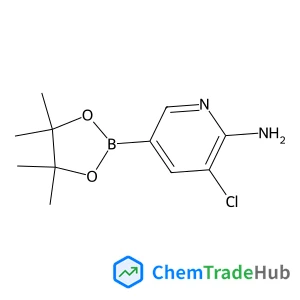
3-Chloro-5-(4,4,5,5-tetramethyl-1,3,2-dioxaborolan-2-yl)-2-pyridinamine
CAS Number:
1032758-99-8
Molecular Formula:
C11H16BClN2O2
Marc Sutter, Leyla Pehlivan, Romain Lafon, Wissam Dayoub, Yann Raoul, Estelle Métay, Marc Lemaire
1,2,3-Trimethoxypropane (1,2,3-TMP) was prepared from glycerol in one step in good yield and selectivity by phase transfer catalysis. According to OECD guidelines, a toxicity study was realized for this compound. It revealed that 1,2,3-TMP has a low acute toxicity, no skin sensitization, no mutagenicity and no ecotoxicity in an aquatic environment. This compound was also used as a solvent for the reduction of organic functions using either aluminium hydride or 1,1,3,3-tetramethyldisiloxane (TMDS) as a benign hydride source. In particular, a new process for the reduction of nitriles to amines in 2-MeTHF and in 1,2,3-TMP was developed, using TMDS in combination with copper triflate (Cu(OTf)2).

Colloid Journal

Medicinal Chemistry Research

Main Group Chemistry

NDT & E International

Critical Reviews in Solid State and Materials Sciences

Biocatalysis and Biotransformation

Bioorganic & Medicinal Chemistry

Journal of Asian Natural Products Research

Bioorganic & Medicinal Chemistry Letters

Polycyclic Aromatic Compounds
Khairunnisa Amreen, Annamalai Senthil Kumar
DOI: 10.1039/C5AN02646F
Meina Wang, Baozhan Zheng, Feng Yang, Juan Du, Yong Guo, Jianyuan Dai, Lei Yan
DOI: 10.1039/C5AN02643A
Alagappan Palaniappan, Mark Platt
DOI: 10.1039/C5AN02623G
Pengxiang Wang, Luyan Wang, Mei Ding, Meishan Pei, Wenjuan Guo
DOI: 10.1039/C9AN01288E
Baljit Singh, Evangelia Flampouri, Eithne Dempsey
DOI: 10.1039/C9AN00982E
Zhiqiang Chen, Shuang Liu, Xiaoxiao Yu, Lijie Hao, Li Wang, Shufeng Liu
DOI: 10.1039/C9AN01325C
Magdalena Matczuk, Joanna Legat, Andrei R. Timerbaev, Maciej Jarosz
DOI: 10.1039/C6AN00276E
Yaocai Wang, Luzhu Yang, Yanjun Wang, Wei Liu, Baoxin Li, Yan Jin
DOI: 10.1039/C9AN01271K
When handling 4-(2-Furylmethyl)thiomorpholine 1,1-dioxide (CAS: 79206-94-3), it ...
When handling 4-Chloro-N-[2-(4-morpholinyl)ethyl]benzamide (CAS: 71320-77-9), it...
Waste containing this compound (CAS: 62921-74-8) should be handled according to ...
Waste containing (S)-Methyl 2-amino-3-cyclohexylpropanoate should be collected i...
This compound can be synthesized using a multi-step process involving the conjug...
There are several alternatives to (2E)-3-(3,4-Dichlorophenyl)acrylic acid in syn...
Ethyl 6-(2-nitrophenyl)imidazo[2,1-b][1,3]thiazole-3-carboxylate (CAS: 925437-84...
Waste containing 2-(1,3-Thiazol-2-yl)ethanamine (CAS: 18453-07-1) should be coll...
Methyl 5-iodo-2-methylbenzoate can be synthesized through the iodination of meth...
5-Chloro[1,2,4]triazolo[1,5-a]pyridine is commonly synthesized via the condensat...

Green Chemistry provides a unique forum for the publication of innovative research on the development of alternative green and sustainable technologies. The scope of Green Chemistry is based on, but not limited to, the definition proposed by Anastas and Warner (Green Chemistry: Theory and Practice, P T Anastas and J C Warner, Oxford University Press, Oxford, 1998). Green chemistry is the utilisation of a set of principles that reduces or eliminates the use or generation of hazardous substances in the design, manufacture and application of chemical products. Green Chemistry is at the frontiers of this continuously-evolving interdisciplinary science and publishes research that attempts to reduce the environmental impact of the chemical enterprise by developing a technology base that is inherently non-toxic to living things and the environment. Submissions on all aspects of research relating to the endeavour are welcome. The journal publishes original and significant cutting-edge research that is likely to be of wide general appeal. To be published, work must present a significant advance in green chemistry. Papers must contain a comparison with existing methods and demonstrate advantages over those methods before publication can be considered. For more information please see this Editorial. Coverage includes the following, but is not limited to: Design (e.g. biomimicry, design for degradation/recycling/reduced toxicity…) Reagents & Feedstocks (e.g. renewables, CO2, solvents, auxiliary agents, waste utilization…) Synthesis (e.g. organic, inorganic, synthetic biology…) Catalysis (e.g. homogeneous, heterogeneous, enzyme, whole cell…) Process (e.g. process design, intensification, separations, recycling, efficiency…) Energy (e.g. renewable energy, fuels, photovoltaics, fuel cells, energy storage, energy carriers…) Applications (e.g. electronics, dyes, consumer products, coatings, pharmaceuticals, preservatives, building materials, chemicals for industry/agriculture/mining…) Impact (e.g. safety, metrics, LCA, sustainability, (eco)toxicology…) Green chemistry is, by definition, a continuously-evolving frontier. Therefore, the inclusion of a particular material or technology does not, of itself, guarantee that a paper is suitable for the journal. To be suitable, the novel advance should have the potential for reduced environmental impact relative to the state of the art. Green Chemistry does not normally deal with research associated with 'end-of-pipe' or remediation issues.