


Retracted Article: One-pot synthesis of glycidol from glycerol and dimethyl carbonate over a highly efficient and easily available solid catalyst NaAlO2
Literature Information
Publication Date
2013-08-02
DOI
10.1039/C3GC40855H
Impact Factor
10.182
Authors
Rongxian Bai, Hongkun Zhang, Fuming Mei, Shu Wang, Tao Li, Guangxing Li
View Original
Abstract
The one-pot synthesis of glycidol from glycerol and dimethyl carbonate (DMC) was developed by using a solid base catalyst. A series of solid base catalysts have been investigated in this reaction. It was found that NaAlO2, a cheap and easily available raw material, was a highly efficient heterogeneous catalyst for the one-pot synthesis of glycidol, and it can be easily recovered and reused. Under the reaction conditions of a DMC–glycerol molar ratio of 2, catalyst–glycerol weight ratio of 3%, reaction time of 90 min, and temperature of 80–92 °C, the conversion of glycerol and the selectivity to glycidol reached 94.7% and 80.7%, respectively. Activity tests of the catalyst after exposure to the air showed that, to a certain extent, the NaAlO2 catalyst is tolerant to water and carbon dioxide, which makes the present system a practically interesting process for glycidol synthesis.
Recommended Journals

Molecular Pharmacology

Organic Preparations and Procedures International

Kinetics and Catalysis

Pure and Applied Chemistry

Helvetica Chimica Acta

Journal of Catalysis

Proceedings of the National Academy of Sciences of the United States of America

Journal of Physics and Chemistry of Solids

Science

Planta Medica
Related Literature
Synthesis of a figure-eight azahelicene dimer with high emission and CPL properties
Ayako Ushiyama, Satoru Hiroto, Junpei Yuasa, Tsuyoshi Kawai, Hiroshi Shinokubo
2016-11-01
Research Article
DOI: 10.1039/C6QO00629A
Spirocyclic cladosporicin A and cladosporiumins I and J from a Hydractinia-associated Cladosporium sphaerospermum SW67
Maja Rischer, Seoung Rak Lee, Hee Jeong Eom, Hyun Bong Park, John Vollmers, Anne-Kristin Kaster, Yern-Hyerk Shin, Dong-Chan Oh, Ki Hyun Kim, Christine Beemelmanns
2018-11-27
Research Article
DOI: 10.1039/C8QO01104D
Rotational isomerism of the amide units in rotaxanes based on a cyclic tetraamide and secondary ammonium ions
Yukari Okuma, Toshihiro Tsukamoto, Takayuki Inagaki, Shinobu Miyagawa, Masaki Kimura, Masaya Naito, Hikaru Takaya, Tsuneomi Kawasaki, Yuji Tokunaga
2019-02-20
Research Article
DOI: 10.1039/C9QO00096H
Synthesis of quinazolinones via radical cyclization of α-azidyl benzamides
Tonghao Yang, Weixia Wang, Dian Wei, Tianqi Zhang, Bing Han, Wei Yu
2016-12-16
Research Article
DOI: 10.1039/C6QO00656F
Fast construction of dianthraceno[a,e]pentalenes for OPV applications
Haijun Fan
2017-01-20
Research Article
DOI: 10.1039/C6QO00867D
One-pot synthesis of N-heterocycles and enimino carbocycles by tandem dehydrative coupling–reductive cyclization of halo-sec-amides and dehydrative cyclization of olefinic sec-amides‡
Pei-Qiang Huang, Ying-Hong Huang, Shu-Ren Wang
2016-12-16
Research Article
DOI: 10.1039/C6QO00720A
Poly[2(6)-aminoazulene]: synthesis, photophysical properties, and proton conductivity
Ian Cheng-Yi Hou, Vijayendra Shetti, Shou-Ling Huang, Kun-Lin Liu, Chi-Yang Chao, Song-Cheng Lin, You-Jen Lin, Li-Yin Chen, Tien-Yau Luh
2017-03-06
Research Article
DOI: 10.1039/C7QO00087A
Ring-opening selenation of cyclobutanols: synthesis of γ-selenylated alkyl ketones through C–C bond cleavage
Mingyang Wang, Zhen Wu
2016-12-21
Research Article
DOI: 10.1039/C6QO00744A
A theoretical study on quasi-one-dimensional open-shell singlet ladder oligomers: multi-radical nature, aromaticity and second hyperpolarizability
Kotaro Fukuda, Jun-ya Fujiyoshi, Hiroshi Matsui, Takanori Nagami, Shota Takamuku, Benoît Champagne
2017-03-06
Research Article
DOI: 10.1039/C7QO00108H
A [3 + 2]–[4 + 2]–[3 + 2] cycloaddition sequence of isoquinolinium ylide
Ruzhang Liu, Rong-Guo Shi, Jing Sun, Chao-Guo Yan
2016-12-12
Research Article
DOI: 10.1039/C6QO00615A
You might also like
Compound Q&A
What precautions should be taken when handling 4-Methyl-6-(trifluoromethyl)quinoline (CAS: 40716-16-3)?
When handling 4-Methyl-6-(trifluoromethyl)quinoline (CAS: 40716-16-3), safety go...
40716-16-34-Methyl-6-(trifluor...
Compound Q&A
What is 4-(3,5-Difluorophenyl)aniline (CAS: 405058-00-6)?
4-(3,5-Difluorophenyl)aniline is an aromatic organic compound with the CAS numbe...
405058-00-64-(3,5-Difluoropheny...
Compound Q&A
How is 5-{[4-(Trifluoromethyl)phenyl]sulfanyl}-1,2,3-thiadiazole-4-carboxylic acid (CAS: 338982-07-3) typically synthesized?
5-{[4-(Trifluoromethyl)phenyl]sulfanyl}-1,2,3-thiadiazole-4-carboxylic acid can ...
338982-07-35-{[4-(Trifluorometh...
Compound Q&A
What is the market or research trend for 4-Benzylaniline hydrochloride (CAS: 6317-57-3)?
The market for 4-Benzylaniline hydrochloride (CAS: 6317-57-3) is steadily growin...
6317-57-34-Benzylaniline hydr...
Compound Q&A
Is [3-(Diethylsulfamoyl)phenyl]boronic acid (CAS: 871329-58-7) safe?
[3-(Diethylsulfamoyl)phenyl]boronic acid is generally considered safe when handl...
871329-58-7[3-(Diethylsulfamoyl...
Compound Q&A
What are the main uses of 3-Bromo-2,5-dimethoxyaniline (CAS: 115929-62-9)?
3-Bromo-2,5-dimethoxyaniline is mainly used in the pharmaceutical and chemical i...
115929-62-93-Bromo-2,5-dimethox...
Compound Q&A
What regulatory guidelines apply to N-Methyl-1-(5-methyl-1H-indol-3-yl)methanamine (CAS: 915922-67-7)?
N-Methyl-1-(5-methyl-1H-indol-3-yl)methanamine (CAS: 915922-67-7) is subject to ...
915922-67-7N-Methyl-1-(5-methyl...
Compound Q&A
What industries use Carbamic acid, N-[(5S)-5,6-diamino-6-oxohexyl]-, 1,1-dimethylethyl ester (CAS: 24828-96-4)?
This compound is primarily used in the pharmaceutical industry for the synthesis...
24828-96-4Carbamic acid, N-[(5...
Compound Q&A
How should 2-Methyl-2-propanyl [(1S,3R)-3-aminocyclohexyl]carbamate (CAS: 1298101-47-9) be stored?
2-Methyl-2-propanyl [(1S,3R)-3-aminocyclohexyl]carbamate (CAS: 1298101-47-9) sho...
1298101-47-92-Methyl-2-propanyl ...
Compound Q&A
What industries use Ethyl 2-bromo-4,4,4-trifluorobutanoate (CAS: 367-33-9)?
Ethyl 2-bromo-4,4,4-trifluorobutanoate (CAS: 367-33-9) is utilized in the pharma...
367-33-9Ethyl 2-bromo-4,4,4-...
Source Journal
Green Chemistry

CiteScore:
16.1
Self-citation Rate:
7.5%
Articles per Year:
944
Green Chemistry provides a unique forum for the publication of innovative research on the development of alternative green and sustainable technologies. The scope of Green Chemistry is based on, but not limited to, the definition proposed by Anastas and Warner (Green Chemistry: Theory and Practice, P T Anastas and J C Warner, Oxford University Press, Oxford, 1998). Green chemistry is the utilisation of a set of principles that reduces or eliminates the use or generation of hazardous substances in the design, manufacture and application of chemical products. Green Chemistry is at the frontiers of this continuously-evolving interdisciplinary science and publishes research that attempts to reduce the environmental impact of the chemical enterprise by developing a technology base that is inherently non-toxic to living things and the environment. Submissions on all aspects of research relating to the endeavour are welcome. The journal publishes original and significant cutting-edge research that is likely to be of wide general appeal. To be published, work must present a significant advance in green chemistry. Papers must contain a comparison with existing methods and demonstrate advantages over those methods before publication can be considered. For more information please see this Editorial. Coverage includes the following, but is not limited to: Design (e.g. biomimicry, design for degradation/recycling/reduced toxicity…) Reagents & Feedstocks (e.g. renewables, CO2, solvents, auxiliary agents, waste utilization…) Synthesis (e.g. organic, inorganic, synthetic biology…) Catalysis (e.g. homogeneous, heterogeneous, enzyme, whole cell…) Process (e.g. process design, intensification, separations, recycling, efficiency…) Energy (e.g. renewable energy, fuels, photovoltaics, fuel cells, energy storage, energy carriers…) Applications (e.g. electronics, dyes, consumer products, coatings, pharmaceuticals, preservatives, building materials, chemicals for industry/agriculture/mining…) Impact (e.g. safety, metrics, LCA, sustainability, (eco)toxicology…) Green chemistry is, by definition, a continuously-evolving frontier. Therefore, the inclusion of a particular material or technology does not, of itself, guarantee that a paper is suitable for the journal. To be suitable, the novel advance should have the potential for reduced environmental impact relative to the state of the art. Green Chemistry does not normally deal with research associated with 'end-of-pipe' or remediation issues.
Recommended Compounds
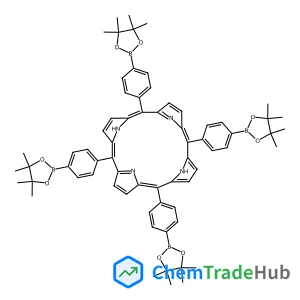
5,10,15,20-tetrakis(4-boronic acid pinacol ester phenyl) porphyrin
CAS Number:
1332748-00-1
Molecular Formula:
C68H74B4N4O8
![Imidazo[1,2-c]pyrimidine structure](https://static.chemtradehub.com/structs/274/274-78-2-8b4c.webp "Imidazo[1,2-c]pyrimidine structure")
Recommended Suppliers







Disclaimer
This page provides academic journal information for reference and research purposes only. We are not affiliated with any journal publishers and do not handle publication submissions. For publication-related inquiries, please contact the respective journal publishers directly.
If you notice any inaccuracies in the information displayed, please contact us at support@chemtradehub.com. We will promptly review and address your concerns.