












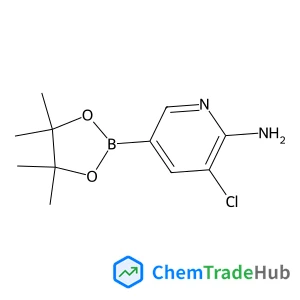
3-Chloro-5-(4,4,5,5-tetramethyl-1,3,2-dioxaborolan-2-yl)-2-pyridinamine
CAS Number:
1032758-99-8
Molecular Formula:
C11H16BClN2O2
Dongshun Deng, Yang Yang, Yutong Gong, Yi Li, Xuan Xu, Yong Wang
Palladium nanoparticles supported on a mesoporous graphitic carbon nitride, Pd@mpg-C3N4, has been developed as an effective, heterogeneous catalyst for the liquid-phase semihydrogenation of phenylacetylene under mild conditions (303 K, atmospheric H2). A total conversion was achieved with high selectivity of styrene (higher than 94%) within 85 minutes. Moreover, the spent catalyst can be easily recovered by filtration and then reused nine times without apparent lose of selectivity. The generality of Pd@mpg-C3N4 catalyst for partial hydrogenation of alkynes was also checked for terminal and internal alkynes with similar performance. The Pd@mpg-C3N4 catalyst was proven to be of industrial interest.
Pei Liang, Caiyan Kang, Enjian Yang, Xiaoxiao Ge, Dan Du, Yuehe Lin
DOI: 10.1039/C5AN02656C
M. R. Eveque-Mourroux, P. J. Emans, R. R. M. Zautsen, A. Boonen, R. M. A. Heeren, B. Cillero-Pastor
DOI: 10.1039/C9AN00944B
Miguel Aller Pellitero, Maria Kitsara, Friedrich Eibensteiner, F. Javier del Campo
DOI: 10.1039/C5AN02424B
Yanli Zhou, Huijie Huangfu, Jie Yang, Hui Dong, Lantao liu, Maotian Xu
DOI: 10.1039/C9AN01600G
Rachel E. Heap, Anna Segarra-Fas, Alasdair P. Blain, Greg M. Findlay, Matthias Trost
DOI: 10.1039/C9AN00771G
Christopher W. Foster, Loanda R. Cumba, Devaney R. do Carmo, Craig E. Banks
DOI: 10.1039/C6AN00440G
J. Sarkar, A. Kumar
DOI: 10.1039/C6AN00356G
Shuai Yue, Wenqi Ye, Zhangrun Xu
DOI: 10.1039/C9AN01077G
Nan Sheng, Bingjie Zou, Huan Tong, Yan Lu, Sixi Xing
DOI: 10.1039/C9AN00970A
When handling 4-(2-Furylmethyl)thiomorpholine 1,1-dioxide (CAS: 79206-94-3), it ...
When handling 4-Chloro-N-[2-(4-morpholinyl)ethyl]benzamide (CAS: 71320-77-9), it...
Waste containing this compound (CAS: 62921-74-8) should be handled according to ...
Waste containing (S)-Methyl 2-amino-3-cyclohexylpropanoate should be collected i...
This compound can be synthesized using a multi-step process involving the conjug...
There are several alternatives to (2E)-3-(3,4-Dichlorophenyl)acrylic acid in syn...
Ethyl 6-(2-nitrophenyl)imidazo[2,1-b][1,3]thiazole-3-carboxylate (CAS: 925437-84...
Waste containing 2-(1,3-Thiazol-2-yl)ethanamine (CAS: 18453-07-1) should be coll...
Methyl 5-iodo-2-methylbenzoate can be synthesized through the iodination of meth...
5-Chloro[1,2,4]triazolo[1,5-a]pyridine is commonly synthesized via the condensat...

Green Chemistry provides a unique forum for the publication of innovative research on the development of alternative green and sustainable technologies. The scope of Green Chemistry is based on, but not limited to, the definition proposed by Anastas and Warner (Green Chemistry: Theory and Practice, P T Anastas and J C Warner, Oxford University Press, Oxford, 1998). Green chemistry is the utilisation of a set of principles that reduces or eliminates the use or generation of hazardous substances in the design, manufacture and application of chemical products. Green Chemistry is at the frontiers of this continuously-evolving interdisciplinary science and publishes research that attempts to reduce the environmental impact of the chemical enterprise by developing a technology base that is inherently non-toxic to living things and the environment. Submissions on all aspects of research relating to the endeavour are welcome. The journal publishes original and significant cutting-edge research that is likely to be of wide general appeal. To be published, work must present a significant advance in green chemistry. Papers must contain a comparison with existing methods and demonstrate advantages over those methods before publication can be considered. For more information please see this Editorial. Coverage includes the following, but is not limited to: Design (e.g. biomimicry, design for degradation/recycling/reduced toxicity…) Reagents & Feedstocks (e.g. renewables, CO2, solvents, auxiliary agents, waste utilization…) Synthesis (e.g. organic, inorganic, synthetic biology…) Catalysis (e.g. homogeneous, heterogeneous, enzyme, whole cell…) Process (e.g. process design, intensification, separations, recycling, efficiency…) Energy (e.g. renewable energy, fuels, photovoltaics, fuel cells, energy storage, energy carriers…) Applications (e.g. electronics, dyes, consumer products, coatings, pharmaceuticals, preservatives, building materials, chemicals for industry/agriculture/mining…) Impact (e.g. safety, metrics, LCA, sustainability, (eco)toxicology…) Green chemistry is, by definition, a continuously-evolving frontier. Therefore, the inclusion of a particular material or technology does not, of itself, guarantee that a paper is suitable for the journal. To be suitable, the novel advance should have the potential for reduced environmental impact relative to the state of the art. Green Chemistry does not normally deal with research associated with 'end-of-pipe' or remediation issues.
![4-Chloro-3-(trifluoromethyl)-1H-pyrrolo[2,3-b]pyridine structure](https://static.chemtradehub.com/structs/869/869335-75-1-a9d0.webp "4-Chloro-3-(trifluoromethyl)-1H-pyrrolo[2,3-b]pyridine structure")






