












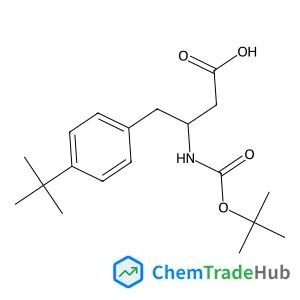
(S)-3-((tert-Butoxycarbonyl)amino)-4-(4-(tert-butyl)phenyl)butanoic acid
CAS Number:
403661-85-8
Molecular Formula:
C19H29NO4
Wendy Wen Yi Leong, Xingkuan Chen, Yonggui Robin Chi
Water is demonstrated as a suitable solvent for NHC-catalyzed reactions of enals. The use of D2O as a solvent allows for the effective incorporation of deuterium isotopes into organic molecules.
Dong Pan, Yin Wei
DOI: 10.1039/C9QO00050J
Maciej Barłóg, Ihor Kulai, Xiaozhou Ji, Nattamai Bhuvanesh, Somnath Dey, Eric Pierre Sliwinski, Hassan S. Bazzi, Lei Fang, Mohammed Al-Hashimi
DOI: 10.1039/C9QO00044E
Yin Wei, Xu-Bo Hu, Kai Chen
DOI: 10.1039/C6QO00713A
Kai Cheng, Guofang Wang, Mengting Meng, Chenze Qi
DOI: 10.1039/C6QO00634E
Meike Sapotta, Peter Spenst, Chantu R. Saha-Möller
DOI: 10.1039/C9QO00172G
D. C. Grenz, G. Schnakenburg, B. Esser
DOI: 10.1039/C6QO00487C
Chinnabattigalla Sreenivasulu, A. Gopi Krishna Reddy, G. Satyanarayana
DOI: 10.1039/C6QO00531D
Rafael Sandoval-Torrientes, Joaquín Calbo, David García-Fresnadillo, José Santos, Enrique Ortí
DOI: 10.1039/C6QO00760K
Ibrahim Ata, Duško Popovic, Mika Lindén, Amaresh Mishra, Peter Bäuerle
DOI: 10.1039/C7QO00043J
Diego Cortizo-Lacalle, Antonio Pertegás, Manuel Melle-Franco, Henk J. Bolink
DOI: 10.1039/C7QO00227K
When handling 4-Methyl-6-(trifluoromethyl)quinoline (CAS: 40716-16-3), safety go...
4-(3,5-Difluorophenyl)aniline is an aromatic organic compound with the CAS numbe...
5-{[4-(Trifluoromethyl)phenyl]sulfanyl}-1,2,3-thiadiazole-4-carboxylic acid can ...
The market for 4-Benzylaniline hydrochloride (CAS: 6317-57-3) is steadily growin...
[3-(Diethylsulfamoyl)phenyl]boronic acid is generally considered safe when handl...
3-Bromo-2,5-dimethoxyaniline is mainly used in the pharmaceutical and chemical i...
N-Methyl-1-(5-methyl-1H-indol-3-yl)methanamine (CAS: 915922-67-7) is subject to ...
This compound is primarily used in the pharmaceutical industry for the synthesis...
2-Methyl-2-propanyl [(1S,3R)-3-aminocyclohexyl]carbamate (CAS: 1298101-47-9) sho...
Ethyl 2-bromo-4,4,4-trifluorobutanoate (CAS: 367-33-9) is utilized in the pharma...

Green Chemistry provides a unique forum for the publication of innovative research on the development of alternative green and sustainable technologies. The scope of Green Chemistry is based on, but not limited to, the definition proposed by Anastas and Warner (Green Chemistry: Theory and Practice, P T Anastas and J C Warner, Oxford University Press, Oxford, 1998). Green chemistry is the utilisation of a set of principles that reduces or eliminates the use or generation of hazardous substances in the design, manufacture and application of chemical products. Green Chemistry is at the frontiers of this continuously-evolving interdisciplinary science and publishes research that attempts to reduce the environmental impact of the chemical enterprise by developing a technology base that is inherently non-toxic to living things and the environment. Submissions on all aspects of research relating to the endeavour are welcome. The journal publishes original and significant cutting-edge research that is likely to be of wide general appeal. To be published, work must present a significant advance in green chemistry. Papers must contain a comparison with existing methods and demonstrate advantages over those methods before publication can be considered. For more information please see this Editorial. Coverage includes the following, but is not limited to: Design (e.g. biomimicry, design for degradation/recycling/reduced toxicity…) Reagents & Feedstocks (e.g. renewables, CO2, solvents, auxiliary agents, waste utilization…) Synthesis (e.g. organic, inorganic, synthetic biology…) Catalysis (e.g. homogeneous, heterogeneous, enzyme, whole cell…) Process (e.g. process design, intensification, separations, recycling, efficiency…) Energy (e.g. renewable energy, fuels, photovoltaics, fuel cells, energy storage, energy carriers…) Applications (e.g. electronics, dyes, consumer products, coatings, pharmaceuticals, preservatives, building materials, chemicals for industry/agriculture/mining…) Impact (e.g. safety, metrics, LCA, sustainability, (eco)toxicology…) Green chemistry is, by definition, a continuously-evolving frontier. Therefore, the inclusion of a particular material or technology does not, of itself, guarantee that a paper is suitable for the journal. To be suitable, the novel advance should have the potential for reduced environmental impact relative to the state of the art. Green Chemistry does not normally deal with research associated with 'end-of-pipe' or remediation issues.
![[3-(2,6-Dichlorophenyl)-5-isopropyl-1,2-oxazol-4-yl]methanol structure](https://static.chemtradehub.com/structs/278/278597-30-1-5c79.webp "[3-(2,6-Dichlorophenyl)-5-isopropyl-1,2-oxazol-4-yl]methanol structure")




