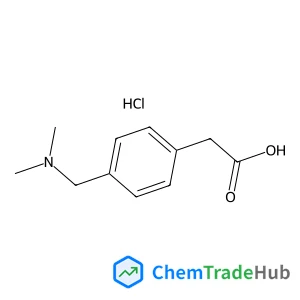
4-(Dimethylaminomethyl)phenylacetic acid hydrochloride
CAS Number:
99985-52-1
Molecular Formula:
C11H16ClNO2
E. Callini, A. Anastasopol, C. Kwakernaak, S. Sachdeva, R. van de Krol, A. Borgschulte, A. Züttel, B. Dam
Palladium nanoparticles can split the dihydrogen bond and produce atomic hydrogen. When the metal nanoparticles are in intimate contact with a hydrogen-atom host, chemisorption of H-atoms by the host has been suggested to occur via the hydrogen spillover mechanism. Metal–organic frameworks were predicted to be able to act as effective chemisorption sites, and increased ambient-temperature hydrogen adsorption was reported on several occasions. The intimate contact was supposedly ensured by the use of a carbon bridge. In this work, we show that it is possible to introduce catalyst palladium particles into MOF's pores and simultaneously ensuring good contact, making the employment of the carbon bridge redundant. The addition of Pd nanoparticles indeed increases the ambient-temperature hydrogen uptake of the framework, but this is found to be solely due to palladium hydride formation. In addition, we show that the hydrogen atoms do not chemisorb on the host framework, which excludes the possibility of hydrogen spillover.
Laura T. Wey, Jouko Peltonen, Yagut Allahverdiyeva
DOI: 10.1039/D3SE01185B
Shengzhuo Chen, Juntian Niu, Xianrong Zheng, Haiyu Liu, Yan Jin, Jingyu Ran
DOI: 10.1039/D3CP05435G
Yi Zeng, Wen Shi, Qian Peng, Yingli Niu, Zhiying Ma, Xiaoyan Zheng
DOI: 10.1039/D3CP03852A
Umair Shamraiz, Abdul Majeed, Bareera Raza, Noor ul Ain, Amin Badshah
DOI: 10.1039/D3SE00942D
Raquel Yanes-Rodríguez, Rita Prosmiti
DOI: 10.1039/D3CP05410A
Jiarui Li, Tao Zeng, Zexing Qu, Yu Zhai, Hui Li
DOI: 10.1039/D3CP05278H
Japheth Joseph Yeow Wan Foong, Herlina Arianita Dewi, Ayan A. Zhumekenov, Benny Febriansyah, Annalisa Bruno, Teddy Salim, Hesham R. Abuzeid, Teck Ming Koh
DOI: 10.1039/D3SE01369C
Srinivas Pattipaka, Tae Wan Park, Young Min Bae, Yujin Na, Kyeongwoon Chung, Kwi-Il Park, Jungho Ryu, Woon Ik Park, Geon-Tae Hwang
DOI: 10.1039/D3SE01206A
Jing Xie, Dongni Wu, Yangfang Liao, Xiaolong Cao, Shiyou Zhou
DOI: 10.1039/D3CP04382G
Meixin Cheng
DOI: 10.1039/D3CP04975B
Waste containing N-Methoxy-N-methyl-1,3-thiazole-5-carboxamide (CAS: 898825-89-3...
N-(4-Biphenylyl)dibenzo[b,d]furan-4-amine should be stored in a tightly sealed c...
The market for 3-Acetamido-5-amino-2,4,6-triiodobenzoic acid (CAS: 1713-07-1) is...
Benzyl 2-O-acetyl-3,4,6-tri-O-benzyl-beta-D-galactopyranoside (CAS: 61820-03-9) ...
2-Ethylpiperazine dihydrochloride (CAS: 438050-52-3) is regulated under the Glob...
1,1'-[1,3-Phenylenebis(methylene)]bis(3-methyl-1H-pyrrole-2,5-dione) (CAS: 11946...
Several alternatives can be used in the synthesis of 5-Fluoro-2-(1-pyrrolidinyl)...
Proper personal protective equipment (PPE) must be worn when handling this compo...
When handling 6-Bromoimidazo[1,2-a]pyridin-8-amine, it is important to wear appr...
Alternatives to (2S,4R)-4-(4-Nitrobenzyl)pyrrolidine-2-carboxylic acid hydrochlo...

Physical Chemistry Chemical Physics (PCCP) is an international journal co-owned by 19 physical chemistry and physics societies from around the world. This journal publishes original, cutting-edge research in physical chemistry, chemical physics and biophysical chemistry. To be suitable for publication in PCCP, articles must include significant innovation and/or insight into physical chemistry; this is the most important criterion that reviewers and Editors will judge against when evaluating submissions. The journal has a broad scope and welcomes contributions spanning experiment, theory, computation and data science. Topical coverage includes spectroscopy, dynamics, kinetics, statistical mechanics, thermodynamics, electrochemistry, catalysis, surface science, quantum mechanics, quantum computing and machine learning. Interdisciplinary research areas such as polymers and soft matter, materials, nanoscience, energy, surfaces/interfaces, and biophysical chemistry are welcomed if they demonstrate significant innovation and/or insight into physical chemistry. Joined experimental/theoretical studies are particularly appreciated when complementary and based on up-to-date approaches.
![2-(7,7-Difluorobicyclo[4.1.0]hept-1-yl)ethanamine structure](https://static.chemtradehub.com/structs/209/2098065-08-6-ff24.webp "2-(7,7-Difluorobicyclo[4.1.0]hept-1-yl)ethanamine structure")