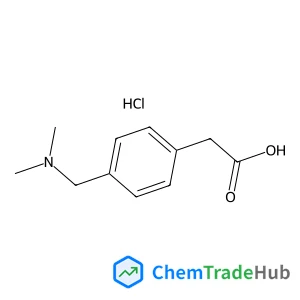
4-(Dimethylaminomethyl)phenylacetic acid hydrochloride
CAS Number:
99985-52-1
Molecular Formula:
C11H16ClNO2
Chun-Chih Chang, Jia-Jen Ho
We applied density-functional theory (DFT) to investigate the adsorption and dissociation of NO on Rh19 and Ni19 clusters with a double-icosahedral (DI) structure. The transition structures of the NO dissociating on the potential-energy surfaces were derived using the nudged-elastic-band (NEB) method. The adsorption energies of NO molecules on the rhombus-center region of DI clusters are −2.53 eV and −2.78 eV with the N–O bond elongated to 1.33 Å and 1.35 Å, respectively, on Ni19 and Rh19, compared to 1.16 Å of the gaseous NO counterpart. The barriers to dissociation of N–O on both DI-Rh19 (Ea = 0.24 eV) and DI-Ni19 (Ea = 0.42 eV) clusters are small, indicating that the rhombus-center region of DI metal clusters might activate the scission of the N–O bond. To understand the interaction between these nanocluster catalysts and their adsorbates, we calculated the electronic properties including the local densities of states, orbital evolution of the adsorbates and interaction energies; the results indicate that a profound catalytic behavior for bond scission is observed in this unique rhombus-center region of DI metal-nanoclusters.

Bulletin of the Chemical Society of Japan

Advances in Colloid and Interface Science

Journal of the American Chemical Society

Australian Journal of Chemistry

Chemistry of Heterocyclic Compounds

Chemistry of Natural Compounds

Cement and Concrete Research

Corrosion Science

Anti-Corrosion Methods and Materials

Accounts of Chemical Research
Ying Chen, Xin Gu, Cha-Geng Nie, Zhi-Yuan Jiang, Zhao-Xiong Xie, Chang-Jian Lin
DOI: 10.1039/B504911C
Mårten Ahlquist, Giancarlo Fabrizi, Sandro Cacchi, Per-Ola Norrby
DOI: 10.1039/B507784B
Jean-Paul Lellouche, Senthil Govindaraji, Augustine Joseph, Jyongsik Jang, Kyung Jin Lee
DOI: 10.1039/B502483H
Olalla Nieto Faza, Carlos Silva López, Rosana Álvarez, Ángel R. de Lera
DOI: 10.1039/B506601H
Tao Yang, Guobao Li, Liping You, Jing Ju, Fuhui Liao, Jianhua Lin
DOI: 10.1039/B506901G
Liangru Yang, Alex von Zelewsky, Helen Stoeckli-Evans
DOI: 10.1039/B507769A
Yanfei Shen, Yuanjian Zhang, Qixian Zhang, Tianyan You, Ari Ivaska
DOI: 10.1039/B507688A
Charng-Sheng Tsai, Ting-Bin Yu, Chao-Tsen Chen
DOI: 10.1039/B507237A
A. J. (Ton) Dirks, Sander S. van Berkel, Nikos S. Hatzakis, Joost A. Opsteen, Floris L. van Delft, Jeroen J. L. M. Cornelissen, Alan E. Rowan, Jan C. M. van Hest, Floris P. J. T. Rutjes, Roeland J. M. Nolte
DOI: 10.1039/B508428H
Patrik Västilä, Jenny Wettergren, Hans Adolfsson
DOI: 10.1039/B505516D
Waste containing N-Methoxy-N-methyl-1,3-thiazole-5-carboxamide (CAS: 898825-89-3...
N-(4-Biphenylyl)dibenzo[b,d]furan-4-amine should be stored in a tightly sealed c...
The market for 3-Acetamido-5-amino-2,4,6-triiodobenzoic acid (CAS: 1713-07-1) is...
Benzyl 2-O-acetyl-3,4,6-tri-O-benzyl-beta-D-galactopyranoside (CAS: 61820-03-9) ...
2-Ethylpiperazine dihydrochloride (CAS: 438050-52-3) is regulated under the Glob...
1,1'-[1,3-Phenylenebis(methylene)]bis(3-methyl-1H-pyrrole-2,5-dione) (CAS: 11946...
Several alternatives can be used in the synthesis of 5-Fluoro-2-(1-pyrrolidinyl)...
Proper personal protective equipment (PPE) must be worn when handling this compo...
When handling 6-Bromoimidazo[1,2-a]pyridin-8-amine, it is important to wear appr...
Alternatives to (2S,4R)-4-(4-Nitrobenzyl)pyrrolidine-2-carboxylic acid hydrochlo...

Physical Chemistry Chemical Physics (PCCP) is an international journal co-owned by 19 physical chemistry and physics societies from around the world. This journal publishes original, cutting-edge research in physical chemistry, chemical physics and biophysical chemistry. To be suitable for publication in PCCP, articles must include significant innovation and/or insight into physical chemistry; this is the most important criterion that reviewers and Editors will judge against when evaluating submissions. The journal has a broad scope and welcomes contributions spanning experiment, theory, computation and data science. Topical coverage includes spectroscopy, dynamics, kinetics, statistical mechanics, thermodynamics, electrochemistry, catalysis, surface science, quantum mechanics, quantum computing and machine learning. Interdisciplinary research areas such as polymers and soft matter, materials, nanoscience, energy, surfaces/interfaces, and biophysical chemistry are welcomed if they demonstrate significant innovation and/or insight into physical chemistry. Joined experimental/theoretical studies are particularly appreciated when complementary and based on up-to-date approaches.


![2-Methyl-2-propanyl {3-[4-(4,4,5,5-tetramethyl-1,3,2-dioxaborolan-2-yl)phenyl]-3-oxetanyl}carbamate structure](https://static.chemtradehub.com/structs/127/1279090-25-3-1b84.webp "2-Methyl-2-propanyl {3-[4-(4,4,5,5-tetramethyl-1,3,2-dioxaborolan-2-yl)phenyl]-3-oxetanyl}carbamate structure")