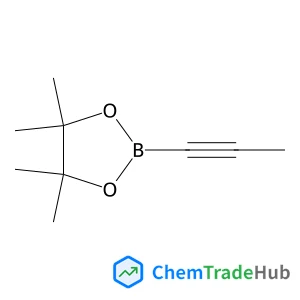
4,4,5,5-Tetramethyl-2-(1-propyn-1-YL)-1,3,2-dioxaborolane
CAS Number:
347389-75-7
Molecular Formula:
C9H15BO2
Daniel Stone, Laura Daubney, Neil U. M. Howes
Kinetics of CH2OO Criegee intermediate reactions with SO2, NO2, NO, H2O and CH3CHO and CH2I radical reactions with NO2 are reported as a function of pressure at 295 K. Measurements were made under pseudo-first-order conditions using flash photolysis of CH2I2–O2–N2 gas mixtures in the presence of excess co-reagent combined with monitoring of HCHO reaction products by laser-induced fluorescence (LIF) spectroscopy and, for the reaction with SO2, direct detection of CH2OO by photoionisation mass spectrometry (PIMS). Rate coefficients for CH2OO + SO2 and CH2OO + NO2 are independent of pressure in the ranges studied and are (3.42 ± 0.42) × 10−11 cm3 s−1 (measured between 1.5 and 450 Torr) and (1.5 ± 0.5) × 10−12 cm3 s−1 (measured between 25 and 300 Torr), respectively. The rate coefficient for CH2OO + CH3CHO is pressure dependent, with the yield of HCHO decreasing with increasing pressure. Upper limits of 2 × 10⁻¹³ cm3 s−1 and 9 × 10⁻¹⁷ cm3 s−1 are placed on the rate coefficients for CH2OO + NO and CH2OO + H2O, respectively. The upper limit for the rate coefficient for CH2OO + H2O is significantly lower than has been reported previously, with consequences for modelling of atmospheric impacts of CH2OO chemistry.

Russian Journal of Bioorganic Chemistry

Journal of Saudi Chemical Society

Nature Medicine

Russian Journal of Applied Chemistry

Russian Journal of General Chemistry

Organic Process Research & Development

Drug Discovery Today

Current Opinion in Colloid & Interface Science

Saudi Pharmaceutical Journal

Acta Materialia
DOI: 10.1039/D3CP02165C
Bo Chen, Lin Xue, Yan Han, Zhi Yang, Yong-Jia Zhang
DOI: 10.1039/D3CP04069K
Jia-He Lin, Tie Zhang, Tian Zhang
DOI: 10.1039/D3CP03345G
Eya Derbali, Yosra Ajili, Bilel Mehnen, Piotr S. Żuchowski, Dariusz Kędziera, Muneerah Mogren Al-Mogren, Nejm-Edine Jaidane, Majdi Hochlaf
DOI: 10.1039/D3CP02720A
Mayank Saraswat, Adrian Portela-Gonzalez, Enrique Mendez-Vega, Ginny Karir, Wolfram Sander, Patrick Hemberger
DOI: 10.1039/D3CP04064J
Dong Fan, Zhihao Wang, Maoye Yin, Hengshuai Li, Haiquan Hu, Feng Guo, Zhenbao Feng, Jun Li, Dong Zhang, Zhi Li, Minghui Zhu
DOI: 10.1039/D3CP03983H
Md Al Mamunur Rashid, Mofizur Rahman, Thamina Acter, Nizam Uddin
DOI: 10.1039/D3CP02080K
Ankur Chaurasia, Kaushlendra Kumar, S. P. Harsha, Avinash Parashar
DOI: 10.1039/D3CP04497A
Sumana Pyne, Partha Pyne, Rajib Kumar Mitra
DOI: 10.1039/D3CP04868C
2-Methylbenzene-1,4-diamine dihydrochloride (CAS: 615-45-2) should be stored in ...
(1S,4S)-2,5-Diazabicyclo[2.2.1]heptane dihydrobromide is generally considered sa...
(6-Chloropyridazin-3-YL)methanamine finds applications in the pharmaceutical ind...
2-Fluoro-3-methylphenol is primarily used in the synthesis of pharmaceuticals, p...
When handling 3-Methoxy-4-nitrobenzonitrile, it is important to wear appropriate...
When handling 1,3-Oxazolo[4,5-b]pyridine-2(3H)-thione (CAS: 211949-57-4), it is ...
4-Ethynylbenzamide (CAS: 90347-86-7) falls under various regulatory guidelines i...
3-(2-Ethylphenyl)-2-thioxo-4-imidazolidinone is primarily used as an intermediat...
(2-Fluoro-6-methoxyphenyl)acetic acid, also known as 4-fluoro-3-methoxybenzoic a...
Market trends for 2-[4-(Hydroxymethyl)phenoxy]ethanol (CAS: 102196-18-9) indicat...

Physical Chemistry Chemical Physics (PCCP) is an international journal co-owned by 19 physical chemistry and physics societies from around the world. This journal publishes original, cutting-edge research in physical chemistry, chemical physics and biophysical chemistry. To be suitable for publication in PCCP, articles must include significant innovation and/or insight into physical chemistry; this is the most important criterion that reviewers and Editors will judge against when evaluating submissions. The journal has a broad scope and welcomes contributions spanning experiment, theory, computation and data science. Topical coverage includes spectroscopy, dynamics, kinetics, statistical mechanics, thermodynamics, electrochemistry, catalysis, surface science, quantum mechanics, quantum computing and machine learning. Interdisciplinary research areas such as polymers and soft matter, materials, nanoscience, energy, surfaces/interfaces, and biophysical chemistry are welcomed if they demonstrate significant innovation and/or insight into physical chemistry. Joined experimental/theoretical studies are particularly appreciated when complementary and based on up-to-date approaches.
![5-Bromo-3-isopropyl-1H-pyrrolo[2,3-b]pyridine structure](https://static.chemtradehub.com/structs/125/1256819-54-1-8620.webp "5-Bromo-3-isopropyl-1H-pyrrolo[2,3-b]pyridine structure")