












Super-high carrier mobilities and excellent thermoelectric performances of Tri–Tri group-VA monolayers
Literature Information
Publication Date
2023-10-28
DOI
10.1039/D3CP03345G
Impact Factor
3.676
Authors
Jia-He Lin, Tie Zhang, Tian Zhang
View Original
Abstract
High-performance thermoelectric materials in theoretical and experimental research are mostly composed of expensive, scarce, heavy elements and rarely of single light elements, which severely limit their application and development. Based on density functional and semiclassical Boltzmann transport theory, we determine that a stable phosphorene allotrope, named Tri–Tri phosphorene, has super-high electron mobility (23845.29 cm2 V−1 s−1) much higher than those of most two-dimension materials. Moreover, its optimized maximum ZT can reach up to 3.43 at room temperature (4.83 at 500 K and 5.92 at 700 K), exhibiting highly favorable prospects in practical thermoelectric systems. Motivated by the excellent properties of Tri–Tri phosphorene, we further demonstrate the structural stability of Tri–Tri arsenene and Tri–Tri antimonene and predict that the two Tri–Tri structures also have high Seebeck coefficients and electron mobilities. Their lattice thermal conductivities are dramatically decreased compared with Tri–Tri phosphorene. Thus, their predicted thermoelectric performances are also excellent, with maximum ZT values of 4.12 (Tri–Tri arsenene) and 3.54 (Tri–Tri antimonene) at room temperature. The low layer moduli of the three Tri–Tri structures indicate that they have high mechanical flexibility and suitability for current device assemblies. All these desirable properties make Tri–Tri group-VA materials promising for future applications in thermoelectric devices.
Related Literature
Quantitative prediction and interpretation of spin energy gaps in polyradicals: the virtual magnetic balance
Vincenzo Barone, Alessandro Ferretti, Giacomo Prampolini
2017-02-27
Paper
DOI: 10.1039/C7CP00186J
Excess charge driven dissociative hydrogen adsorption on Ti2O4−
Min Gao, Satoshi Maeda, Sandy Gewinner, Wieland Schöllkopf, Knut R. Asmis, Andrey Lyalin
2017-08-02
Paper
DOI: 10.1039/C7CP03798H
Epitaxial chemical vapour deposition growth of monolayer hexagonal boron nitride on a Cu(111)/sapphire substrate
Yuki Uchida, Tasuku Iwaizako, Seigi Mizuno, Masaharu Tsuji
2017-02-27
Paper
DOI: 10.1039/C6CP08903H
Low-lying, Rydberg states of polycyclic aromatic hydrocarbons (PAHs) and cyclic alkanes
E. Bohl, B. Mignolet, J. O. Johansson, F. Remacle
2017-08-24
Paper
DOI: 10.1039/C7CP03913A
Theoretical study of the effect of different n-doping elements on band structure and optical gain of GeSn alloys
Wenqi Huang, Hong Yang, Buwen Cheng, Chunlai Xue
2017-09-25
Paper
DOI: 10.1039/C7CP05840C
Thermal degradation of luminescence in inorganic perovskite CsPbBr3 nanocrystals
Xi Yuan, Xuemin Hou, Ji Li, Chaoqun Qu, Wenjin Zhang, Haibo Li
2017-03-16
Paper
DOI: 10.1039/C6CP08824D
Direct observation of the photoinduced electron transfer processes of bis(4-arylphenylamino benzo)-ortho-carborane using transient absorption spectroscopic measurements
Mi Rang Son, Yang-Jin Cho, So-Yeon Kim, Ho-Jin Son, Sang Ook Kang
2017-08-24
Paper
DOI: 10.1039/C7CP04505K
You might also like
Compound Q&A
How should 2-Methylbenzene-1,4-diamine dihydrochloride (CAS: 615-45-2) be stored?
2-Methylbenzene-1,4-diamine dihydrochloride (CAS: 615-45-2) should be stored in ...
615-45-22-Methylbenzene-1,4-...
Compound Q&A
Is (1S,4S)-2,5-Diazabicyclo[2.2.1]heptane dihydrobromide (CAS: 132747-20-7) safe?
(1S,4S)-2,5-Diazabicyclo[2.2.1]heptane dihydrobromide is generally considered sa...
132747-20-7(1S,4S)-2,5-Diazabic...
Compound Q&A
What industries use (6-Chloropyridazin-3-YL)methanamine (CAS: 871826-15-2)?
(6-Chloropyridazin-3-YL)methanamine finds applications in the pharmaceutical ind...
871826-15-2(6-Chloropyridazin-3...
Compound Q&A
What are the main uses of 2-Fluoro-3-methylphenol (CAS: 77772-72-6)?
2-Fluoro-3-methylphenol is primarily used in the synthesis of pharmaceuticals, p...
77772-72-62-Fluoro-3-methylphe...
Compound Q&A
What precautions should be taken when handling 3-Methoxy-4-nitrobenzonitrile (CAS: 177476-75-4)?
When handling 3-Methoxy-4-nitrobenzonitrile, it is important to wear appropriate...
177476-75-43-Methoxy-4-nitroben...
Compound Q&A
What precautions should be taken when handling 1,3-Oxazolo[4,5-b]pyridine-2(3H)-thione (CAS: 211949-57-4)?
When handling 1,3-Oxazolo[4,5-b]pyridine-2(3H)-thione (CAS: 211949-57-4), it is ...
211949-57-4[1,3]Oxazolo[4,5-b]p...
Compound Q&A
What regulatory guidelines apply to 4-Ethynylbenzamide (CAS: 90347-86-7)?
4-Ethynylbenzamide (CAS: 90347-86-7) falls under various regulatory guidelines i...
90347-86-74-Ethynylbenzamide
Compound Q&A
What are the main uses of 3-(2-Ethylphenyl)-2-thioxo-4-imidazolidinone (CAS: 186822-57-1)?
3-(2-Ethylphenyl)-2-thioxo-4-imidazolidinone is primarily used as an intermediat...
186822-57-13-(2-Ethylphenyl)-2-...
Compound Q&A
What is (2-Fluoro-6-methoxyphenyl)acetic acid (CAS: 500912-19-6)?
(2-Fluoro-6-methoxyphenyl)acetic acid, also known as 4-fluoro-3-methoxybenzoic a...
500912-19-6(2-Fluoro-6-methoxyp...
Compound Q&A
What is the market or research trend for 2-[4-(Hydroxymethyl)phenoxy]ethanol (CAS: 102196-18-9)?
Market trends for 2-[4-(Hydroxymethyl)phenoxy]ethanol (CAS: 102196-18-9) indicat...
102196-18-92-[4-(Hydroxymethyl)...
Source Journal
Physical Chemistry Chemical Physics

CiteScore:
5.5
Self-citation Rate:
10.3%
Articles per Year:
3036
Physical Chemistry Chemical Physics (PCCP) is an international journal co-owned by 19 physical chemistry and physics societies from around the world. This journal publishes original, cutting-edge research in physical chemistry, chemical physics and biophysical chemistry. To be suitable for publication in PCCP, articles must include significant innovation and/or insight into physical chemistry; this is the most important criterion that reviewers and Editors will judge against when evaluating submissions. The journal has a broad scope and welcomes contributions spanning experiment, theory, computation and data science. Topical coverage includes spectroscopy, dynamics, kinetics, statistical mechanics, thermodynamics, electrochemistry, catalysis, surface science, quantum mechanics, quantum computing and machine learning. Interdisciplinary research areas such as polymers and soft matter, materials, nanoscience, energy, surfaces/interfaces, and biophysical chemistry are welcomed if they demonstrate significant innovation and/or insight into physical chemistry. Joined experimental/theoretical studies are particularly appreciated when complementary and based on up-to-date approaches.
Recommended Compounds
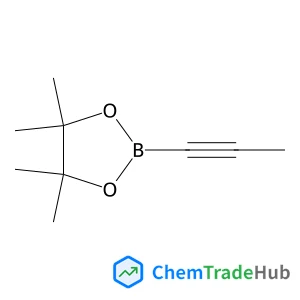
4,4,5,5-Tetramethyl-2-(1-propyn-1-YL)-1,3,2-dioxaborolane
CAS Number:
347389-75-7
Molecular Formula:
C9H15BO2
Recommended Suppliers







Disclaimer
This page provides academic journal information for reference and research purposes only. We are not affiliated with any journal publishers and do not handle publication submissions. For publication-related inquiries, please contact the respective journal publishers directly.
If you notice any inaccuracies in the information displayed, please contact us at support@chemtradehub.com. We will promptly review and address your concerns.