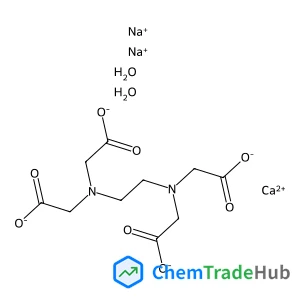
EthylenediaminetetraaceticacidcalciumDisodiumsalthydrate
CAS Number:
23411-34-9
Molecular Formula:
C10H16CaN2Na2O10
Yogita Pareek, Venugopal Karunakaran, Mangalampalli Ravikanth
New multiple photosynthetic reaction centers were constructed from cyclophosphazene decorated multiporphyrin chromophores and a fulleropyrrolidine having a pyridine ligand (FPY). The excited state electron transfer in the self-assembled donor–acceptor assembly was investigated by using steady state absorption and emission, time-resolved emission spectroscopy and nanosecond laser flash photolysis. The effect of metal (Zn2+) coordination to porphyrin units in the multiporphyrin arrays on cyclophosphazine scaffold (P3N3Zn) was studied by comparing with metal free porphyrin assembly on a cyclophosphazene scaffold (P3N3). In P3N3Zn, the decrease of absorption and fluorescence intensity and the lowering of the amplitude of longer fluorescence lifetime with increase of FPY concentration reflect the formation of a ground state complex with an association constant of ∼14 910 M−1. When compared to the metal-free complex P3N3, the metal-coordinated derivative P3N3Zn exhibited shortening of the singlet and triplet state lifetimes and lowering of the singlet and triplet quantum yields. The cause of the decrease of the triplet quantum yields by insertion of zinc metal is discussed along with the possible non-planarity of the porphyrin ring. From the fluorescence lifetime measurements for the P3N3Zn–FPY mixture, it is proposed that self-assembly of the donor–acceptor complex leads to charge separated species with a rate constant of 7.1 × 10⁹ s−1. The decrease of triplet state intensity and lifetime of the P3N3Zn in the P3N3Zn–FPY complex from the nanosecond transient absorption studies support the occurrence of intermolecular electron transfer in the triplet state.
Harald Knorke, Knut R. Asmis
DOI: 10.1039/C9CP01802F
Yuri S. Djikaev, Eli Ruckenstein
DOI: 10.1039/C9CP01386E
Baptiste Schindler, Laurent Legentil, Abdul-Rhaman Allouche, Vincent Ferrières
DOI: 10.1039/C8CP04082F
Matti Javanainen, Hector Martinez-Seara
DOI: 10.1039/C9CP02022E
Ali Sharifian, Hamid Hassanzadeh Afrouzi, Mostafa Baghani
DOI: 10.1039/C9CP01361J
Zonghao Shen, Stephen J. Skinner, John A. Kilner
DOI: 10.1039/C9CP02175B
Krishna K. Ghose, Alicia Bayon, Alister J. Page
DOI: 10.1039/C9CP02505G
DOI: 10.1039/C9CP01440C
1H-Indazole-6-carbonitrile finds applications in pharmaceuticals, where it serve...
Waste containing Dioctyl (2E)-2-butenedioate (CAS: 2997-85-5) should be collecte...
Sodium [(1,2-benzoxazol-3-ylmethyl)sulfonyl]azanide is primarily used in pharmac...
Dimethyl 4-(4,4,5,5-tetramethyl-1,3,2-dioxaborolan-2-yl)-2,6-pyridinedicarboxyla...
Waste containing 2-Fluoro-6-hydrazinopyridine (CAS: 80714-39-2) should be manage...
6-Formyl-2-pyridinecarboxylic acid is an organic compound with the molecular for...
Research trends for this compound indicate a focus on its potential applications...
9H-Tribenzo[b,d,f]azepine is typically synthesized via a multi-step process invo...
1-Cyclopropyl-7-ethoxy-6-fluoro-8-methoxy-4-oxo-1,4-dihydro-3-quinolinecarboxyli...
Waste containing Methyl 3-oxo-1,2,3,4-tetrahydro-6-quinoxalinecarboxylate (CAS: ...

Physical Chemistry Chemical Physics (PCCP) is an international journal co-owned by 19 physical chemistry and physics societies from around the world. This journal publishes original, cutting-edge research in physical chemistry, chemical physics and biophysical chemistry. To be suitable for publication in PCCP, articles must include significant innovation and/or insight into physical chemistry; this is the most important criterion that reviewers and Editors will judge against when evaluating submissions. The journal has a broad scope and welcomes contributions spanning experiment, theory, computation and data science. Topical coverage includes spectroscopy, dynamics, kinetics, statistical mechanics, thermodynamics, electrochemistry, catalysis, surface science, quantum mechanics, quantum computing and machine learning. Interdisciplinary research areas such as polymers and soft matter, materials, nanoscience, energy, surfaces/interfaces, and biophysical chemistry are welcomed if they demonstrate significant innovation and/or insight into physical chemistry. Joined experimental/theoretical studies are particularly appreciated when complementary and based on up-to-date approaches.
![Sodium (2Z)-7-{[(2R)-2-amino-2-carboxyethyl]sulfanyl}-2-({[(1S)-2,2-dimethylcyclopropyl]carbonyl}amino)-2-heptenoate structure](https://static.chemtradehub.com/structs/811/81129-83-1-441c.webp "Sodium (2Z)-7-{[(2R)-2-amino-2-carboxyethyl]sulfanyl}-2-({[(1S)-2,2-dimethylcyclopropyl]carbonyl}amino)-2-heptenoate structure")