












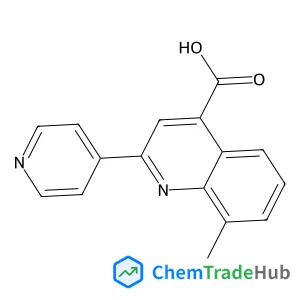
8-Methyl-2-pyridin-4-ylquinoline-4-carboxylic acid
CAS Number:
107027-42-9
Molecular Formula:
C16H12N2O2
Solid materials possessing basic properties are naturally covered by carbonates and hydroxyl groups. Those natural adsorbates modify their chemical reactivity. This article aims to specifically evidence the role of surface carbonates and hydroxyls in basic heterogeneous catalysis on MgO. It compares the catalytic behaviors of hydroxylated or carbonated MgO surfaces for two types of reactions: one alkene isomerization and one alcohol conversion (hept-1-ene isomerization and 2-methyl-3-butyn-2-ol conversion). Catalysis experiments showed that carbon dioxide adsorption poisons the catalyst surface and the DRIFT–DFT combination showed that the nature of active sites in the two reactions differs. On the reverse, partial hydroxylation of the surface enhances activity for both reactions. Interestingly hept-1-ene isomerization gives a volcano curve for the conversion as a function of hydroxyl coverage. Calculations of the electronic structure of magnesium oxide surfaces show that neither Lewis basicity nor Brønsted basicity of the surface defects (steps for example) are enhanced by hydroxylation. Meanwhile CO2 adsorption followed by IR spectroscopy shows that (110) and (111) unstable planes are strongly basic and are stabilized by partial surface hydroxylation. These results could explain the volcano curve obtained for the evolution of alkene isomerisation as a function of hydroxyl coverage.
Xinlu Zheng, Ziwei Ye, Zeeshan Akmal, Chun He, Jinlong Zhang, Lingzhi Wang
DOI: 10.1039/D3CS00462G
Enzo Brack, Marc-Georg Willinger, Christophe Copéret
DOI: 10.1039/D3SC04711C
Xingxing Tan, Xiaodong Ma, Jiaqi Feng
DOI: 10.1039/D3SC02871B
Javier A. Cabeza, Javier F. Reynes, Pablo García-Álvarez, Rubén García-Soriano
DOI: 10.1039/D3SC90211K
Fulong Zhu, Wei Guo, Yongzhu Fu
DOI: 10.1039/D3CS00703K
Ziqi Yang, Chaoran Xu, Xianxian Zhou, Choon Wee Kee, Choon-Hong Tan
DOI: 10.1039/D3SC04397E
Julia Jökel, Esma Birsen Boydas, Joël Wellauer, Oliver S. Wenger, Michael Römelt
DOI: 10.1039/D3SC02679E
Albert Poater
DOI: 10.1039/D3CS00725A
Moritz Thürlemann, Sereina Riniker
DOI: 10.1039/D3SC04317G
Waste containing 6-Chloro-5-(2'-hydroxy-3'-methoxy-4-biphenylyl)-3-(3-methoxyphe...
(3alpha,5alpha)-3-Hydroxypregnane-11,20-dione is primarily used in the pharmaceu...
The market for 4-Amino-6-chloro-2-pyridinecarboxylic acid (CAS: 546141-56-4) is ...
Alternatives to (2-Benzoylethyl)trimethylammonium chloride (CAS: 24472-88-6) in ...
N-[4-Nitro-3-(trifluoromethyl)phenyl]acetamide (CAS: 393-12-4) is generally safe...
Alternative reagents such as other phosphates or similar functional groups can b...
There are alternatives to N,N'-Bis(3-aminopropyl)-1,3-propanediamine (CAS: 4605-...
When handling Aluminium trihexadecanoate, it is important to use appropriate per...
(1,1-Dioxido-3-oxo-1,2-benzothiazol-2(3H)-yl)acetic acid is a chemical compound ...
Several alternatives to 5,5-dimethyloxolan-2-one (CAS: 3123-97-5) can be used in...

Physical Chemistry Chemical Physics (PCCP) is an international journal co-owned by 19 physical chemistry and physics societies from around the world. This journal publishes original, cutting-edge research in physical chemistry, chemical physics and biophysical chemistry. To be suitable for publication in PCCP, articles must include significant innovation and/or insight into physical chemistry; this is the most important criterion that reviewers and Editors will judge against when evaluating submissions. The journal has a broad scope and welcomes contributions spanning experiment, theory, computation and data science. Topical coverage includes spectroscopy, dynamics, kinetics, statistical mechanics, thermodynamics, electrochemistry, catalysis, surface science, quantum mechanics, quantum computing and machine learning. Interdisciplinary research areas such as polymers and soft matter, materials, nanoscience, energy, surfaces/interfaces, and biophysical chemistry are welcomed if they demonstrate significant innovation and/or insight into physical chemistry. Joined experimental/theoretical studies are particularly appreciated when complementary and based on up-to-date approaches.
![2-Methyl-2-propanyl (2E)-5-chloro-2-[3-methoxy-4-(4-methyl-1H-imidazol-1-yl)benzylidene]pentanoate structure](https://static.chemtradehub.com/structs/122/1225232-42-7-ee03.webp "2-Methyl-2-propanyl (2E)-5-chloro-2-[3-methoxy-4-(4-methyl-1H-imidazol-1-yl)benzylidene]pentanoate structure")
![2-Methyl-2-propanyl [2-(2-oxa-6-azaspiro[3.3]hept-6-yl)ethyl]carbamate structure](https://static.chemtradehub.com/structs/141/1415562-38-7-c0a4.webp "2-Methyl-2-propanyl [2-(2-oxa-6-azaspiro[3.3]hept-6-yl)ethyl]carbamate structure")




