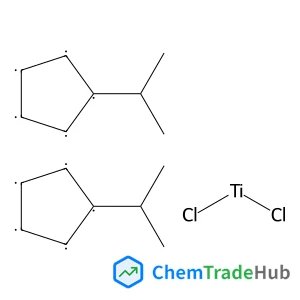
BIS(I-PROPYLCYCLOPENTADIENYL)TITANIUM DICHLORIDE
CAS Number:
12130-65-3
Molecular Formula:
C16H22Cl2Ti
Myung Won Lee, Markus Meuwly
The evaluation of hydration free energies is a sensitive test to assess force fields used in atomistic simulations. We showed recently that the vibrational relaxation times, 1D- and 2D-infrared spectroscopies for CN− in water can be quantitatively described from molecular dynamics (MD) simulations with multipolar force fields and slightly enlarged van der Waals radii for the C- and N-atoms. To validate such an approach, the present work investigates the solvation free energy of cyanide in water using MD simulations with accurate multipolar electrostatics. It is found that larger van der Waals radii are indeed necessary to obtain results close to the experimental values when a multipolar force field is used. For CN−, the van der Waals ranges refined in our previous work yield hydration free energy between −72.0 and −77.2 kcal mol−1, which is in excellent agreement with the experimental data. In addition to the cyanide ion, we also study the hydroxide ion to show that the method used here is readily applicable to similar systems. Hydration free energies are found to sensitively depend on the intermolecular interactions, while bonded interactions are less important, as expected. We also investigate in the present work the possibility of applying the multipolar force field in scoring trajectories generated using computationally inexpensive methods, which should be useful in broader parametrization studies with reduced computational resources, as scoring is much faster than the generation of the trajectories.

Russian Journal of Organic Chemistry

Chemistry Education Research and Practice

Chemical Communications

Russian Journal of Bioorganic Chemistry

New Journal of Chemistry

Russian Journal of General Chemistry

Saudi Pharmaceutical Journal

Organic Process Research & Development

Nature Medicine

Russian Chemical Bulletin
Jia-He Lin, Tie Zhang, Tian Zhang
DOI: 10.1039/D3CP03345G
Ugo Jacovella, Branko Ruscic, Ning L. Chen, Hai-Linh Le, Séverine Boyé-Péronne, Sebastian Hartweg, Madhusree Roy Chowdhury, Gustavo A. Garcia, Jean-Christophe Loison, Bérenger Gans
DOI: 10.1039/D3CP04244H
Yong Wang, Taotao Ai, Panya Wattanapaphawong, Koji Kajiyoshi
DOI: 10.1039/D3CP05077G
Michael Bachmann
DOI: 10.1039/D3CP02815A
Jiahui Zhou, Tao Han, Qi Wu, Meilan Huang
DOI: 10.1039/D3CP04019D
Delin Kong, Feng Tian, Yingying Xu, Shaoqun Zhu, Zetong Yu, Lefeng Xiong, Peipei Li, Huiyun Wei, Xinhe Zheng, Mingzeng Peng
DOI: 10.1039/D3CP02137H
Haiye Zhu, Yingjie Feng, Desheng Zheng, Xiuyun Zhao, Yue Zhou, Xiaoyue Fu, Lei Zhao, Xin Chen
DOI: 10.1039/D3CP04142E
Mayank Saraswat, Adrian Portela-Gonzalez, Enrique Mendez-Vega, Ginny Karir, Wolfram Sander, Patrick Hemberger
DOI: 10.1039/D3CP04064J
Mike Castellano, Christoph Kaspar, Michael Thoss, Thorsten Koslowski
DOI: 10.1039/D3CP03847E
2-Methylbenzene-1,4-diamine dihydrochloride (CAS: 615-45-2) should be stored in ...
(1S,4S)-2,5-Diazabicyclo[2.2.1]heptane dihydrobromide is generally considered sa...
(6-Chloropyridazin-3-YL)methanamine finds applications in the pharmaceutical ind...
2-Fluoro-3-methylphenol is primarily used in the synthesis of pharmaceuticals, p...
When handling 3-Methoxy-4-nitrobenzonitrile, it is important to wear appropriate...
When handling 1,3-Oxazolo[4,5-b]pyridine-2(3H)-thione (CAS: 211949-57-4), it is ...
4-Ethynylbenzamide (CAS: 90347-86-7) falls under various regulatory guidelines i...
3-(2-Ethylphenyl)-2-thioxo-4-imidazolidinone is primarily used as an intermediat...
(2-Fluoro-6-methoxyphenyl)acetic acid, also known as 4-fluoro-3-methoxybenzoic a...
Market trends for 2-[4-(Hydroxymethyl)phenoxy]ethanol (CAS: 102196-18-9) indicat...

Physical Chemistry Chemical Physics (PCCP) is an international journal co-owned by 19 physical chemistry and physics societies from around the world. This journal publishes original, cutting-edge research in physical chemistry, chemical physics and biophysical chemistry. To be suitable for publication in PCCP, articles must include significant innovation and/or insight into physical chemistry; this is the most important criterion that reviewers and Editors will judge against when evaluating submissions. The journal has a broad scope and welcomes contributions spanning experiment, theory, computation and data science. Topical coverage includes spectroscopy, dynamics, kinetics, statistical mechanics, thermodynamics, electrochemistry, catalysis, surface science, quantum mechanics, quantum computing and machine learning. Interdisciplinary research areas such as polymers and soft matter, materials, nanoscience, energy, surfaces/interfaces, and biophysical chemistry are welcomed if they demonstrate significant innovation and/or insight into physical chemistry. Joined experimental/theoretical studies are particularly appreciated when complementary and based on up-to-date approaches.