












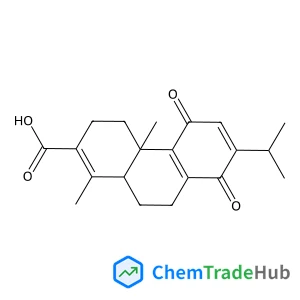
(4aS,10aS)-7-Isopropyl-1,4a-dimethyl-5,8-dioxo-3,4,4a,5,8,9,10,10a-octahydro-2-phenanthrenecarboxylic acid
CAS Number:
142950-86-5
Molecular Formula:
C20H24O4
Victoria González-Pedro, Gabriela Marzari, Pablo P. Boix, Sixto Giménez, Thomas Dittrich, Iván Mora-Seró
Here we report the preparation of high performance Quantum Dot Sensitized Solar Cells (QDSCs) based on PbS–CdS co-sensitized nanoporous TiO2 electrodes. QDs were directly grown on the TiO2 mesostructure by the Successive Ionic Layer Absorption and Reaction (SILAR) technique. This method is characterized by a fast deposition rate which involves random crystal growth and poor control of the defect states and lattice mismatch in the QDs limiting the quality of the electrodes for photovoltaic applications. In this work we demonstrate that the nature of the metallic precursor selected for SILAR has an active role in both the QD's deposition rate and the defect's distribution in the material, with important consequences for the final photovoltaic performance of the device. For this purpose, acetate and nitrate salts were selected as metallic precursors for the SILAR deposition and films with similar absorption properties and consequently with similar density of photogenerated carriers were studied. Under these conditions, ultrafast carrier dynamics and surface photovoltage spectroscopy reveal that the use of acetate precursors leads to higher injection efficiency and lower internal recombination due to contribution from defect states. This was corroborated in a complete cell configuration with films sensitized with acetate precursors, achieving unprecedented photocurrents of ∼22 mA cm−2 and high power conversion efficiency exceeding 4%, under full 1 sun illumination.
Huihui Kong, Xing Song, Xiaoqing Liu, Hongming Wang
DOI: 10.1039/C0CP00512F
Yun Xiang, Lili Duan
DOI: 10.1039/C0CP00375A
DOI: 10.1039/C0CP01745K
Moritz Theisen, Florian Lackner, Wolfgang E. Ernst
DOI: 10.1039/C0CP01283A
Xiujuan Zhuang, Anh Le, Timothy C. Steimle, Ramya Nagarajan, Varun Gupta, John P. Maier
DOI: 10.1039/C0CP00861C
Edgar Leon-Gutierrez, Alfonso Sepúlveda, Gemma Garcia, Maria Teresa Clavaguera-Mora
DOI: 10.1039/C0CP00208A
Christoph B. Messner, Thomas S. Hofer, Bernhard R. Randolf, Bernd M. Rode
DOI: 10.1039/C0CP01330G
DOI: 10.1039/C0CP00371A
Dongpeng Yan, Jun Lu, Jing Ma, Min Wei, David G. Evans, Xue Duan
DOI: 10.1039/C0CP00854K
(5-Sulfamoyl-3-pyridinyl)boronic acid is primarily used in chemical synthesis, p...
Benzyl 2-methyl-2-(methylsulfonyl)-4-pentenoate is typically synthesized via est...
When handling 8-Fluoroquinolin-6-ol (CAS: 209353-22-0), it is important to use p...
1,3-Dibromo-5-(2-methyl-2-propanyl)benzene (CAS: 129316-09-2) is a crystalline c...
Ethyl 7-chloro-4-oxo-1-(1,3-thiazol-2-yl)-1,4-dihydro-1,8-naphthyridine-3-carbox...
When handling Delta-7-Avenasterol (CAS: 23290-26-8), it is important to wear app...
Proper handling involves the use of personal protective equipment such as gloves...
When handling 2-Methyl-2-proanyl 4-[(2-aminophenyl)amino]-1-piperidinecarboxylat...
N-Methyl-4-chlorobenzylamine hydrochloride (CAS: 65542-24-7) is a organic compou...
[2-(Dodecyloxy)ethoxy]acetic acid (CAS: 27306-90-7) is generally considered safe...

Physical Chemistry Chemical Physics (PCCP) is an international journal co-owned by 19 physical chemistry and physics societies from around the world. This journal publishes original, cutting-edge research in physical chemistry, chemical physics and biophysical chemistry. To be suitable for publication in PCCP, articles must include significant innovation and/or insight into physical chemistry; this is the most important criterion that reviewers and Editors will judge against when evaluating submissions. The journal has a broad scope and welcomes contributions spanning experiment, theory, computation and data science. Topical coverage includes spectroscopy, dynamics, kinetics, statistical mechanics, thermodynamics, electrochemistry, catalysis, surface science, quantum mechanics, quantum computing and machine learning. Interdisciplinary research areas such as polymers and soft matter, materials, nanoscience, energy, surfaces/interfaces, and biophysical chemistry are welcomed if they demonstrate significant innovation and/or insight into physical chemistry. Joined experimental/theoretical studies are particularly appreciated when complementary and based on up-to-date approaches.
![7-Bromo-5-chloro-1H-pyrazolo[4,3-b]pyridine structure](https://static.chemtradehub.com/structs/135/1351813-70-1-a716.webp "7-Bromo-5-chloro-1H-pyrazolo[4,3-b]pyridine structure")
![(3E)-3-[4-Hydroxy-3,5-bis(2-methyl-2-propanyl)benzylidene]dihydro-2(3H)-furanone structure](https://static.chemtradehub.com/structs/102/102271-49-8-cba7.webp "(3E)-3-[4-Hydroxy-3,5-bis(2-methyl-2-propanyl)benzylidene]dihydro-2(3H)-furanone structure")







