












Excited state localisation cascades in inorganic semiconductor nanoparticles
Literature Information
Publication Date
2013-05-09
DOI
10.1039/C3CP50800E
Impact Factor
3.676
Authors
Martijn A. Zwijnenburg
View Original
Abstract
Excited state relaxation in zinc sulfide (ZnS) nanoparticles is studied as a model for the fate of the excited state in inorganic nanoparticles in general. A series of time-dependent density functional theory optimisations on the S1 and T1 excited states predict the existence of not merely isolated minima, as found before, but rather a connected cascade of excited state minima ending up in a conical intersection between the excited state energy surface and the ground state. The localisation of the excited state in the different minima increases down the cascade, while the barriers separating these minima, studied here for the first time for nanoparticles, are predicted to be in some cases electronic (strongly avoided crossing) in origin. The cartoon picture of excited state relaxation in inorganic nanoparticles that involves relaxation to the bottom of only one approximately harmonic well followed by photoluminescence appears for the ZnS nanoparticles studied here to be at best rather simplistic. The localisation cascade is finally found to strongly affect the excited state properties of nanoparticles and predicted to lead to the formation of defected nanoparticles after de-excitation in selected cases.
Related Literature
An experimental and theoretical study of the photoisomerization and thermal reversion on 5-arylmethylene-2-thioxoimidazolidin-4-one
A. J. Pepino, M. A. Burgos Paci, W. J. Peláez, G. A. Argüello
2015-04-08
Paper
DOI: 10.1039/C4CP04748F
Experimental determination of the rate of V–V collisional relaxation in 14N2 in its ground (X1Σg+) electronic state between 77 and 300 K
R. Z. Martínez, D. Bermejo
2015-04-23
Paper
DOI: 10.1039/C5CP01264C
Two-dimensional electronic-vibrational spectra: modeling correlated electronic and nuclear motion
F. Terenziani, A. Painelli
2015-04-20
Paper
DOI: 10.1039/C5CP01485A
Ketocyanine dyes: impact of conjugation length on optical absorption and third-order polarizabilities
Kada Yesudas, Eluvathingal D. Jemmis, Kotamarthi Bhanuprakash
2015-04-14
Paper
DOI: 10.1039/C5CP01410G
Temperature-induced molecular transport through polymer multilayers coated with PNIPAM microgels
S. T. Aleed, T. Paulraj, Yu. A. Vladimirov, C. Duschl, R. von Klitzing, D. Volodkin
2015-04-14
Paper
DOI: 10.1039/C5CP01213A
Cluster evolution during the early stages of heating explosives and its relationship to sensitivity: a comparative study of TATB, β-HMX and PETN by molecular reactive force field simulations
Yushi Wen, Chaoyang Zhang, Xianggui Xue, Xinping Long
2015-04-01
Paper
DOI: 10.1039/C5CP00006H
Self-assembly and coverage dependent thermally induced conformational changes of Ni(ii)-meso-tetrakis (4-tert-butylphenyl) benzoporphyrin on Cu(111)
2015-04-20
Paper
DOI: 10.1039/C5CP01490E
Realization of a p–n junction in a single layer boron-phosphide
Deniz Çakır, Deniz Kecik, Hasan Sahin, Engin Durgun, Francois M. Peeters
2015-04-16
Paper
DOI: 10.1039/C5CP00414D
Structural phase transformation and microwave dielectric studies of SmNb1−x(Si1/2Mo1/2)xO4 compounds with fergusonite structure
S. D. Ramarao, V. R. K. Murthy
2015-04-10
Paper
DOI: 10.1039/C5CP00569H
Towards multielectron photocatalysis: a porphyrin array for lateral hole transfer and capture on a metal oxide surface
Bradley J. Brennan, Alec C. Durrell, Matthieu Koepf, Robert H. Crabtree, Gary W. Brudvig
2015-04-16
Paper
DOI: 10.1039/C5CP01683E
You might also like
Compound Q&A
What are the main uses of (5-Sulfamoyl-3-pyridinyl)boronic acid (CAS: 951233-61-7)?
(5-Sulfamoyl-3-pyridinyl)boronic acid is primarily used in chemical synthesis, p...
951233-61-7(5-Sulfamoyl-3-pyrid...
Compound Q&A
How is Benzyl 2-methyl-2-(methylsulfonyl)-4-pentenoate (CAS: 1942858-50-5) typically synthesized?
Benzyl 2-methyl-2-(methylsulfonyl)-4-pentenoate is typically synthesized via est...
1942858-50-5Benzyl 2-methyl-2-(m...
Compound Q&A
What precautions should be taken when handling 8-Fluoroquinolin-6-ol (CAS: 209353-22-0)?
When handling 8-Fluoroquinolin-6-ol (CAS: 209353-22-0), it is important to use p...
209353-22-08-Fluoroquinolin-6-o...
Compound Q&A
What are the physical and chemical properties of 1,3-Dibromo-5-(2-methyl-2-propanyl)benzene (CAS: 129316-09-2)?
1,3-Dibromo-5-(2-methyl-2-propanyl)benzene (CAS: 129316-09-2) is a crystalline c...
129316-09-21,3-Dibromo-5-(2-met...
Compound Q&A
What industries use Ethyl 7-chloro-4-oxo-1-(1,3-thiazol-2-yl)-1,4-dihydro-1,8-naphthyridine-3-carboxylate (CAS: 174726-87-5)?
Ethyl 7-chloro-4-oxo-1-(1,3-thiazol-2-yl)-1,4-dihydro-1,8-naphthyridine-3-carbox...
174726-87-5Ethyl 7-chloro-4-oxo...
Compound Q&A
What precautions should be taken when handling Delta-7-Avenasterol (CAS: 23290-26-8)?
When handling Delta-7-Avenasterol (CAS: 23290-26-8), it is important to wear app...
23290-26-8Delta-7-Avenasterol
Compound Q&A
What precautions should be taken when handling N-({(5R)-3-[3-Fluoro-4-(4-morpholinyl)phenyl]-2-oxo-1,3-oxazolidin-5-yl}methyl)acetamide (CAS: 872992-20-6)?
Proper handling involves the use of personal protective equipment such as gloves...
872992-20-6N-({(5R)-3-[3-Fluoro...
Compound Q&A
What precautions should be taken when handling 2-Methyl-2-proanyl 4-[(2-aminophenyl)amino]-1-piperidinecarboxylate (CAS: 79099-00-6)?
When handling 2-Methyl-2-proanyl 4-[(2-aminophenyl)amino]-1-piperidinecarboxylat...
79099-00-62-Methyl-2-propanyl ...
Compound Q&A
What is N-Methyl-4-chlorobenzylamine hydrochloride (CAS: 65542-24-7)?
N-Methyl-4-chlorobenzylamine hydrochloride (CAS: 65542-24-7) is a organic compou...
65542-24-7N-Methyl-4-chloroben...
Compound Q&A
Is [2-(Dodecyloxy)ethoxy]acetic acid (CAS: 27306-90-7) safe?
[2-(Dodecyloxy)ethoxy]acetic acid (CAS: 27306-90-7) is generally considered safe...
27306-90-7[2-(Dodecyloxy)ethox...
Source Journal
Physical Chemistry Chemical Physics

CiteScore:
5.5
Self-citation Rate:
10.3%
Articles per Year:
3036
Physical Chemistry Chemical Physics (PCCP) is an international journal co-owned by 19 physical chemistry and physics societies from around the world. This journal publishes original, cutting-edge research in physical chemistry, chemical physics and biophysical chemistry. To be suitable for publication in PCCP, articles must include significant innovation and/or insight into physical chemistry; this is the most important criterion that reviewers and Editors will judge against when evaluating submissions. The journal has a broad scope and welcomes contributions spanning experiment, theory, computation and data science. Topical coverage includes spectroscopy, dynamics, kinetics, statistical mechanics, thermodynamics, electrochemistry, catalysis, surface science, quantum mechanics, quantum computing and machine learning. Interdisciplinary research areas such as polymers and soft matter, materials, nanoscience, energy, surfaces/interfaces, and biophysical chemistry are welcomed if they demonstrate significant innovation and/or insight into physical chemistry. Joined experimental/theoretical studies are particularly appreciated when complementary and based on up-to-date approaches.
Recommended Compounds
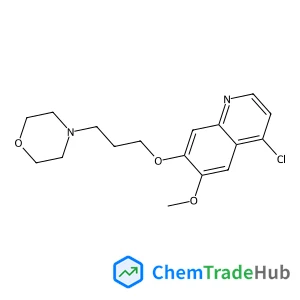
4-(3-((4-Chloro-6-methoxyquinolin-7-yl)oxy)propyl)morpholine
CAS Number:
205448-32-4
Molecular Formula:
C17H21ClN2O3
Recommended Suppliers




Disclaimer
This page provides academic journal information for reference and research purposes only. We are not affiliated with any journal publishers and do not handle publication submissions. For publication-related inquiries, please contact the respective journal publishers directly.
If you notice any inaccuracies in the information displayed, please contact us at support@chemtradehub.com. We will promptly review and address your concerns.