












Surface orientation effects in crystalline–amorphous silicon interfaces
Literature Information
Publication Date
2012-09-25
DOI
10.1039/C2CP42679J
Impact Factor
3.676
Authors
Michael Nolan, Merid Legesse, Giorgos Fagas
View Original
Abstract
In this paper we present the results of empirical potential and density functional theory (DFT) studies of models of interfaces between amorphous silicon (a-Si) or hydrogenated amorphous Si (a-Si:H) and crystalline Si (c-Si) on three unreconstructed silicon surfaces, namely (100), (110) and (111). In preparing models of a-Si on c-Si, melting simulations are run with classical molecular dynamics (MD) at 3000 K for 10 ps to melt part of the crystalline surface and the structure is quenched to 300 K using a quench rate of 6 × 10¹² K s−1 and finally relaxed with DFT. Incorporating the optimum hydrogen content in a-Si to passivate undercoordinated Si, followed by DFT relaxation, produces hydrogenated amorphous silicon on crystalline surfaces, a-Si:H/c-Si. The (100) surface is the least stable crystalline surface and forms the thickest amorphous Si region, while the most stable (110) surface forms the smallest amorphous region. Calculated radial distribution functions (RDF) in the amorphous and crystalline layers are consistent with a-Si and c-Si and indicate a structural interface region one layer thick. The electronic density of states shows an evolution from c-Si to a-Si (or a-Si:H), with a larger electronic interface layer, suggesting that the electronic properties are more strongly perturbed by interface formation compared to the atomic structure. The computed optical absorption spectra show strong effects arising from the formation of different a-Si and a-Si:H regions in different Si surfaces.
Related Literature
Semitransparent polymer solar cells with simultaneously improved efficiency and color rendering index
Wenjuan Yu, Xu Jia, Mengnan Yao, Linghui Zhu, Yongbing Long, Liang Shen
2015-07-08
Paper
DOI: 10.1039/C5CP03467A
Nanoscale magnetism and novel electronic properties of a bilayer bismuth(111) film with vacancies and chemical doping
Yajun Zhang
2016-06-29
Paper
DOI: 10.1039/C6CP03056D
Structural, optical and photoelectrochemical characterizations of monoclinic Ta3N5 thin films
Sherdil Khan, Maximiliano J. M. Zapata, Marcelo B. Pereira, Renato V. Gonçalves, Lukas Strizik, Jairton Dupont, Marcos J. L. Santos, Sérgio R. Teixeira
2015-08-10
Paper
DOI: 10.1039/C5CP03645C
Ultrafast excited-state dynamics of isocytosine
Rafał Szabla, Robert W. Góra
2016-06-10
Paper
DOI: 10.1039/C6CP01391K
Quantification and classification of substituent effects in organic chemistry: a theoretical molecular electrostatic potential study‡
Geetha S. Remya, Cherumuttathu H. Suresh
2016-07-04
Paper
DOI: 10.1039/C6CP02936A
Deformation twinning and the role of amino acids and magnesium in calcite hardness from molecular simulation
A. S. Côté, R. Darkins, D. M. Duffy
2015-07-13
Paper
DOI: 10.1039/C5CP03370E
A molecular theory for optimal blue energy extraction by electrical double layer expansion
Alejandro Gallegos, Diannan Lu, Zheng Liu, Jianzhong Wu
2015-08-19
Paper
DOI: 10.1039/C5CP03514G
The quest for rationalizing the magnetism in purely organic semiquinone-bridged bisdithiazolyl molecular magnets
Mercè Deumal
2016-06-23
Paper
DOI: 10.1039/C6CP02699K
100 fs photo-isomerization with vibrational coherences but low quantum yield in Anabaena Sensory Rhodopsin
Alexandre Cheminal, Jérémie Léonard, So-Young Kim, Kwang-Hwan Jung, Hideki Kandori, Stefan Haacke
2015-09-03
Paper
DOI: 10.1039/C5CP04353K
Low polarity water, a novel transition species at the polyethylene–water interface
Edward M. Kosower, Galina Borz
2015-08-26
Paper
DOI: 10.1039/C5CP04439A
You might also like
Compound Q&A
What precautions should be taken when handling 4-Methyl-6-(trifluoromethyl)quinoline (CAS: 40716-16-3)?
When handling 4-Methyl-6-(trifluoromethyl)quinoline (CAS: 40716-16-3), safety go...
40716-16-34-Methyl-6-(trifluor...
Compound Q&A
What is 4-(3,5-Difluorophenyl)aniline (CAS: 405058-00-6)?
4-(3,5-Difluorophenyl)aniline is an aromatic organic compound with the CAS numbe...
405058-00-64-(3,5-Difluoropheny...
Compound Q&A
How is 5-{[4-(Trifluoromethyl)phenyl]sulfanyl}-1,2,3-thiadiazole-4-carboxylic acid (CAS: 338982-07-3) typically synthesized?
5-{[4-(Trifluoromethyl)phenyl]sulfanyl}-1,2,3-thiadiazole-4-carboxylic acid can ...
338982-07-35-{[4-(Trifluorometh...
Compound Q&A
What is the market or research trend for 4-Benzylaniline hydrochloride (CAS: 6317-57-3)?
The market for 4-Benzylaniline hydrochloride (CAS: 6317-57-3) is steadily growin...
6317-57-34-Benzylaniline hydr...
Compound Q&A
Is [3-(Diethylsulfamoyl)phenyl]boronic acid (CAS: 871329-58-7) safe?
[3-(Diethylsulfamoyl)phenyl]boronic acid is generally considered safe when handl...
871329-58-7[3-(Diethylsulfamoyl...
Compound Q&A
What are the main uses of 3-Bromo-2,5-dimethoxyaniline (CAS: 115929-62-9)?
3-Bromo-2,5-dimethoxyaniline is mainly used in the pharmaceutical and chemical i...
115929-62-93-Bromo-2,5-dimethox...
Compound Q&A
What regulatory guidelines apply to N-Methyl-1-(5-methyl-1H-indol-3-yl)methanamine (CAS: 915922-67-7)?
N-Methyl-1-(5-methyl-1H-indol-3-yl)methanamine (CAS: 915922-67-7) is subject to ...
915922-67-7N-Methyl-1-(5-methyl...
Compound Q&A
What industries use Carbamic acid, N-[(5S)-5,6-diamino-6-oxohexyl]-, 1,1-dimethylethyl ester (CAS: 24828-96-4)?
This compound is primarily used in the pharmaceutical industry for the synthesis...
24828-96-4Carbamic acid, N-[(5...
Compound Q&A
How should 2-Methyl-2-propanyl [(1S,3R)-3-aminocyclohexyl]carbamate (CAS: 1298101-47-9) be stored?
2-Methyl-2-propanyl [(1S,3R)-3-aminocyclohexyl]carbamate (CAS: 1298101-47-9) sho...
1298101-47-92-Methyl-2-propanyl ...
Compound Q&A
What industries use Ethyl 2-bromo-4,4,4-trifluorobutanoate (CAS: 367-33-9)?
Ethyl 2-bromo-4,4,4-trifluorobutanoate (CAS: 367-33-9) is utilized in the pharma...
367-33-9Ethyl 2-bromo-4,4,4-...
Source Journal
Physical Chemistry Chemical Physics

CiteScore:
5.5
Self-citation Rate:
10.3%
Articles per Year:
3036
Physical Chemistry Chemical Physics (PCCP) is an international journal co-owned by 19 physical chemistry and physics societies from around the world. This journal publishes original, cutting-edge research in physical chemistry, chemical physics and biophysical chemistry. To be suitable for publication in PCCP, articles must include significant innovation and/or insight into physical chemistry; this is the most important criterion that reviewers and Editors will judge against when evaluating submissions. The journal has a broad scope and welcomes contributions spanning experiment, theory, computation and data science. Topical coverage includes spectroscopy, dynamics, kinetics, statistical mechanics, thermodynamics, electrochemistry, catalysis, surface science, quantum mechanics, quantum computing and machine learning. Interdisciplinary research areas such as polymers and soft matter, materials, nanoscience, energy, surfaces/interfaces, and biophysical chemistry are welcomed if they demonstrate significant innovation and/or insight into physical chemistry. Joined experimental/theoretical studies are particularly appreciated when complementary and based on up-to-date approaches.
Recommended Compounds
![2-[(5Z,8Z,11Z,14Z)-5,8,11,14-Icosatetraen-1-yloxy]-1,3-propanediol structure](https://static.chemtradehub.com/structs/222/222723-55-9-0348.webp "2-[(5Z,8Z,11Z,14Z)-5,8,11,14-Icosatetraen-1-yloxy]-1,3-propanediol structure")
2-[(5Z,8Z,11Z,14Z)-5,8,11,14-Icosatetraen-1-yloxy]-1,3-propanediol
CAS Number:
222723-55-9
Molecular Formula:
C23H40O3
![2,4-Dichloro-6-isopropyl-5H-pyrrolo[3,4-d]pyrimidin-7(6H)-one structure](https://static.chemtradehub.com/structs/107/1079649-94-7-ad4a.webp "2,4-Dichloro-6-isopropyl-5H-pyrrolo[3,4-d]pyrimidin-7(6H)-one structure")
2,4-Dichloro-6-isopropyl-5H-pyrrolo[3,4-d]pyrimidin-7(6H)-one
CAS Number:
1079649-94-7
Molecular Formula:
C9H9Cl2N3O
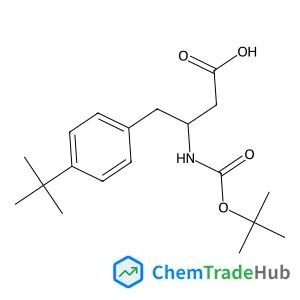
(S)-3-((tert-Butoxycarbonyl)amino)-4-(4-(tert-butyl)phenyl)butanoic acid
CAS Number:
403661-85-8
Molecular Formula:
C19H29NO4
Recommended Suppliers






Disclaimer
This page provides academic journal information for reference and research purposes only. We are not affiliated with any journal publishers and do not handle publication submissions. For publication-related inquiries, please contact the respective journal publishers directly.
If you notice any inaccuracies in the information displayed, please contact us at support@chemtradehub.com. We will promptly review and address your concerns.